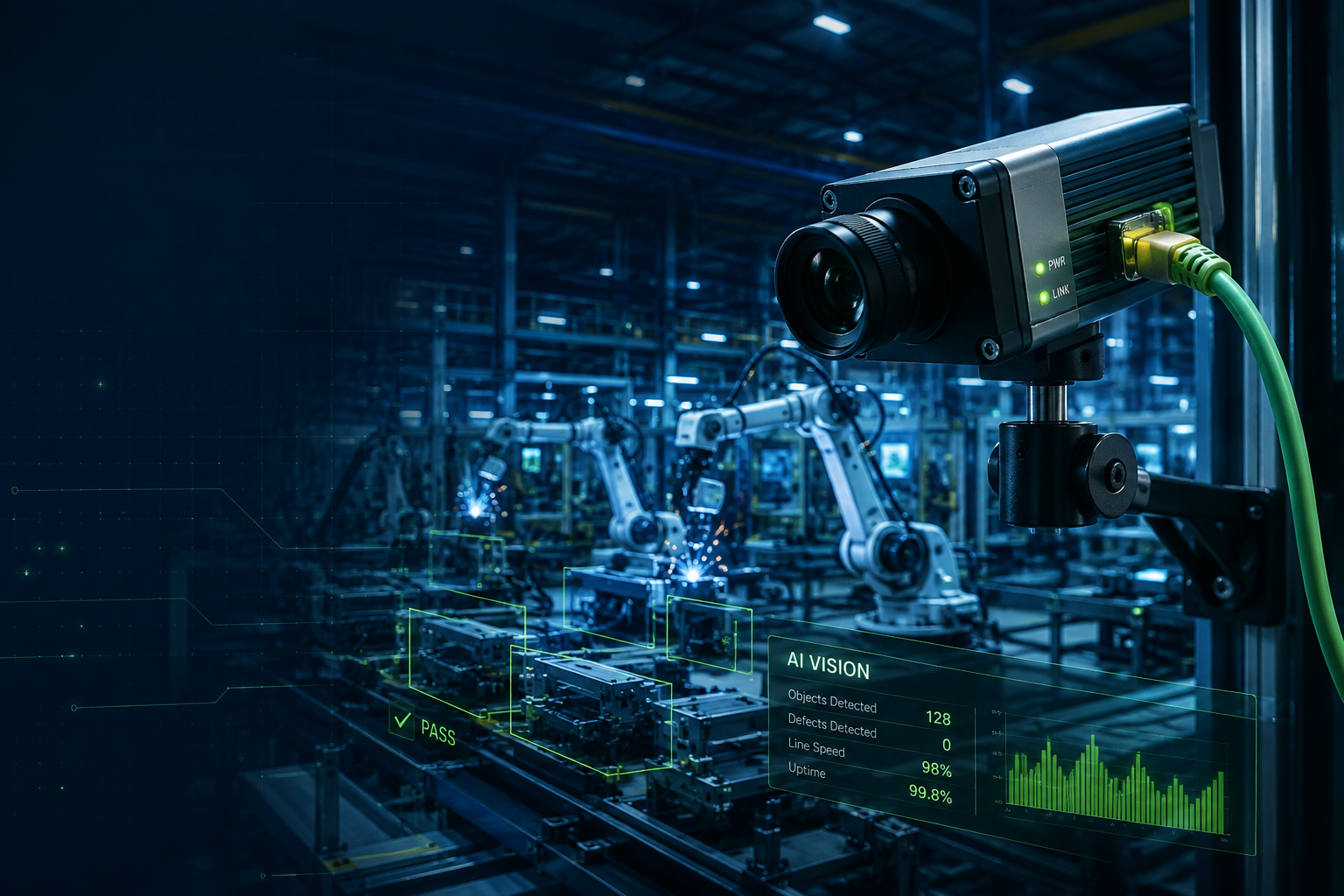
MVTec Software, Bosch Rexroth and Bosch Manufacturing Solutions are integrating industrial machine vision software into automation systems operating on ctrlX OS.
The collaboration combines MVTec’s HALCON image processing software with Bosch Manufacturing Solutions’ Nexeed Integrated Vision application and Bosch Rexroth’s open industrial operating environment. It is intended to reduce the engineering effort involved in connecting visual inspection functions with machine control systems.
Announced on 5 November, the arrangement also brings MVTec and Bosch Manufacturing Solutions into the ctrlX World partner ecosystem. Bosch Rexroth supplies the underlying ctrlX OS platform and associated software environment.
The partners have distinct technical roles. MVTec provides image processing procedures through HALCON, Bosch Manufacturing Solutions supplies the application that connects those procedures to the automation environment, and Bosch Rexroth provides the operating system on which the combined functions can run.
Machine vision is used to extract information from images captured during industrial operations. Applications include checking component dimensions, identifying parts, detecting defects and establishing the position of objects before they are handled by automated equipment.
In a typical inspection process, a camera captures an image under controlled lighting conditions. Image processing software examines the data to identify specified features or differences, then provides a result that can be used by the machine or an operator.
That result may be a measurement, a classification or information about the position of a component. A production system can then use the result to determine whether the part should continue to the next stage, be rejected or undergo another operation.
Connecting the image processing application to the machine controller requires reliable communication between the software and the equipment carrying out the manufacturing process. The controller must receive information in the expected format and coordinate its response with the operating sequence.
Additional engineering work may be required when the camera system, vision application and automation controller use different software platforms or interfaces. The developer must configure data exchange, error handling and the relationship between the inspection result and the associated machine action.
Nexeed Integrated Vision is intended to simplify that connection by making HALCON procedures available as functions within ctrlX OS. The application provides a defined interface between the image processing software and the wider control environment.
Machine builders and system integrators can therefore develop vision procedures using HALCON and incorporate them into compatible automation projects without independently constructing every connection to the control platform.
The benefits depend on the particular application and its software architecture. The collaboration establishes a supported integration route, but it does not remove the need to configure cameras, develop inspection logic or validate the complete manufacturing system.
HALCON provides both established rule-based image processing functions and technologies for three-dimensional vision and deep learning. These methods can be applied to different types of inspection according to the available image information and the task being performed.
Rule-based vision procedures use defined image characteristics and processing operations to identify features or carry out measurements. Deep learning approaches instead use trained models to identify patterns or classify image data, with performance influenced by the examples used during development.
Three-dimensional vision may provide additional information about object position or geometry. Such information can support applications requiring spatial measurements or the guidance of automated handling equipment.
None of these methods is universally suitable for every inspection task. Surface reflectivity, lighting, camera placement, material variation and the geometry of the component can affect the quality of the available image data.
A measurement application also requires calibration so that image coordinates can be related to physical dimensions. The accuracy of the result depends on the imaging arrangement and the assumptions used in the measurement procedure.
Where machine vision is connected to robot guidance, the system must supply position information appropriate to the robot’s coordinate system. That information must then be used by the controller in conjunction with the machine’s programmed movements and safety arrangements.
ctrlX OS provides a software environment for industrial automation applications. It underpins Bosch Rexroth’s ctrlX CORE control platform and is also available independently of a single hardware configuration.
Applications can be obtained through the ctrlX OS Store, allowing compatible functions from different software providers to be assembled into a common automation project. The new integration is intended to make machine vision available within this approach.
Carina Heil, group lead for business operations automation software at Bosch Rexroth, said the collaboration would allow vision functions to be combined with other machine applications on the same platform.
Marc Bindel, head of Nexeed Automation at Bosch Manufacturing Solutions, identified the engineering time associated with connecting vision software to control systems as the principal difficulty addressed by Nexeed Integrated Vision.
The approach may reduce the amount of interface programming required, but inspection performance still depends on the vision procedure and the equipment used to capture the images. A common software environment does not establish that a camera or algorithm will meet the needs of every production process.
Manufacturing cycle time also places limits on the integration. Inspection data must be produced and transferred within the time available for the machine to act on the result, particularly where a production line operates continuously.
Applications involving coordinated movement may require additional timing guarantees. The partners have not published general latency figures or demonstrated that every HALCON procedure can satisfy a particular real-time control requirement merely because it operates through ctrlX OS.
For quality inspection, validation must include the range of acceptable parts and defects that may be encountered during production. Changes in material condition, lighting or component presentation can affect the reliability of a procedure that performed successfully during initial development.
Deep learning inspection methods may require further validation when training data or models are changed. The production system must also have suitable arrangements for recording results and responding when an inspection cannot provide a dependable decision.
Dr Maximilian Lückenhaus, director of marketing and business development at MVTec, said the partnership would make machine vision functions more accessible through the ctrlX ecosystem.
The companies have not disclosed customer deployment figures, benchmark performance improvements or a contract value for the collaboration. The confirmed development is the supported connection between HALCON, Nexeed Integrated Vision and ctrlX OS, alongside the addition of MVTec and Bosch Manufacturing Solutions as partners.
The integration provides another software route for combining inspection and automation functions. Its effectiveness in production will be established by how individual machine builders configure, test and maintain the complete system.