thyssenkrupp Uhde is undertaking front-end engineering design for a proposed urea liquor upgrade at CF Industries’ Courtright nitrogen complex in Ontario, Canada. The project would direct more of the site’s available carbon dioxide into urea production and increase the supply of diesel exhaust fluid (DEF), a reagent used in diesel exhaust aftertreatment. CF Industries estimates that a positive investment decision could lead to more than 400,000 short tons of additional DEF production capacity annually.
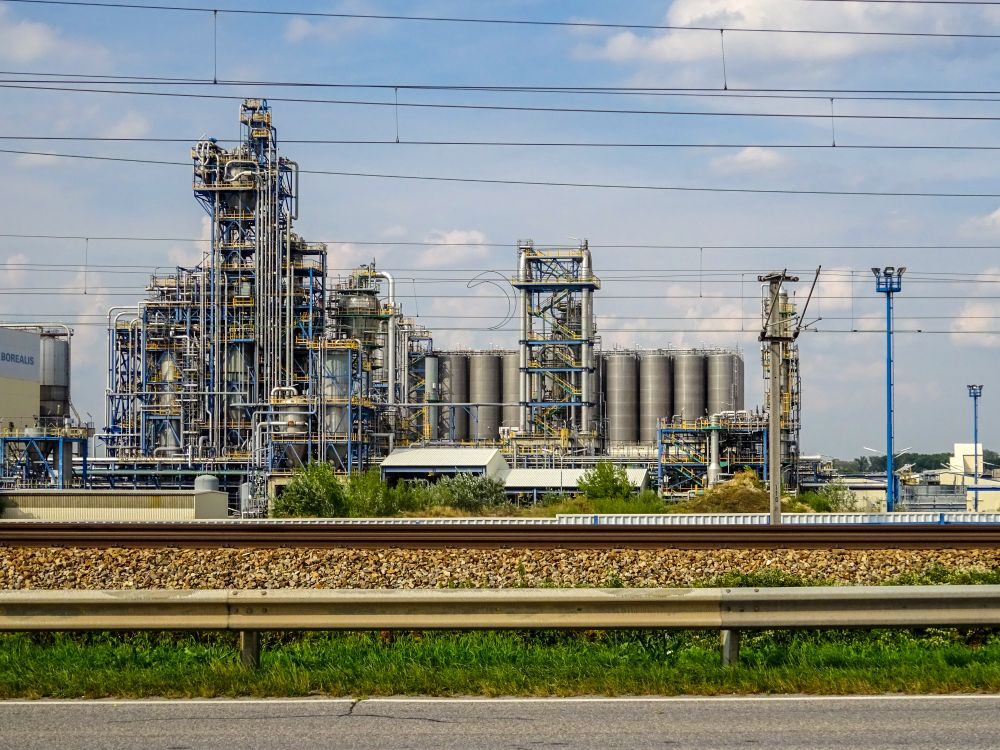
CF Industries commissioned the FEED study through an affiliate and had already identified the agreement in its first-half 2026 financial results. The later technical description specifies thyssenkrupp Uhde’s role in designing the upgrade, while the investment decision remains targeted for 2027. Courtright lies south of Sarnia in St Clair Township and manufactures ammonia, urea ammonium nitrate and DEF. Its road and rail connections, existing utilities and nitrogen processing equipment will shape the engineering scope and the distribution arrangements for any additional output.
Ammonia and carbon dioxide react in industrial urea production, providing an established route for incorporating a carbon-containing process stream into a marketable chemical product. DEF is a precisely formulated aqueous urea solution, and its manufacture requires control of water quality, composition and trace impurities. The plant therefore needs a processing and quality assurance chain suited to an exhaust-treatment reagent, in addition to the capacity to make extra urea liquor. Treatment, storage and transfer arrangements will have to accommodate the finished material and the standards demanded by vehicle emissions systems.
In a selective catalytic reduction system, diesel exhaust fluid is injected into the exhaust stream, where its urea component forms ammonia under the appropriate thermal conditions. The ammonia reacts with nitrogen oxides over a catalyst to produce nitrogen and water. The chemical plant therefore supplies a functional reagent to downstream emissions control systems, rather than a fuel for the diesel engine itself. Consistency of the solution is necessary because contaminants or incorrect concentration can interfere with injection equipment and catalytic performance.
The FEED team will establish a design basis for equipment selection, plant modifications, cost estimates and a construction proposal. Capacity must be assessed across the production train rather than at the urea reaction stage alone: purification, water supply, cooling, tanks, pumping and road or rail loading can each constrain the volume of qualified fluid that leaves the site. Integrating changes into a running nitrogen complex also requires the interfaces with existing ammonia and other fertiliser operations to be defined before detailed engineering and procurement.
Additional urea output would make productive use of carbon dioxide streams within the existing complex, connecting feedstock management to the product mix. The quantity incorporated into urea will depend on the final process configuration and operating rates. The carbon used as a chemical feedstock will subsequently enter the product lifecycle, while DEF itself reduces nitrogen oxide emissions through selective catalytic reduction. Those are distinct processes with different environmental and operating functions; the investment case will depend on manufacturing and sales assumptions as well as the chemistry.
The choice between DEF and other nitrogen products also affects plant balances. Courtright has capacity for up to one million tons of nitrogen products annually across agricultural and industrial markets, and CF Industries has identified the ability to vary its mix of urea liquor, DEF and urea ammonium nitrate. Increasing one output stream can change the allocation of feedstocks and intermediate products elsewhere in the complex. That makes process integration and sustained operation of the existing equipment central to evaluating the expansion.
Courtright employs approximately 200 permanent staff on a 700-acre site, so any installation programme must be planned around existing production and maintenance activities. Interfaces between pipework, treatment equipment and controls will determine how new and existing process trains operate together. Commissioning will also need to establish that the upgraded line produces DEF to the required composition before higher output can be dispatched. Those practical operating requirements sit alongside capital costs, utility demand and the allocation of nitrogen products in the FEED assessment.
Additional DEF manufacturing would serve vehicles and industrial engines equipped with selective catalytic reduction, but distribution must preserve the solution’s composition between filling, transport and use. Storage tanks, loading equipment and material compatibility are therefore part of the production system. The proposed capacity describes a potential annual manufacturing rate; realised deliveries would also depend on plant availability, product qualification and logistics. These considerations will feed into the engineering and commercial assessment ahead of the investment decision.
CF Industries expects to consider the Courtright final investment decision in 2027, following the design and economic assessment. Thyssenkrupp Uhde’s FEED work will provide the process definition on which costs, equipment requirements and a possible construction programme can be based. Until that decision is taken and the plant is commissioned, Courtright’s proposed additional DEF output remains planned capacity rather than production available for dispatch.