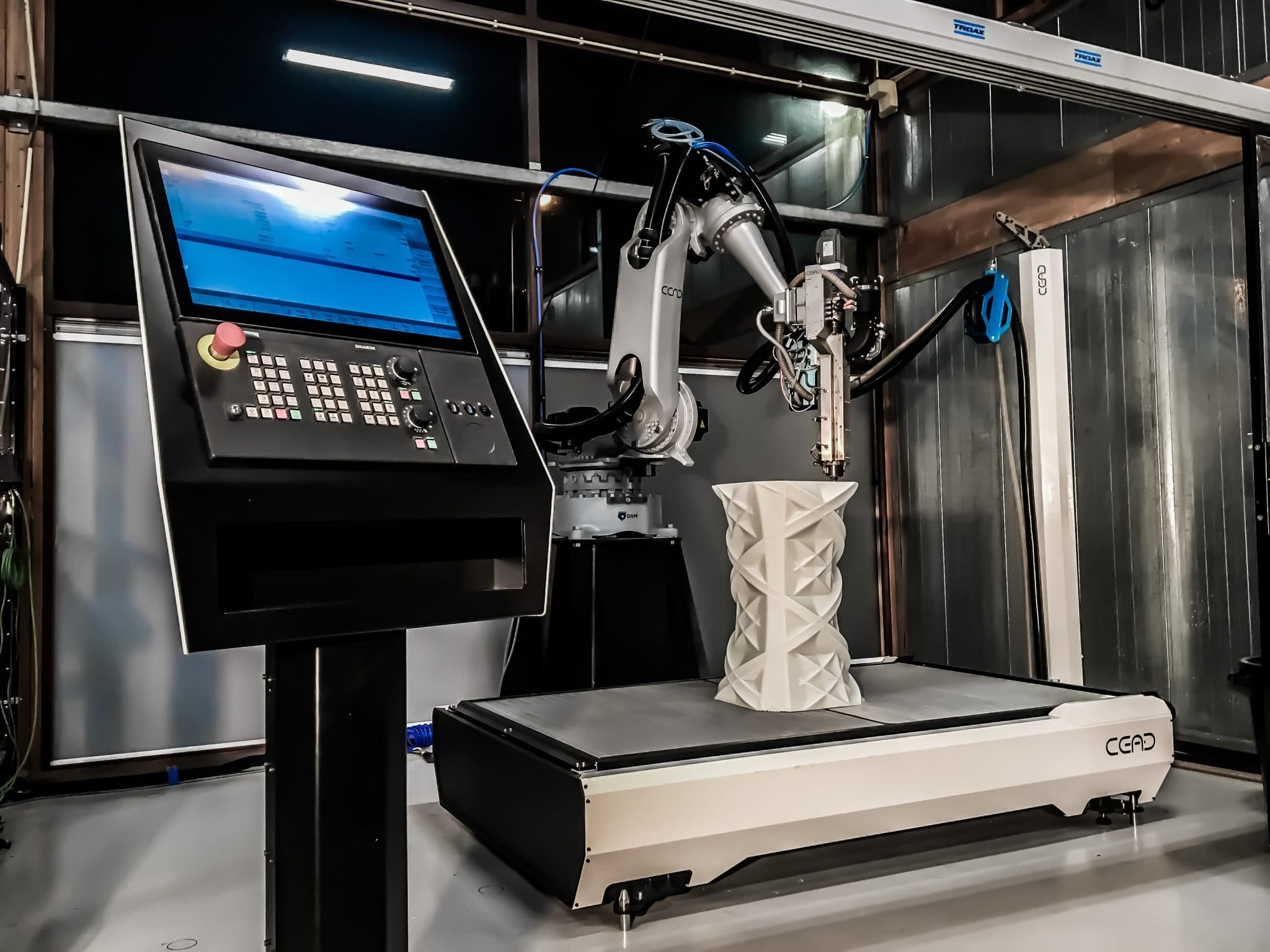
The Manufacturing Technology Centre (MTC) is undertaking a major upgrade to its large-format additive manufacturing cell after formalising its collaboration with Dutch composite printing equipment specialist CEAD. The companies will use the facility to develop and demonstrate production-scale applications of large-format additive manufacturing (LFAM), building on technical work carried out together over recent years.
CEAD has become a Tier 3 member of the MTC, formalising earlier technical collaboration. Its portfolio combines robotic and gantry-based systems with pellet extrusion and, for relevant configurations, machining capabilities to produce large polymer and composite parts. The upgraded MTC workshop cell will give manufacturers access to that engineering capability for trials of materials, equipment settings and potential industrial applications.
In large-format pellet extrusion, a feed system delivers polymer granules to a heated processing unit, where material is melted and deposited along a programmed toolpath. The moving print head or workpiece forms a component layer by layer. A large working envelope allows the equipment to build structures that exceed the practical dimensions of many smaller filament-printing machines, although achievable accuracy and cycle time depend on material behaviour, deposition rate, toolpath and machine design.
Composite feedstocks can contain reinforcing fibres dispersed within a polymer matrix. Their effect on stiffness and strength depends on the material formulation and the structure created by deposition. Fibre orientation, bonding between beads, voids and thermal history all influence the printed part, particularly where loads act across deposited layers. Testing must therefore reflect the component’s actual geometry, build direction and intended loading.
The ability to print near the required shape can reduce the amount of material removed during manufacturing, especially for large moulds, tooling structures or non-critical housings. The resulting surface may still need machining to obtain tighter dimensional tolerances or a suitable finish. Integrating deposition and finishing within a production route can reduce handling, but requires accurate referencing between operations, suitable fixtures and controlled allowance for material removal.
Large printed components experience thermal and geometric effects that can be less apparent in small specimens. Polymer contracts during cooling, and temperature differences across a part can produce distortion, residual stress or dimensional error. Bead geometry, deposition sequence and cooling strategy must be coordinated with machine movement and the intended use. Some structures also require joining, additional reinforcement or machining before they reach their final form.
The upgraded MTC cell will permit engineering trials at a scale closer to industrial production. Manufacturers can compare deposition strategies, material choices, machining allowances and inspection methods before specifying equipment for their own sites. Repeatable test results for a particular combination of machine, material and process will form the evidence needed to assess whether the approach suits an intended component.
CEAD serves aerospace, maritime, automotive and construction customers, whose components span tooling, housings and structural applications. Each involves different demands on accuracy, mechanical properties, operating environment and inspection. A printed mould, for instance, has a different acceptance route from an aircraft component or a load-bearing marine structure, so trials must be designed for the specific production application.
Delivered production cost combines feedstock, energy, operator input, machine availability, rejected builds and finishing time. Large-format deposition can make the initial blank quickly, but the amount of machining and inspection subsequently required affects the full process duration. Trial work can establish whether pellet extrusion reduces material use or total production effort for a given component, using the complete manufacturing route as the comparison.
CEAD’s robotics and gantry systems also create different automation choices. A robot arm offers flexibility in tool orientation and access but introduces kinematic and reach considerations; a gantry can provide another combination of travel envelope, structural support and positioning behaviour. Selecting between them requires consideration of part geometry, deposition direction, tool access and how the equipment will fit into the surrounding factory layout.
The new membership builds on MTC’s industrial engineering and automation activity at Ansty. As the UK’s National Centre for Additive Manufacturing, it works with businesses and equipment suppliers to develop manufacturing processes and compare technical options. CEAD’s formal participation expands the machinery and application expertise available for this large-format programme.
The immediate work is to upgrade the existing cell and continue trials of large-format composite printing. Engineers will be able to assess build repeatability, machining requirements and inspection results as projects progress, before individual manufacturers select production equipment and commit components to service.