Manufacturing Technology Centre (MTC) has developed a flexible robotic cell for sorting and presenting small aerospace components, addressing the handling work that frequently precedes automated assembly and inspection. Called FlexSort, the demonstrator combines configurable feeders, machine vision, a multi-tool gripper and specially designed pallets. It was developed through the CONVERGENCE programme and is reported at technology readiness levels 4–6, indicating a validated demonstration rather than an established commercial production installation.
Aerospace parts often arrive at a cell in bulk or at mixed orientations, although the next automated operation requires each item in a predictable position. A conventional vibratory feeder works well when the same component runs repeatedly, but individually designed feed tracks become less attractive when production moves between small batches of different parts. Manual kitting can then be used to transfer items from bulk packaging into arranged trays. MTC’s CONVERGENCE programme has examined how this preparation step could be automated without making the entire handling line specific to one part number.
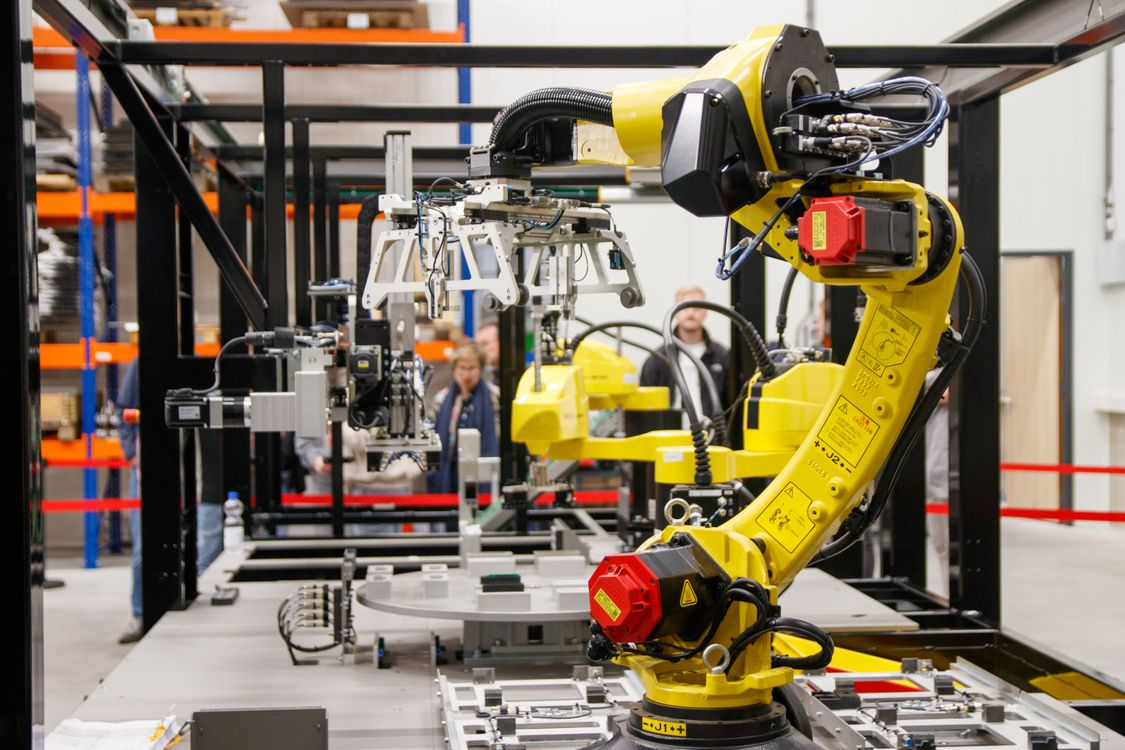
FlexSort uses two flexible feeders to present different component types for machine vision inspection. The vision system locates a suitable item, allowing a robot with a multi-tool gripper to pick it and place it at the required position. The gripper is intended to accommodate more than one part type without an end-effector change at every batch transition. The system also includes configurable pallets for orderly presentation to subsequent processes. MTC has not provided a full inventory of compatible geometries, gripping forces or a maximum cycle rate across its possible component families.
The pallets are designed to be reconfigured for differing jobs, so the same cell architecture can be adapted as the downstream assembly or inspection task changes. Reliable placement matters because an otherwise functioning assembly robot or measuring system can still lose time when presented with misoriented or inconsistently spaced parts. Pallet geometry, robot reach, gripper access and vision calibration need to work together if parts are to arrive in the positions expected by the next machine. The demonstrator addresses that interface between bulk components and repeatable automated operations, rather than changing the downstream machinery itself.
A vision system provides information about component location and orientation, but recognition performance can depend on material finish, illumination, geometry and the degree to which objects overlap. Gripper selection introduces a further constraint because contact surfaces and forces appropriate for one part may not be acceptable for another. The FlexSort architecture addresses flexibility through an integrated set of feeders, optics and end effectors, rather than claiming that one generic gripper can automatically process every aerospace component. MTC describes the combination as a demonstrator of adaptable, high-reliability handling.
In the demonstrated arrangement, an operator mainly refills feed hoppers and exchanges pallets, rather than individually arranging every item. Replenishment and pallet exchange still have to be coordinated with the cell’s operating sequence and safety measures. A production installation would also need validated safeguards, reliable detection of missed grips and recovery procedures for incorrectly placed parts. MTC says the demonstrator was designed with safety considerations, but has not identified a named customer factory where the equipment has completed site acceptance testing.
MTC reports a 15% reduction in non-value-add time and 100% traceability of handled parts in its account of the FlexSort project. The figures relate to the demonstrator; the organisation does not publish a complete sample size, baseline duration or list of tested part families. They therefore describe the reported result of the development work rather than a guaranteed efficiency improvement for every aerospace factory. Practical performance will depend on the mix of components and the amount of manual sorting or kitting the cell replaces.
Traceability in small-part handling relies on maintaining a consistent connection between the items delivered, the positions used for presentation and the records passed to subsequent operations. Pallet locations can provide ordered references for later equipment, although full component genealogy may require serialisation, batch tracking or integration with manufacturing execution systems. MTC has not published a detailed data architecture for FlexSort. It has demonstrated that the handling arrangement can support traceability, but any production solution would need to match the customer’s own quality and recordkeeping requirements.
MTC places FlexSort at technology readiness levels 4–6, covering validation and demonstration in laboratory and relevant conditions. A prospective production user would still need to prove its performance using representative components, production schedules and quality requirements. Uptime, failed-pick recovery, changeover time and the handling of mixed batches would be relevant acceptance tests. Any investment case would also need to compare the expected labour and tooling savings with the cost of the feeders, optics, robot, pallets and integration into the existing line.
The demonstrator establishes an integrated arrangement of two adaptable feeders, machine vision, robotic gripping and reconfigurable pallets for small-part presentation. That arrangement can support subsequent automated inspection or assembly while reducing the need for manual reorientation of bulk components. MTC’s stated time saving and traceability results provide a basis for further testing, but production adoption remains subject to qualification with customers’ real components and factory systems. No series deployment or purchase order has been announced.