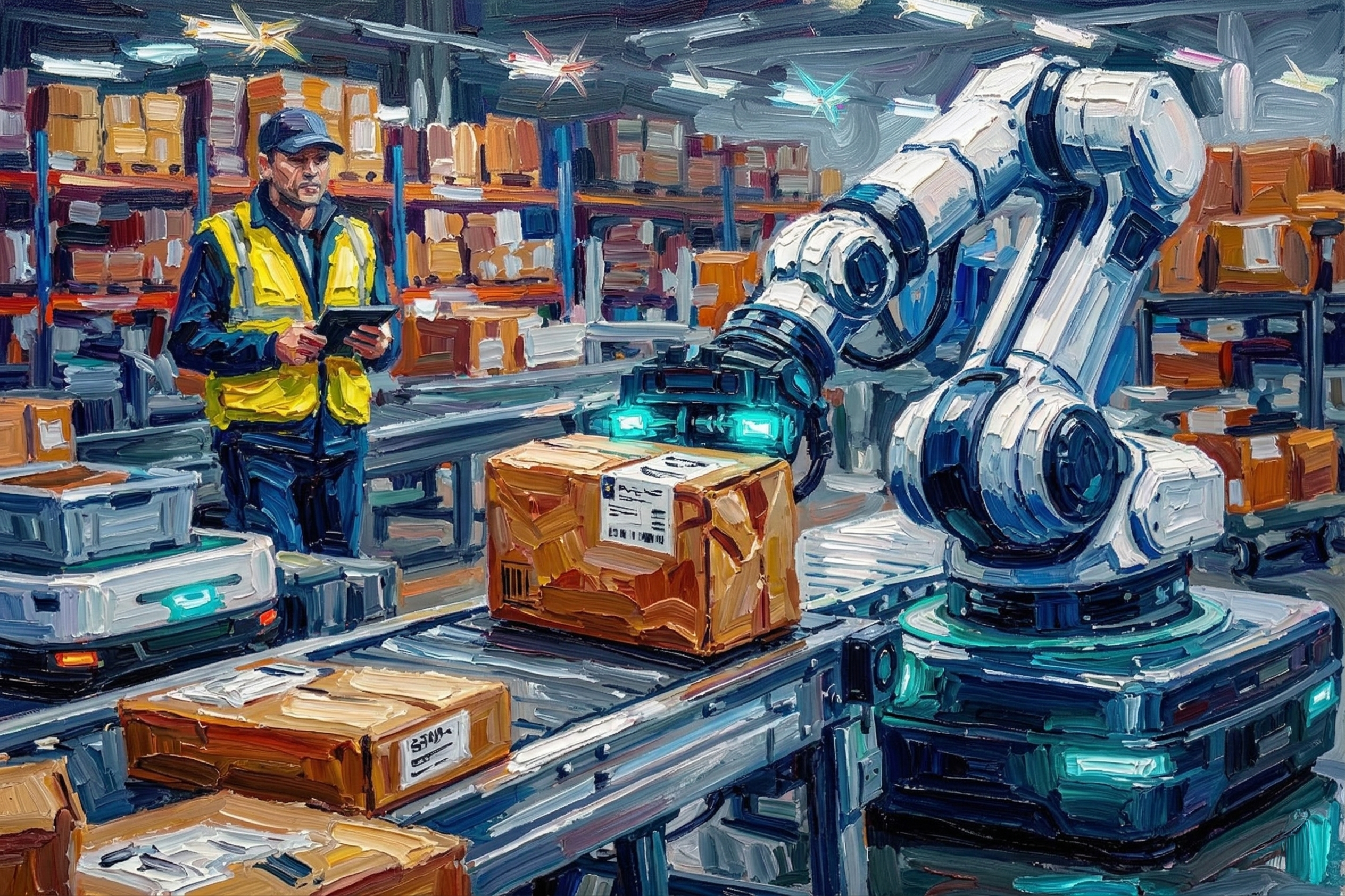
Berlin robotics developer Sereact has connected data from warehouse returns robots to a simulation and model retraining workflow involving NVIDIA, Nebius, CEVA Logistics and Zalando. The new process is designed to improve Sereact’s Cortex control software using examples recorded during handling of variable returned goods. Selected CEVA returns stations provide the initial operational setting; the October development is the retraining architecture, rather than a first installation of returns automation.
Sereact and its logistics partners were already using dual-arm robots to handle selected clothing returns before 21 October. The new workflow captures cases where the current policy encounters difficulty, generates related simulated variations and trains an updated model before evaluation and station testing. The participants say that a tested policy correction may now be developed within days rather than weeks. That is their stated expectation for the pipeline; no independently audited comparison of update frequency or handling accuracy has been released.
Returned garments are more variable than uniform packaged items arriving from a controlled production line. Clothes can be folded, crumpled or partly enclosed in bags, and tags can be missing or concealed. A handling robot must locate an accessible part of an item, grip it without losing control, identify its condition and route it to the correct next operation. Model performance can change when the product assortment, packaging, materials or lighting differs from cases encountered during earlier training. Each unusual return can expose a limitation in the current manipulation policy.
The system begins with recordings from physical robot stations. These episodes combine video with kinematic information describing how the machine moved and responded during the task. The data are placed into Nebius object storage as part of a shared workflow. NVIDIA Isaac Lab is then used to generate numerous simulated variants from the recorded examples, while Cosmos tools alter visual conditions and material presentation. Those additional cases can challenge the policy with combinations that would be expensive or time-consuming to stage repeatedly in a working warehouse.
The augmented examples become a versioned dataset for further training of Cortex on NVIDIA Blackwell processors. Keeping track of data versions and simulation settings allows an update to be related to the conditions used during training and evaluation. An improvement on one subset of garments can otherwise mask problems on unfamiliar fabric, packaging or object poses. The published workflow therefore includes an explicit evaluation stage rather than assuming that a larger generated dataset automatically improves every handling operation.
Before any new policy is sent for real-world testing, it is scored against held-out variants and a threshold defined by Sereact. The held-out set is intended to evaluate behaviour on examples not used to fit the updated model. A version that meets the specified gate can proceed to testing at the returns station; a failure triggers additional targeted variants and another training cycle. The public description does not publish the threshold or report a pass rate, so the process should not be described as a proven universal improvement in picking accuracy.
NVIDIA’s Physical AI Data Factory skills guide an AI coding agent through the simulation, post-training and evaluation stages, while Nebius provides the Physical AI Workbench and supporting computing resources in European data centres. According to the companies, engineers specify objectives and approve runs that exceed an agreed spending limit; the automated process estimates compute cost and executes the configured workflow. Sending a policy to a station still depends on passing evaluation and subsequent physical testing, rather than an agent changing live robot behaviour without review.
The use of separate simulation and training processors reflects the different demands of these tasks. Creating virtual scenes and moving simulated robots requires graphics and physical modelling capacity, whereas updating the weights of a large vision-language-action model can require substantial parallel matrix computation. Nebius describes using RTX-class resources for simulation and Blackwell systems for training. The announcement does not quantify how many processing hours each policy revision consumes or the financial savings achieved compared with the previous method.
CEVA Logistics hosts the initial operational environment and Zalando supplies the returns use case. Deployment in a functioning fulfilment centre is important because actual item mix and throughput demands expose cases that are difficult to anticipate from staged demonstrations. Nevertheless, successful testing of a policy in one returns line would not automatically establish suitability for other products, grippers or station designs. Each application still needs an appropriate evaluation set and physical validation before release.
Sereact says the pipeline is available through Nebius as a Physical AI Workbench reference architecture, using consumption-based compute and storage. Its value will be tested in the returns operation itself, where changing garment assortments and packaging expose failures missed by pre-set training examples. The companies have not disclosed evaluation thresholds, intervention-rate changes or reproducible throughput results, so an accelerated engineering cycle should not yet be presented as measured operational improvement.