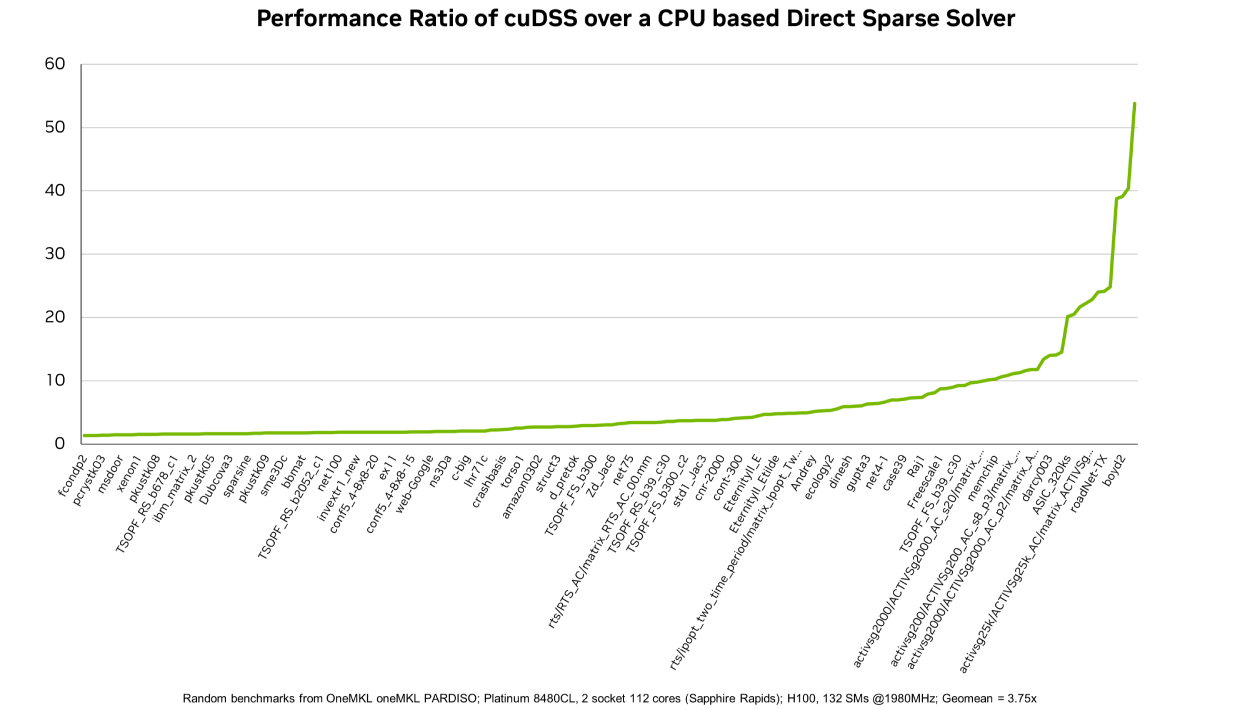
NVIDIA has made its CUDA Direct Sparse Solver (cuDSS) generally available, bringing a GPU accelerated mathematical library into broader use across engineering and scientific simulation software. The 21 October milestone follows earlier development releases and integrations. NVIDIA identified applications in semiconductor manufacturing, electronic design, structural analysis and fluid simulation, while leaving the availability of particular commercial integrations to the software companies concerned.
Computer models of complex physical systems often produce sparse linear equations: mathematical systems containing very large numbers of unknowns, in which most coefficients are zero because each part of the model interacts directly with only a limited number of others. The equations arise when a component is divided into a computational mesh or when electrical, thermal and fluid behaviours are represented numerically. Although sparse storage avoids recording every zero, factorising and solving the remaining equations can still absorb a substantial share of computing time.
cuDSS accelerates this specialised calculation rather than an entire simulation programme. Its workflow includes analysing the matrix structure, carrying out numerical factorisation and calculating the solution. Those phases can recur during optimisation or transient simulation as operating conditions and calculated fields change. Moving appropriate operations onto GPUs can reduce solver time, but mesh generation, assembly of equations, data movement and interpretation of results remain separate parts of an engineering job.
Applied Materials reported that cuDSS accelerated sparse solves in its Ginestra semiconductor simulation platform by up to ten times compared with CPU only methods. Ginestra is used to study defects and device reliability in semiconductor materials. The reported improvement relates specifically to sparse solving within that platform; it is not evidence that every semiconductor development task or complete simulation runs ten times faster.
ZEISS SMT, using COMSOL Multiphysics with cuDSS on NVIDIA accelerated computing, recorded a fourfold speedup in a benchmark simulating plasma for extreme ultraviolet lithography. The complete simulation took six days and 14 hours, according to the figures released by NVIDIA. Dassault Systèmes separately reported gains of eight to ten times in selected operations within Abaqus structural and electromagnetic simulation software. Each comparison uses its own workload and baseline, so the figures cannot be combined into a standard performance expectation.
Other named integrations show how the library is applied to different engineering problems. Cadence uses cuDSS in its Celsius platform for studies of heat, mechanical stress and package warpage in advanced chips. Siemens uses it in Simcenter STAR-CCM+ for calculations involving interactions between fluids and structures. Synopsys integrates it with Sentaurus Device for modelling semiconductor devices, including logic, memory and power components. Those applications share a mathematical requirement even though the design decisions, physical assumptions and numerical models differ.
Solving larger systems also brings memory constraints. Numerical factorisation may create intermediate data that require substantially more storage than the original sparse matrix. NVIDIA had already introduced a hybrid memory mode that can combine GPU and host memory when the calculation does not fit entirely on the accelerator. This increases the range of problems that can be attempted, but data transfers introduce overhead and can reduce the gain obtained from GPU computation.
Other technical capabilities likewise predate general availability. Earlier cuDSS releases added 64-bit indexing for sparse matrix structures with very large numbers of nonzero entries, alongside execution across multiple GPUs. Within one machine, the library manages communication between devices; distributing work across several nodes requires a compatible communication layer. Matrix structure, memory bandwidth and communication costs all influence whether a larger deployment runs faster or merely accommodates a larger calculation.
The library exposes interfaces for C, C++, Python and Fortran, allowing engineering software developers to connect the solver to existing application code. Integration still requires validation of numerical results, including solution residuals, conditioning, tolerances and repeatability. A faster calculation does not remove the need to verify that a physical model and its discretisation are appropriate to the component or process being investigated.
Where sparse solving dominates the computation, a faster solver may permit more design alternatives, material combinations or operating conditions to be examined within a fixed engineering schedule. Yet the reduction in overall simulation time will depend on the portion previously spent in the solver and on how frequently the matrices have to be rebuilt. NVIDIA has named several uses and reported distinct benchmark results, but the announcement does not establish a universal reduction in simulation costs or industrial development times.