Italian automation group Comau is integrating NVIDIA edge computing, robotics simulation and machine learning tools into its industrial automation development. Announced on 21 October, the programme includes planned Jetson-powered robot controllers, digital models of industrial, collaborative and mobile robots in Isaac Sim, and AI training for vision-guided intralogistics. It is an integration and product development programme, not a reported production-wide increase in factory output.
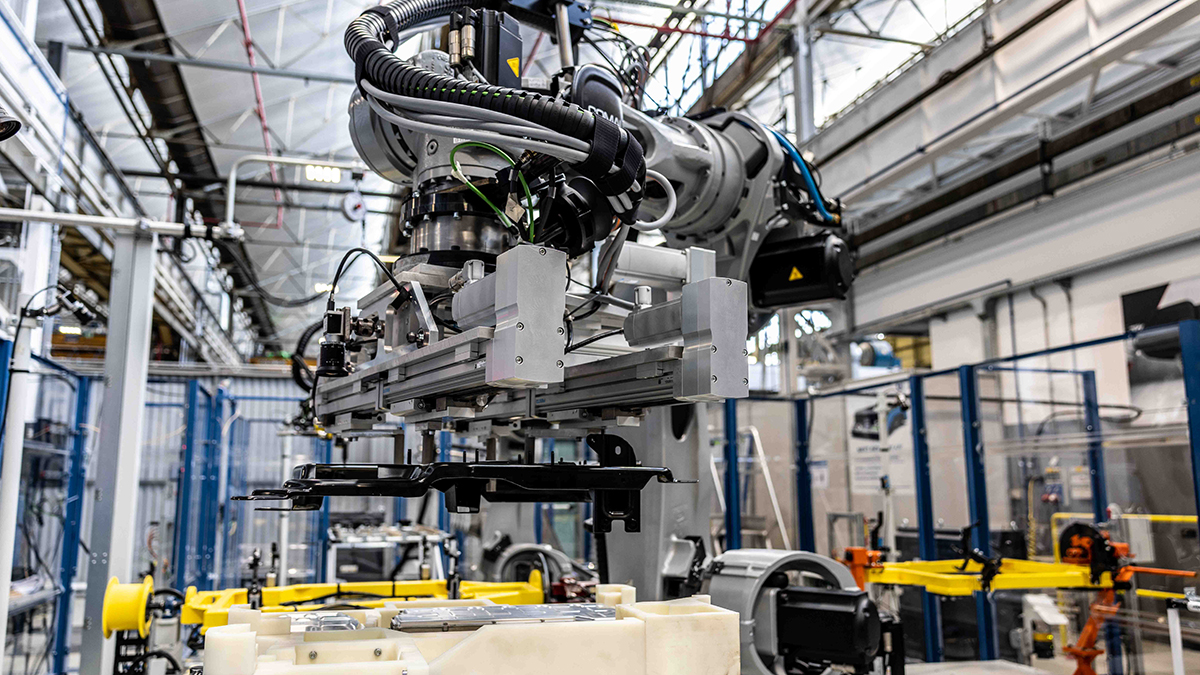
Next-generation controllers are intended to combine conventional robot control responsibilities with additional computing capacity for AI workloads. Industrial robot motion depends on well-defined joint commands, feedback from sensors and suitable supervision of movement within the workcell. Vision and learning applications can add tasks such as detecting object position, recognising variation in material presentation or selecting a handling strategy. Bringing the computing closer to the robot can reduce the need to send every processing task to a separate server, although the performance benefit depends on system design and operating conditions.
NVIDIA Jetson computing is intended for Comau’s next generation of industrial robot controllers. While greater on-device processing may allow perception and planning tasks to run nearer the machine, Comau has not given a controller model number, measured latency improvement or launch date. The safety functions that constrain robot movement also require appropriate design, verification and integration independently of the computing resources used for adaptive task logic. More processing capacity, by itself, does not establish safe performance in a working cell.
A parallel element involves representing Comau’s industrial, collaborative and mobile robots inside NVIDIA Isaac Sim, which is built on Omniverse libraries. This environment is used for simulation, testing and generation of synthetic data. Engineers can construct virtual scenes that represent equipment geometry and physical interactions, then investigate movements and application sequences before using the corresponding hardware. The modelling still needs sufficient fidelity to the real cell, especially where contact, flexible materials or sensor conditions can alter the result of a handling operation.
Comau is contributing SimReady robot assets in OpenUSD format to NVIDIA’s SimReady Central Library on Hugging Face. Prepared assets can include information needed for physical simulation rather than only visual representations, reducing the work required to assemble a useful virtual factory scene. They provide a reusable starting point for developers, but a model still needs to be matched to the actual configuration, payload and operating conditions of the intended installation. Availability in a public library is not evidence that every represented machine has been commissioned in a customer factory.
In intralogistics, the collaboration brings simulation and learning methods into development of Comau’s MI.RA vision systems and handling equipment. The manufacturer specifically identifies reinforcement learning for palletising and depalletising tasks. A vision system must establish what an object is, where it sits and how it can be approached; the robot then has to plan a movement within its reach, load capacity and permitted operating area. Packing variations, occluded surfaces and unstable loads complicate this sequence and can be difficult to reproduce consistently in physical testing alone.
Reinforcement learning uses repeated trials against a defined objective to develop a control policy. Simulated trials can expose a policy to alternative object positions or handling conditions without staging each case on a physical line, but the choice of reward, constraints and generated environments strongly affects the resulting behaviour. Comau is combining Isaac Sim physics, discrete-event simulation for logistics workflows and Isaac Lab learning functions in its approach. That allows the motion of individual robots to be considered alongside the timing and flow of the broader process.
Robot physics and logistics flow must be considered together where material moves through several processing stations. A physics model can be used to investigate gripper contact and robot trajectories; discrete-event simulation addresses arrivals, queues, resource availability and processing time. A handling strategy that operates at workcell level can still leave an upstream queue or starve a downstream machine. Combining those modelling layers offers a means to evaluate system behaviour before installation, but only if site-specific demand and mechanical assumptions are sufficiently representative.
Comau supplies automation for automotive production and other industrial sectors, alongside mobile robotics and material handling systems. Its portfolio creates several potential uses for simulation and computing technology, but different applications will require different levels of sensing, training and integration. The company has not specified how many units will be equipped, what customers will be first to deploy the technology or the commercial cost of the new controller design. Those details remain necessary for assessing the scale of implementation.
Comau has not specified when customers will receive the new controllers, how many robots will use the integration or what measured benefits follow from it. Its next verifiable engineering milestones will be application testing, customer installations and comparisons between simulated results and operation on physical equipment. Those measurements will establish how the announced NVIDIA components affect robot capability and throughput in practice.