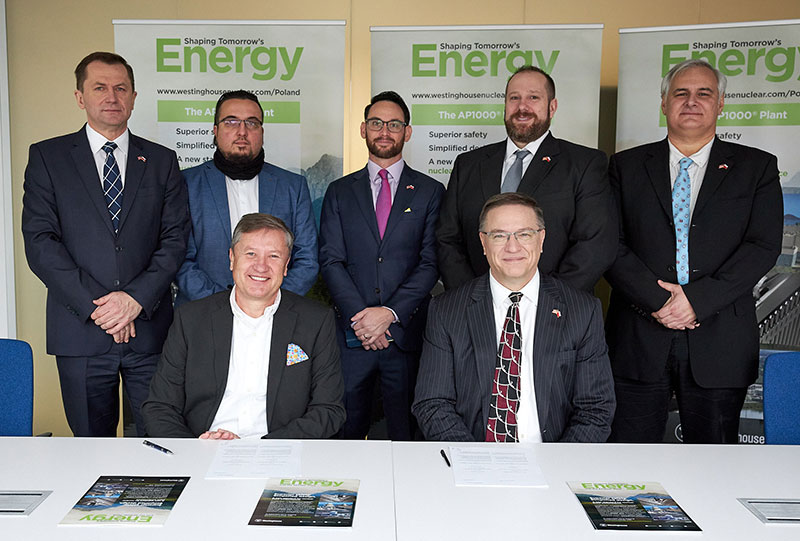
Westinghouse Electric Company has placed conditional orders with four Polish manufacturers for structural modules associated with the first AP1000 nuclear reactor at Lubiatowo-Kopalino. The agreements, announced on 13 October, identify safety-related work packages but make the full production awards dependent on nuclear quality certification and the successful manufacture of pre-production qualification mock-ups.
Energomontaż-Północ Gdynia, known as EPG, has been selected for the CA03 module, while FAMAK will work on the CA20 floors package. Mostostal Kielce has received the conditional CA02 walls scope, and Mostostal Krakow has been assigned the CA05 walls module. The orders were signed during the fourth Nuclear Power Industry Congress in Warsaw.
The four companies are progressing towards compliance with the ASME NQA-1 quality assurance standard. Westinghouse says each must obtain the required certification and fabricate an acceptable qualification mock-up before the full module scope is awarded. The announcement does not confirm that those qualifications have been achieved or that production components have entered routine manufacture.
The modules are intended for the first unit of the nuclear power station being developed by Polskie Elektrownie Jądrowe, or PEJ, on Poland’s Baltic coast in Pomerania. The reactor will use Westinghouse’s AP1000 technology, whose construction method incorporates large prefabricated structural assemblies as well as equipment installed at the nuclear site.
Modular construction transfers part of the fabrication effort into workshops where access, equipment and inspection procedures can be managed under controlled conditions. Assemblies are then transported to the plant and integrated into the surrounding structure. The approach can reduce some site fabrication activities, but it demands accurate interfaces and well-documented manufacturing processes before shipment.
Westinghouse’s allocation identifies distinct functions within the reactor building. The CA02 walls module and CA03 module form part of the in-containment refuelling water storage tank arrangement. That equipment stores water used by safety-related systems, so its structural components must be manufactured against the applicable design and quality requirements.
The CA05 scope comprises reinforced steel plate walls that separate rooms inside the containment building. The CA20 floors package consists of reinforced concrete slabs formed on steel plates within the larger CA20 structure, which houses plant equipment. Those components have different geometries and manufacturing methods, despite being grouped under a single supplier development programme.
Large steel assemblies must maintain their dimensional characteristics through fabrication, inspection and subsequent handling. Welding can introduce distortion, while fit-up accuracy affects whether the completed module can connect to adjacent components during installation. Tooling, controlled fabrication sequences and intermediate measurements help manage those risks.
Where reinforced concrete is incorporated into an assembly, the steel and concrete elements must also perform according to the approved structural design. The supporting plates, reinforcement, interfaces and placement procedures are specified for the particular module rather than inferred from a general description of modular construction.
The qualification mock-ups are intended to demonstrate that the suppliers can carry out representative operations before undertaking production work. Such exercises can expose deficiencies in tooling, welding, inspection or document control while allowing engineers to improve the processes without affecting a component destined for the reactor.
NQA-1 is concerned with establishing and implementing quality assurance arrangements for nuclear facilities and activities. It involves requirements for matters such as document control, procurement, inspection, testing and the management of nonconforming items. A business supplying safety-related components must be able to show that specified procedures were followed and that the resulting records support acceptance of the work.
Material traceability forms part of that task. Plates, structural sections and welding consumables may have to be linked with their certificates and subsequent manufacturing records. If a defect or deviation is identified, the supplier needs evidence of where the material was used and how the issue was evaluated and resolved.
Certification alone would not establish that every possible nuclear component could be manufactured by the same supplier. Each work package has its own specifications, fabrication methods and acceptance criteria, which must be demonstrated through appropriate qualification and project-specific controls.
The conditional awards are also different from a separate decision taken earlier in October to begin procuring long-lead items for the Lubiatowo-Kopalino project. PEJ instructed Westinghouse to initiate that procurement process on 8 October, addressing equipment whose manufacturing lead times can affect the broader construction schedule.
The latest agreements concern development of Polish suppliers for identified structural modules, rather than a second instruction to procure the same long-lead equipment. Retaining that distinction is important because the work packages, supplier responsibilities and milestones differ even though they support the same first AP1000 unit.
Poland is seeking a greater domestic industrial contribution to its nuclear programme. The use of local fabrication companies can develop skills and manufacturing experience, but it also requires investment in quality systems and production methods capable of satisfying nuclear specifications. Workshop experience from conventional power or heavy engineering provides a starting point, not automatic approval for safety-related reactor work.
Polish companies that complete the qualification process may also be positioned for future AP1000 opportunities beyond the first unit. Westinghouse has pointed to that potential, although no additional future module awards have been confirmed for the four suppliers through the October announcement.
The development is part of the project intended to deliver Poland’s first commercial nuclear power station, with the government targeting electricity from the first reactor in 2036. That year is a project objective, not a commissioned operating date. Construction permissions, manufacturing schedules and equipment delivery remain separate stages of the overall programme.
The immediate evidence of progress will be completion of NQA-1 certification, acceptance of the qualification mock-ups and conversion of the conditional orders into full manufacturing assignments. Only after those steps can the companies’ contribution move from supplier qualification towards production of the specified reactor modules.