Leonardo DRS has established a UK subsidiary and opened a purpose built production site for tactical radars, creating local manufacturing capacity for sensors used in counter UAS, air defence, force protection and active protection applications.
The new DRS UK operation is intended to serve British defence customers, system integrators and industry partners while also acting as a hub for the company’s tactical radar business across the UK and Europe. Leonardo DRS has not disclosed the location, investment value or planned output of the site.
The move brings production closer to a market in which tactical radar requirements are expanding as armed forces add more layers of sensing around drones, rockets, artillery, mortars and low flying aircraft. Leonardo DRS says more than 10,000 of its radar panels are already deployed worldwide with the US Armed Forces, NATO allies and other international customers.
Its tactical radar family includes software defined active electronically scanned array systems. Rather than rotating a mechanically steered antenna to search an area, an AESA radar uses many transmit and receive elements and controls the beam electronically, allowing the system to redirect its field of view rapidly and revisit tracks frequently.
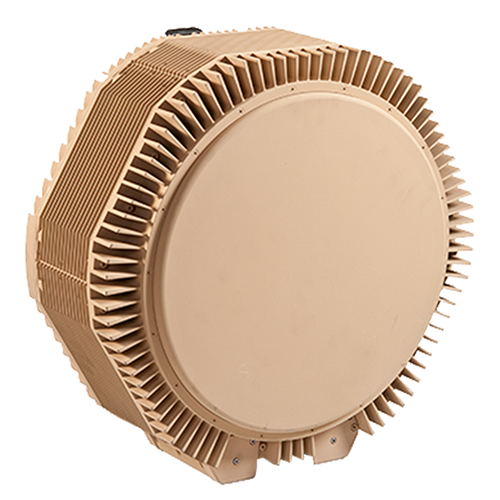
Leonardo DRS describes its Multi-Mission Hemispheric Radar as a 4D AESA pulse Doppler platform using gallium nitride amplifiers. A single panel covers 120 degrees in azimuth, while four panels can be combined for hemispheric coverage. Pulse Doppler processing uses the frequency shift created by movement to help separate moving targets from background returns and estimate radial velocity.
Small drones make that sensing problem more difficult because they can fly slowly, operate close to terrain and structures, and present relatively small radar cross sections. The radar has to distinguish those targets from birds, vehicles, weather and other moving objects without overwhelming operators or downstream command systems with false tracks.
Leonardo DRS says its counter UAS radar systems can detect, identify and track Group 1 to Group 3 unmanned aircraft before passing data into a wider defeat architecture. Radar establishes and maintains the track, command and control software combines information from available sensors, and effectors such as electronic warfare systems, missiles, guns or directed energy equipment can then be assigned against a confirmed threat.
Local production changes the industrial side of that chain. Radar manufacturing involves radio frequency electronics, antenna assemblies, digital processing hardware, power systems, mechanical structures, calibration and acceptance testing, with the exact configuration changing according to platform and mission requirements.
Bringing those activities into the UK can reduce the physical and organisational distance between production, integration and customer acceptance. That becomes significant when radar hardware is incorporated into vehicles or layered air defence systems because mechanical interfaces, power, cooling, networking and command system compatibility have to be resolved alongside detection performance.
A software defined architecture can move some capability changes away from physical redesign because signal processing, tracking logic and mission configuration can be updated as threats develop. Those changes still require verification against the radar hardware and wider system, creating an engineering workload that continues after the initial sensor has been manufactured.
Leonardo DRS already produces tactical radars in the United States, including through DRS RADA Technologies in Maryland, where production, engineering laboratories and testing are co-located. Establishing a UK site extends that manufacturing model into Europe rather than relying entirely on finished sensors exported from North America.
European governments continue to invest in counter drone and short range air defence capability as the number and variety of unmanned threats increases. Recent conflicts have also exposed the economic problem created when comparatively inexpensive drones are intercepted with weapons costing considerably more than the target.
Sensors influence that equation because accurate classification and tracking help a command system select the most appropriate response rather than treating every detected object as the same type of threat. Reliable radar data can support the use of electronic warfare, guns or other lower cost effectors where circumstances permit, while retaining missile or other kinetic options for targets that require them.
DRS UK gives Leonardo DRS a manufacturing base from which to compete for that work, but the scale of the industrial commitment will depend on contracts. Without disclosed headcount, annual output or local content figures, the immediate development is the establishment of qualified production capacity rather than evidence of a large volume UK programme.
The radar variants selected for the site, the level of domestic supply chain participation and the first contracts tied directly to UK manufacture will show how the operation develops. Those details will determine whether DRS UK remains principally a regional production and support base or grows into a larger manufacturing hub serving European and export programmes.