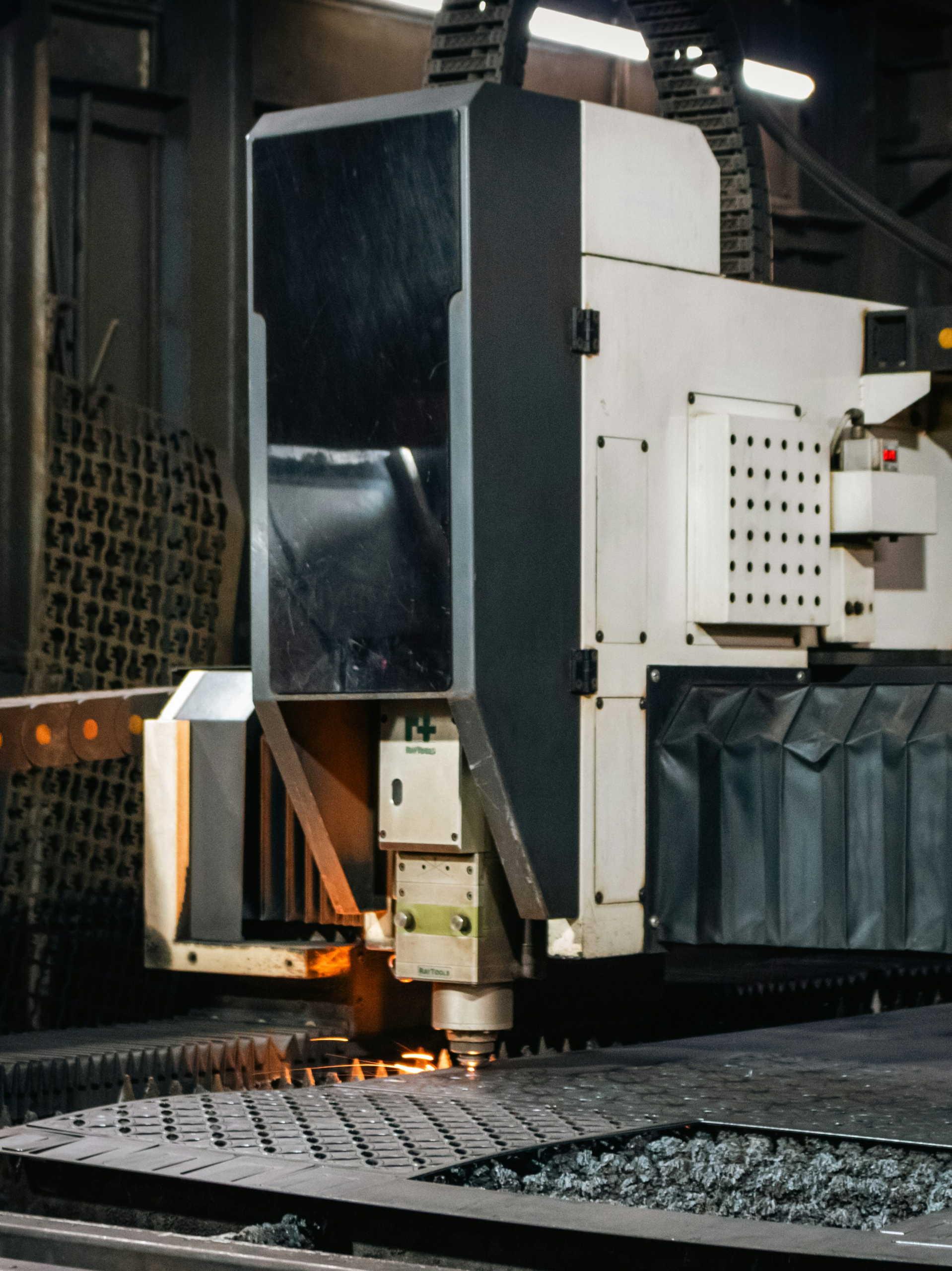
Steel & Glass Solutions has installed a 20kW Nukon Cross 420 fibre laser at its Dunstable factory to support production of stainless steel architectural metalwork for HS2’s Old Oak Common station in west London.
The machine, installed in late April after being displayed at MACH 2026, will cut flat stainless steel sheet for polished posts, glazing tracks, skirting, and other front-of-house metalwork used in glazed screens and architectural finishes at the new station. The contract requires the Bedfordshire manufacturer to process around 400 tonnes of stainless steel sheet in thicknesses from 5mm to 25mm.
Most of the material will be around 15mm thick, which pushed the project beyond the comfortable production range of the company’s existing 6kW Nukon Rex 315 fibre laser. Steel & Glass Solutions therefore part-exchanged that machine for the new Cross 420, increasing available laser power to 20kW and adding a 4m by 2m cutting table.
The Cross 420 can cut stainless steel up to 40mm thick. On the 15mm material that dominates the Old Oak Common workload, the new system is expected to cut at more than ten times the speed of the previous 6kW machine. The larger table also allows bigger sheets to be nested, creating an opportunity to improve material yield and reduce scrap alongside the cycle-time gain.
Warren Few, operations director at Steel & Glass Solutions, said the company recognised that a more powerful laser would “accelerate the cutting process” while reducing the volume of nitrogen used. Assist-gas consumption matters because nitrogen protects cut quality and prevents oxidation on stainless steel, but high flow rates become a significant operating cost when hundreds of tonnes of material are being processed.
The investment is the company’s second step into in-house fibre laser cutting. Steel & Glass Solutions bought its first Nukon Rex machine at MACH 2022, replacing outsourced laser cutting for polished steel fabrications and cladding panels. Bringing the process inside the Dunstable operation gave the business direct control over scheduling and cut quality; the HS2 order has now forced a second change, this time in power and throughput rather than make-or-buy strategy.
A major infrastructure contract can alter the production economics of a specialist fabricator quickly. A 6kW fibre laser may be suitable for a mixed workload, but a large programme dominated by 15mm stainless steel creates a different bottleneck. Higher power shortens the cut itself, while a larger bed can reduce sheet changes and improve nesting.
Neither improvement matters in isolation if downstream forming, finishing, assembly, or installation cannot absorb the additional output. The wider production system has to be balanced around the new cutting rate, otherwise faster laser processing simply shifts waiting time into the next operation.
Fibre lasers have become common in sheet metal production because they combine high cutting speed with comparatively simple beam delivery and lower maintenance requirements than older CO2 systems. Increasing power has expanded the thickness range that can be processed economically, although the most productive setting still depends on material, thickness, edge-quality requirements, gas strategy, and part geometry.
The wider Nukon range covers flat sheet, tube, and three-dimensional applications, with automated loading and unloading available for higher-throughput cells. CAD/CAM nesting is another part of the production equation because faster cutting makes material handling and programming proportionally more important. Once the laser is no longer the slowest process, loading, unloading, sorting, forming, and finishing can become the next constraints.
The Old Oak Common work is not the only HS2 programme expected to use the machine. Steel & Glass Solutions has also secured a project involving 15mm weathering steel sheets up to 3.4m long for two viewing platforms at the Maple Cross tunnels in the Chilterns. That work uses the larger bed and provides a second production stream beyond the stainless steel package.
Industrial laser development is also pushing ultrafast systems into robotic precision-processing applications, while high-power fibre systems continue to increase throughput in conventional flat-sheet fabrication. The technologies address different processes, but both are moving laser equipment deeper into production cells where utilisation, automation, process data, and integration matter as much as headline optical power.
The immediate test at Dunstable is whether the Cross 420 can move hundreds of tonnes of stainless steel through cutting without creating a schedule bottleneck or excessive gas cost. Old Oak Common gives the machine a defined workload from the outset, and the additional HS2 package should extend utilisation beyond the first order. The purchase is tied to contracted production rather than speculative capacity, giving the factory a clear measure of whether higher laser power translates into lower processing cost per finished component.