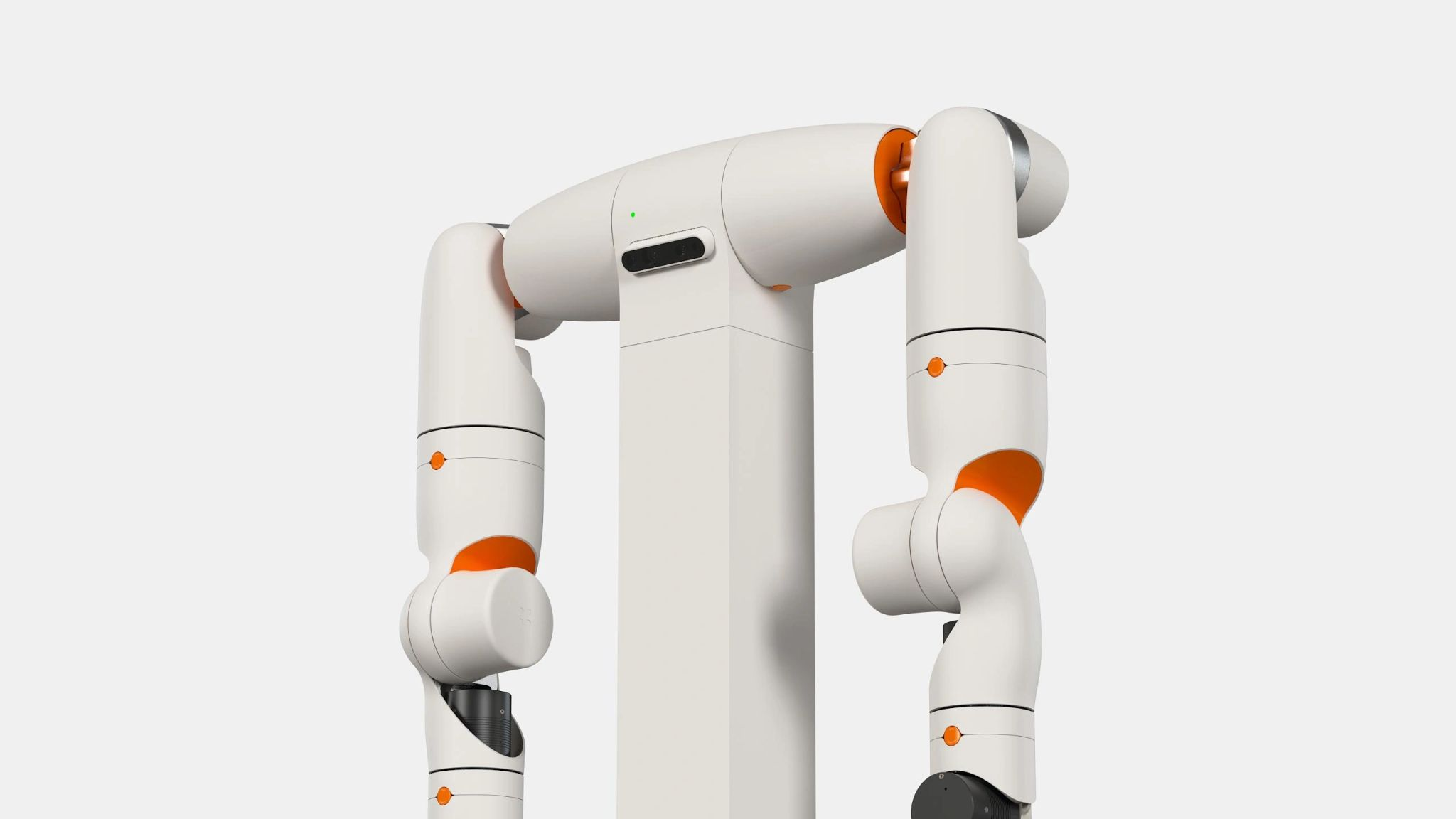
O-ID has raised $1.2 million in pre-seed funding to move its modular humanoid robot from prototype development towards production and factory deployment. TAWANI Ventures led the round, with participation from Hustle Fund, Techstars and angel investors, as the Tokyo company develops the machine for manufacturing and logistics applications.
The platform is being designed around replaceable modules rather than treating the humanoid as one tightly integrated machine that has to be returned to a specialist facility when a major component fails. O-ID says joints, limbs and other assemblies will be replaceable on site, allowing maintenance teams to exchange a module and return the robot to service while the removed component is repaired separately.
The company’s current indicative specification lists a height of 172cm, mass of 70kg, payload of 16kg and 30 degrees of freedom. O-ID describes the platform as containing more than nine replaceable modules and identifies manufacturing, logistics and industrial inspection among its intended applications.
The funding is intended to move the first machine from prototype work towards production, which is a different engineering problem from demonstrating individual motions or manipulation tasks. A robot intended for regular factory use has to be manufactured consistently, commissioned, maintained and supplied with replacement parts, while hardware and software revisions have to remain controlled across machines operating at different customer sites.
Modularity is O-ID’s proposed answer to part of that service challenge. Conventional industrial robots are already designed for maintenance, but they normally operate inside fixed cells whose tooling, guarding and workflows are engineered around defined tasks. Humanoid developers are pursuing a different proposition: a machine using a human-like working envelope may be able to enter processes originally arranged around people without requiring the same degree of surrounding factory reconstruction.
That flexibility carries compromises. A general-purpose machine carrying its own sensing, compute, mobility and manipulation hardware is unlikely to match a dedicated robot cell on every measure of payload, speed or cycle time. Its industrial case instead depends on being useful across enough different tasks, being straightforward to redeploy and remaining available when components wear or fail.
O-ID is placing particular emphasis on availability. The company says onboard sensing will monitor component condition and identify parts approaching failure, with replacement modules intended to be supplied before a developing issue causes prolonged downtime. That moves maintenance towards replacing a known assembly during a planned intervention rather than diagnosing an entire robot after a fault has stopped work.
The principle is familiar elsewhere in manufacturing. Production machinery often uses replaceable drives, servo units, controllers and sensor modules because keeping a line stopped while a specialist carries out component-level diagnosis can cost more than carrying a spare. Applying the same idea to a humanoid robot is technically demanding because mechanical joints, wiring, calibration and control software all have to remain aligned when a module is exchanged.
O-ID has also signed a letter of intent with Sumitomo Electric Industries to explore the potential use of Sumitomo Electric technology in humanoid robot wire harnesses. Cabling receives less attention than actuators or AI systems, but repeated articulation places substantial mechanical demands on conductors and connectors. A humanoid arm or torso has to route power and data through moving joints while retaining sufficient flexibility, bend life and serviceability.
The company’s initial focus is automotive manufacturing and logistics in Japan. Its current product material identifies assembly and transfer between production stages, warehouse case picking and movement, and industrial inspection among the target applications. Those are tasks where workspaces are often already arranged around human reach and mobility rather than around conventional robot cells.
O-ID also intends to manufacture the robots in Japan, placing the project inside an established supply base for precision components, electronics and industrial robotics. The company argues that existing manufacturing capability can support a faster route towards volume production than attempting to establish an entirely new supply chain around the robot.
The $1.2 million round remains modest relative to the capital typically required to industrialise complex robotics hardware. Mechanical tooling, actuators, electronics, batteries, safety validation, software development, spares and field support can absorb substantial investment before meaningful volume is reached. The funding should therefore be read as a move towards production rather than evidence that large-scale manufacture has already been solved.
That distinction is important in a humanoid market attracting increasingly large investment rounds and ambitious deployment claims. A factory robot has to do more than perform a convincing demonstration: it needs to repeat useful work for long periods, recover predictably from faults, operate safely around existing processes and deliver enough productive hours to justify its cost.
Same-day reporting indicates that O-ID is targeting initial factory pilots in 2027, with its next mobile platform under development. That will shift the programme from laboratory integration towards the less forgiving questions of safety, task reliability, serviceability and customer support.
O-ID is attempting to make repairability part of the product architecture before volume production begins. If that approach survives the transition into customer factories, the useful measure will be less how closely the machine resembles a person than how often it can remain productive without specialist intervention. The move from prototype to factory floor will provide the first meaningful evidence.