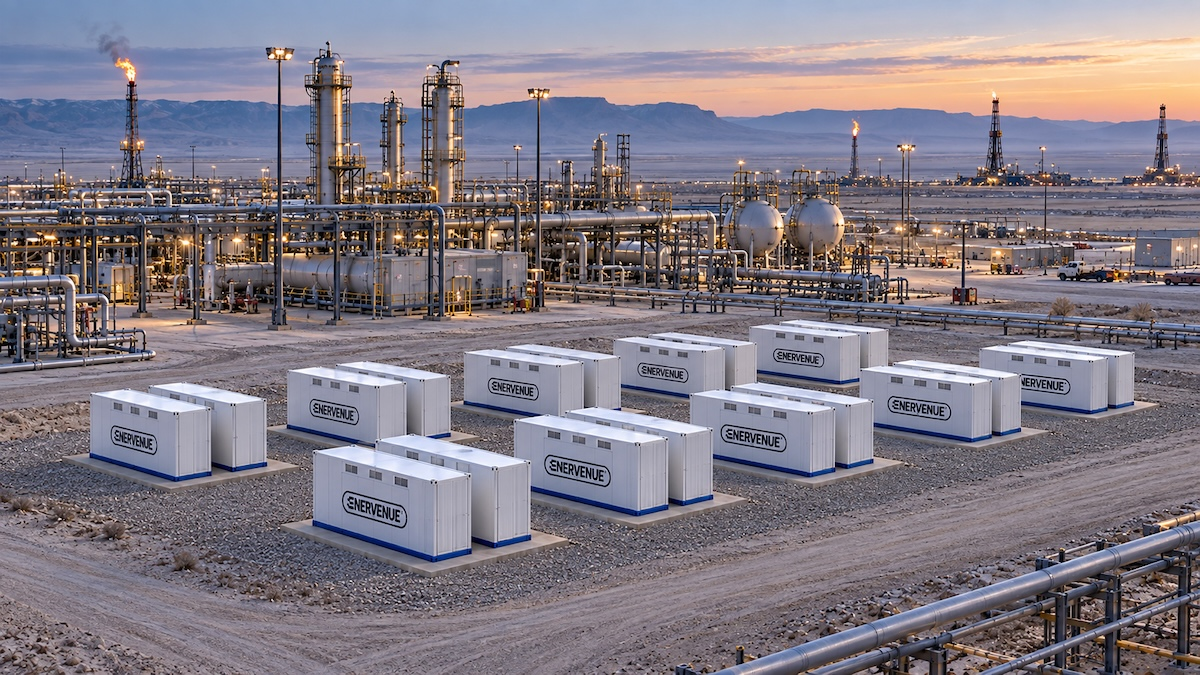
EnerVenue has secured its first commercial energy storage order at multi-megawatt-hour scale, with 26 Energy Prism containerised systems providing a combined 11MWh for an operating oilfield in northern China.
The unidentified Chinese oil and gas producer will use the batteries alongside an onsite solar array, storing generation during the day and returning electricity to the operation when required. The first three containers are scheduled to ship in December 2026, followed by the remaining 23 in March 2027.
The installation is a substantial step up from EnerVenue’s first operating Aqueous Metal Cell project, a 150kWh system at Jintan in Changzhou that has combined onsite renewable generation with electric bus charging since November 2025.
EnerVenue said the oilfield customer selected its technology after examining the battery’s safety characteristics. Oil and gas sites impose demanding requirements around fire protection, process safety, electrical integration, and continuity, giving storage suppliers a more complicated qualification task than demonstrating energy capacity and cycle performance alone.
Henning Rath, chief executive officer of EnerVenue, said: “This customer examined everything before choosing us. It is a perfect location to deploy a large scale project.”
The Energy Prism systems use the company’s fourth generation Aqueous Metal Cell, a water based nickel-hydrogen chemistry rather than a conventional lithium-ion architecture. EnerVenue says the electrolyte is non-flammable, the cell contains no lithium, and the technology has passed UL 9540A testing with no fire propagation at cell level.
The company also states that its chemistry does not produce the same sequence of events associated with thermal runaway in conventional battery systems. That claim is particularly relevant to an oilfield installation, although the safety of the completed project will still depend on site engineering, electrical protection, operating procedures, power conversion equipment, local codes, and the way the containers are integrated into the wider facility.
EnerVenue is also positioning service life as part of the industrial case. The company rates the Aqueous Metal Cell for 30,000 charge cycles and says it is designed for operation over 30 years without scheduled capacity augmentation.
If that performance is achieved in the field, operators could spread the cost of storage across a longer service period and reduce some of the replacement and augmentation work associated with other battery installations. The commercial case will still depend on round trip efficiency, availability, maintenance, capital cost, cycling profile, and the value of the electricity being shifted.
The order also links directly to EnerVenue’s manufacturing expansion in China. Cells for the project will come from the company’s new high volume production line in Changzhou, Jiangsu, which is due to open on 24 September.
The first phase is designed for 250MWh of annual output, with EnerVenue targeting 1GWh during 2027 and multi-gigawatt-hour scale by 2028. The 11MWh oilfield order is small relative to those ambitions, but it provides an early commercial load for a production system that now has to demonstrate repeatability, quality control, logistics, and delivery at greater scale.
That is an important test for an alternative battery chemistry. Lithium-ion storage benefits from large global manufacturing volumes, established suppliers, extensive field data, mature integration practices, and financing assumptions built around years of operating experience. A newer chemistry has to establish similar confidence while manufacturing capacity is still expanding.
EnerVenue’s material profile differs from lithium-ion systems. The company says the Aqueous Metal Cell uses no lithium or rare earths, with bulk materials including steel, nickel, glass fibre composite, and a water based electrolyte. Nickel and steel can be recovered at end of life, although the economic value of that recovery will depend on volumes, material prices, and the recycling route available when the systems are retired.
The operating concept at the oilfield is comparatively straightforward. Solar electricity generated during the day will be stored and shifted into periods when the site requires power, reducing the mismatch between onsite generation and consumption while giving the operator a controllable electrical asset.
The engineering around that concept is less simple. Twenty-six containers have to be integrated with power conversion equipment, protection systems, communications, earthing, site controls, and the oilfield’s broader electrical network. The batteries also have to operate within the safety procedures of an active hydrocarbon production site.
EnerVenue will deliver the Energy Prism units as complete containerised systems ready to connect to the customer’s power conversion equipment. That leaves the performance of the finished installation dependent on commissioning and on the interfaces between the containers, conversion equipment, plant controls, and site load.
The first three shipments in December will begin that process before most of the order arrives in March. The project will then provide a reference at a scale much closer to the commercial and heavy industrial markets EnerVenue is targeting.
The contract is significant because it moves the company beyond a small demonstration installation and gives the new Changzhou line a paying industrial project. The more important evidence will come after commissioning, when cycle performance, availability, safety, maintenance requirements, and manufacturing consistency can be measured under sustained operation.