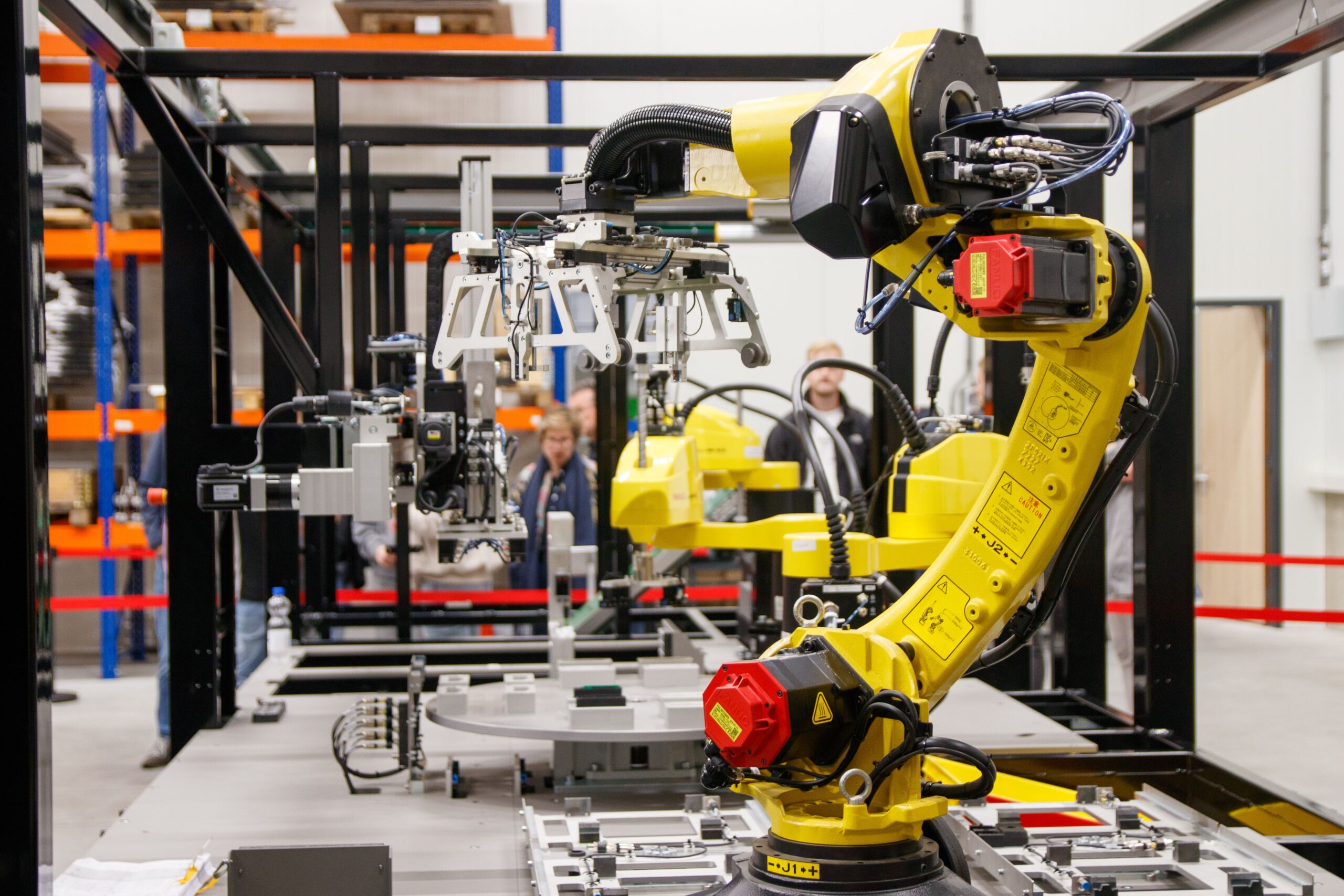
Cognex has agreed to acquire RealSense for approximately $500 million in cash, extending the industrial machine vision company into depth sensing and robotic perception as automation systems increasingly require machines to understand three-dimensional working environments.
The transaction is expected to close during the fourth quarter of 2026, subject to customary conditions, and will be funded from Cognex’s existing cash and investments. RealSense is expected to generate between $80 million and $90 million of revenue this year, representing growth of more than 50% from 2025.
RealSense began within Intel in 2014 and became an independent business in 2025. Its depth cameras and perception technology are used across robot arms, autonomous mobile robots, quadruped platforms, humanoid machines, and other systems that need to determine the distance, position, and movement of objects rather than identify features in a two-dimensional image alone.
Cognex has built its business around industrial identification and machine vision used for inspection, measurement, guidance, and code reading. These applications typically answer tightly defined production questions: whether a part is present, whether dimensions fall within tolerance, where a component is positioned, or whether a code can be read reliably at production speed.
Robotic perception introduces a wider problem. An autonomous machine operating in a factory or warehouse has to interpret changing surroundings, distinguish obstacles from usable routes, and calculate how objects occupy physical space.
A robot picking components from a mixed bin, for example, needs information about depth and orientation before it can calculate a grip and movement path. A mobile robot needs similar spatial information to navigate around workers, pallets, vehicles, and temporary obstructions.
Depth cameras generate that additional information by measuring the distance between the sensor and objects within its field of view. The resulting three-dimensional data can be combined with conventional images, machine learning, and motion-control software to determine where an object is and how a machine can approach it.
Cognex describes the acquisition as a move towards a broader visual-intelligence platform covering industrial identification, two-dimensional and three-dimensional measurement, depth perception, and robotic navigation.
The industrial logic is that inspection, handling, and autonomous movement are beginning to share more of the same visual information. A production cell may use one system to inspect a component, another to guide a robot, and separate sensors on an autonomous mobile platform moving material between lines.
Bringing more of those perception technologies under one supplier can simplify engineering, although customers will still require interfaces with robot controllers, programmable logic controllers, warehouse software, and production systems from other vendors.
The transaction also pushes Cognex further into applications associated with physical AI, where software interprets information from the physical environment and uses it to influence machine behaviour.
The underlying engineering problem remains more specific than the terminology. Industrial perception has to work under changing lighting, reflective surfaces, dust, vibration, moving personnel, mixed products, and variable geometry while still returning a result quickly enough for the robot or line using it.
Accuracy alone is insufficient. A technically precise depth map that takes too long to calculate can restrict cycle time, while unstable measurements can force a robot to slow down or stop. Camera hardware, embedded processing, algorithms, networking, and motion control therefore have to operate as one system.
RealSense gives Cognex exposure to a robotic-perception market the companies estimate is worth around $600 million today and could reach approximately $1.6 billion by 2030. That is a company market estimate rather than a guaranteed growth path, but it explains why depth sensing has become strategically important to a supplier historically concentrated on factory vision.
The transaction does not include every existing RealSense product line. Before closing, the facial-authentication business is expected to be separated into an independent company, keeping Cognex’s acquisition focused on robotic and industrial perception rather than biometric identification.
Cognex is also planning a three-year employee retention programme with a target cash value of $56.5 million and restricted stock units worth approximately $50 million. The size of that package reflects the value of engineering expertise attached to the acquired technology.
Software, calibration, optics, embedded systems, and developer tools can be more difficult to transfer than physical manufacturing assets when a technology business changes ownership. Retaining technical teams therefore becomes part of protecting the value of the acquisition.
The developer ecosystem will be equally important. RealSense hardware is used in research, prototyping, robotics development, and commercial machines, giving Cognex access to users who may not previously have worked with its factory-inspection products.
Converting that installed base into industrial revenue will require maintaining compatibility and support rather than forcing every application into a closed automation architecture.
Cognex brings an established route to industrial customers, which gives RealSense a larger commercial channel into factories and logistics operations. RealSense gives Cognex a way into applications where conventional machine vision alone cannot provide enough spatial information.
The acquisition therefore reflects a broader change in automation. Robots are moving beyond fenced, repetitive cells into warehouses and mixed production environments where objects and routes cannot always be defined perfectly in advance.
Closing the transaction will be the financial milestone; integration will determine the industrial result. Cognex is paying about $500 million to extend its machine vision portfolio from identifying what a machine can see towards helping autonomous equipment understand the space around it.