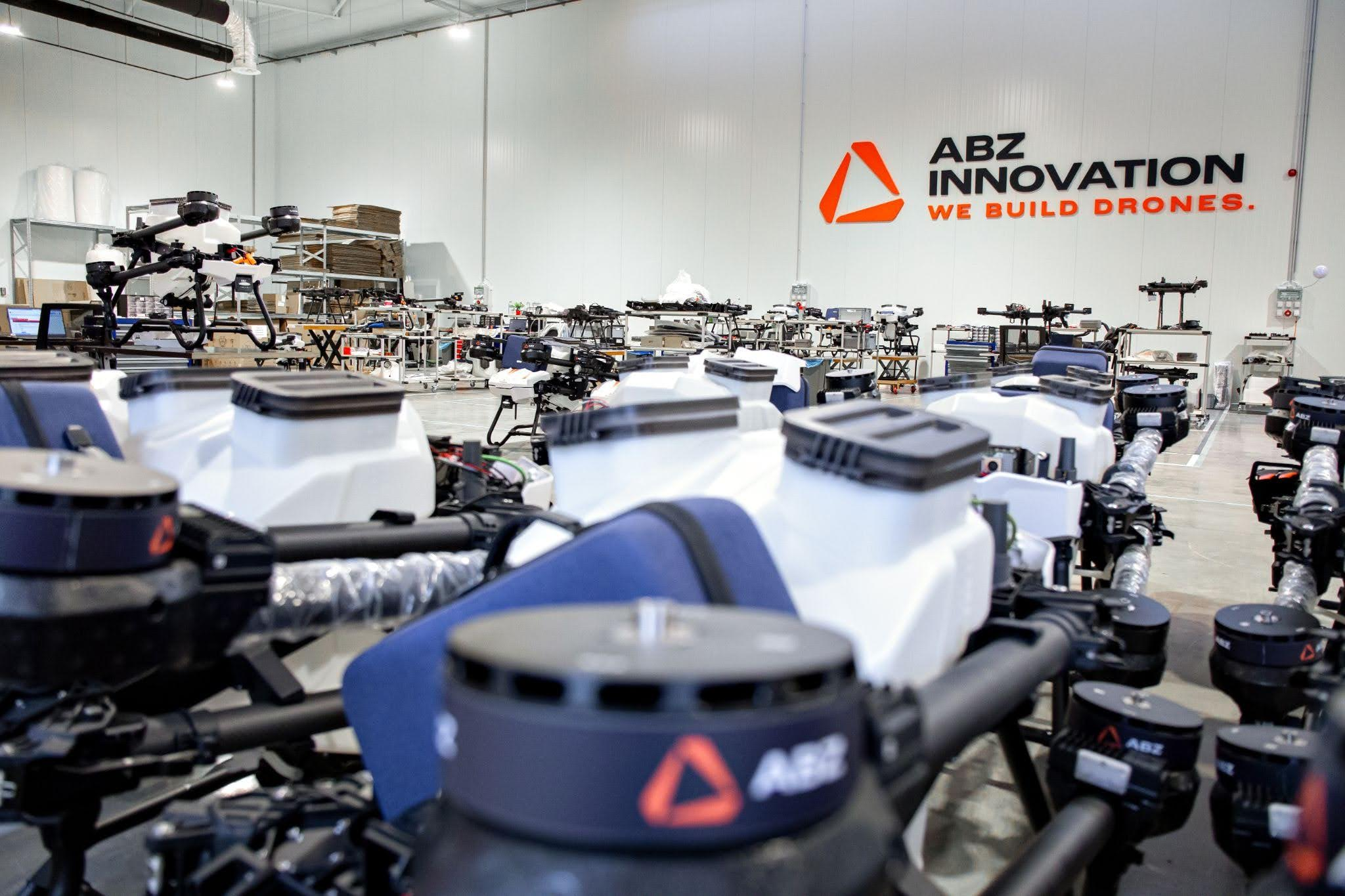
ABZ Innovation has opened a new manufacturing facility in Szentendre, Hungary, giving the civilian drone producer around four times the floor space of its previous site and supporting a target to triple production during 2026. The expansion follows a €7 million funding round completed earlier this year.
ABZ develops heavy-duty drones for agricultural and industrial applications rather than the consumer market. Its systems are used for spraying, spreading seed and fertiliser, cleaning industrial surfaces and moving cargo, with the company saying its equipment is now operating in more than 40 countries.
The larger facility is intended to increase the volume of hardware that can be assembled, tested and shipped from Hungary as that distributor and customer base expands. It also gives the company additional room to organise production around a growing range of platforms rather than relying on the tighter layout of its previous site.
Agriculture remains one of ABZ’s principal markets. Its L-Series drones are aimed at spraying and spreading applications where operators are looking to automate repetitive work and apply inputs more precisely. The company claims its systems can reduce water use by as much as 90% and chemical use by up to 50% compared with conventional methods.
Those figures are application-dependent rather than universal savings. Crop, treatment method, weather, operator practice and the equipment used as a baseline can all affect actual reductions. The engineering challenge is to maintain accurate application while carrying sufficient payload and operating safely across large agricultural areas.
Industrial cleaning is becoming another important part of the product mix. ABZ says its C-Series has become its fastest-growing range as operators look for alternatives to manual access methods on large or difficult-to-reach structures.
Cleaning places different demands on an aircraft from inspection. The drone has to carry or manage a working fluid, remain stable close to a surface and maintain control while hoses, pumps or other equipment impose additional forces. Payload capacity, flight control and system integration consequently become central to the useful work the aircraft can perform.
The Szentendre investment follows the €7 million financing round closed in January, led by Vsquared Ventures with participation from Day One Capital and Assembly Ventures. ABZ said the funding would support manufacturing scale-up, research and development and expansion of its distributor network.
The factory is the most visible production result of that plan so far. It turns the financing into additional floor space and manufacturing capability rather than another prototype programme, although ABZ has not disclosed the absolute annual unit capacity represented by its target to triple output.
Moving into a facility four times larger than the previous plant does not by itself deliver three times as many finished drones. Production still depends on component supply, assembly flow, software loading, calibration, functional testing and final quality control.
Those requirements become harder as the product range broadens. Agricultural spraying, industrial cleaning and cargo transport impose different demands on payloads, pumps, frames, sensors and control software. A manufacturer serving several applications has to maximise the use of common components while maintaining configuration control for machines operating under different duty cycles and national regulations.
ABZ is also emphasising European manufacturing and data control. The Szentendre site gives the company a regional base for assembly, system integration, validation and customer support rather than relying solely on imported finished equipment.
That does not mean every component is produced in Europe. Professional drones depend on batteries, motors, electronic controllers, semiconductors, cameras and communications hardware drawn from international supply chains, and ABZ has not published a detailed localisation breakdown for the new factory.
The industrial significance lies instead in where those components are turned into complete systems. Final assembly, software integration and testing determine whether a collection of hardware becomes a repeatable product capable of being supported across multiple customers and operating environments.
Expansion into more than 40 countries also increases the service burden attached to manufacturing. Industrial equipment can be shipped faster than support networks can be built, particularly where distributors operate across different languages, regulations and seasonal markets.
Spare parts, technical training and repair capability therefore become part of the scale-up. A larger production site can increase shipment volumes, but sustaining those deployments requires enough field support to keep machines operating after the initial sale.
The company has not disclosed the number of units represented by its threefold production target, so the percentage increase cannot yet be translated into a firm annual capacity figure. Floor area and geographic reach provide useful indicators of growth, but future output and delivery performance will give a clearer measure of the factory’s actual scale.
The immediate development is nevertheless concrete. ABZ has moved into a substantially larger manufacturing base and tied that investment to a funded expansion programme rather than a distant capacity proposal. The next test is whether Szentendre can convert the additional space into higher throughput while maintaining the testing, configuration control and customer support expected from professional industrial drones.