GomSpace is integrating around 40 ThrustMe electric-propulsion systems into satellites moving through its production operation, bringing propulsion installation into the standard platform build rather than treating it solely as a mission-specific integration exercise.
The companies announced the manufacturing programme during World Satellite Business Week in Paris. The first spacecraft using the systems are expected to launch from October 2026, giving GomSpace a near-term operational test of the propulsion architecture as part of its regular satellite-production process.
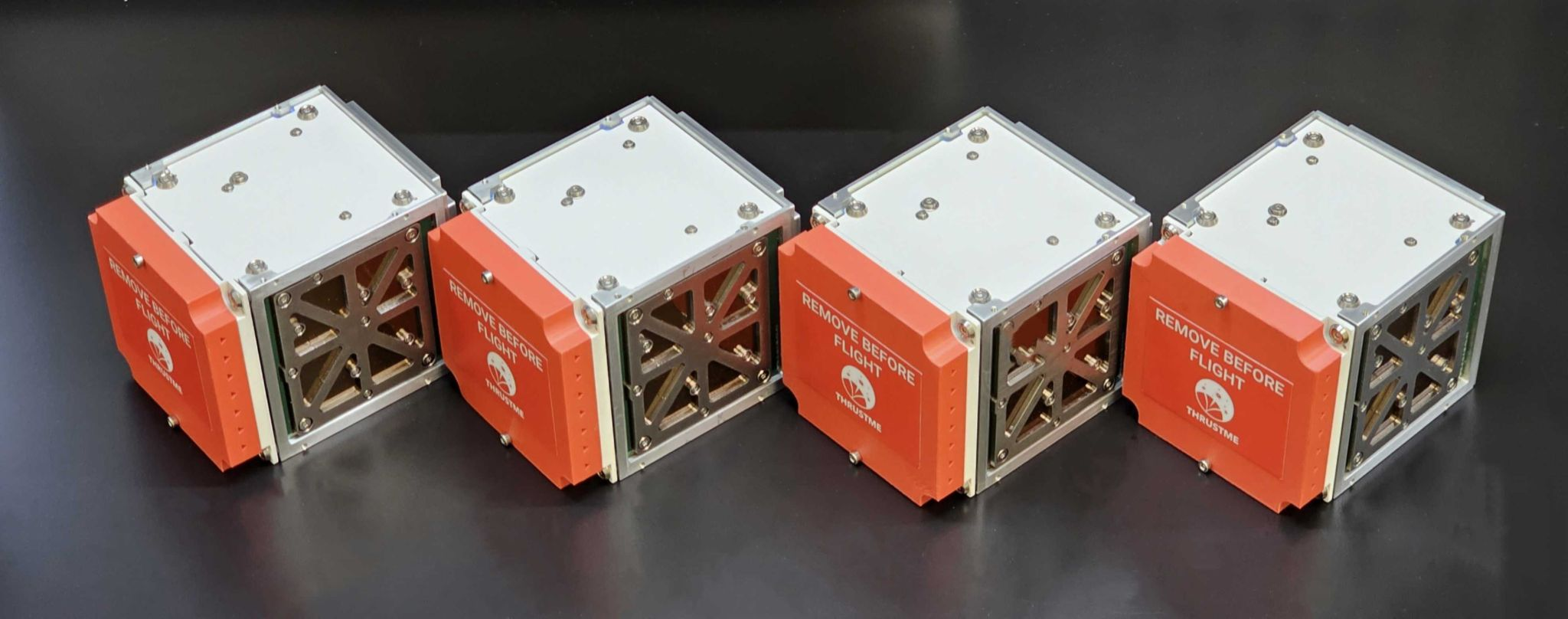
ThrustMe supplies the propulsion equipment as an integrated package combining the thruster, power electronics, propellant-management functions, and onboard software. GomSpace’s own production teams can therefore install the system without developing a separate propulsion-control architecture for every mission.
That matters in a small-satellite industry attempting to replace highly bespoke spacecraft with more repeatable platforms. Every subsystem requiring lengthy customer-specific integration adds engineering time, interface risk, additional testing, and another potential source of delay before launch.
Propulsion is particularly difficult to standardise because it has implications across several other spacecraft systems. Electrical power, thermal control, structure, communications, flight software, mass allocation, and mission operations all have to accommodate the propulsion system before it can deliver useful manoeuvring capability.
Electric propulsion allows satellites to alter orbit, maintain position, perform collision-avoidance manoeuvres, and control end-of-life disposal. Those capabilities are becoming more important as low-Earth orbit becomes more heavily populated and operators face tighter expectations around collision risk and deorbiting.
ThrustMe’s technology uses iodine stored in solid form. The propellant is heated when required and converted into gas before entering the propulsion process, avoiding the high-pressure xenon storage used by many conventional electric systems.
The packaging benefit can be particularly relevant for smaller spacecraft, where tank volume and structural interfaces compete directly with payload, batteries, communications equipment, and other mission hardware. Iodine propulsion still requires careful control of power consumption, thermal behaviour, materials compatibility, thrust, and spacecraft-level software.
ThrustMe says its systems are manufactured at Verrières-le-Buisson near Paris at a rate of roughly one unit per day. More than 500 units have been delivered, while 244 systems have reached orbit across more than 90 satellites and accumulated more than 22,000 hours of manoeuvring.
Those figures are significant to GomSpace because production standardisation depends on more than laboratory performance. A component entering a repeatable spacecraft build needs stable interfaces, predictable lead times, configuration control, repeatable acceptance testing, and enough operational history for engineers to understand its behaviour.
Carsten Drachmann, chief executive officer of GomSpace, said the company wanted propulsion integrated as part of the platform so customers could avoid spending additional time on subsystem integration. The requirement pushed supplier selection towards hardware capable of being installed by GomSpace teams rather than specialist propulsion engineers.
The distinction between a successful mission component and a standard production component is important. Individual satellite projects can tolerate significant engineering attention around one subsystem; a production platform cannot afford to repeat the same integration work every time another spacecraft enters assembly.
For ThrustMe, the arrangement therefore places greater emphasis on manufacturing discipline. Units have to arrive when required, behave consistently during integration, and match controlled mechanical, electrical, software, and test interfaces across a batch of spacecraft rather than a single mission.
GomSpace operates a modular platform strategy from its main facilities in Aalborg, Denmark, supplying subsystems, complete satellites, and mission services to government, commercial, defence, and research customers. Standardised propulsion can extend that approach by making orbital manoeuvring part of a configured spacecraft platform instead of an additional integration programme.
The increasing importance of manoeuvrability is also altering small-satellite architecture. Collision avoidance and controlled disposal demand more from spacecraft that were previously designed around relatively passive missions, while constellation operators may require orbit raising and phasing after deployment.
Building those functions into the manufacturing flow makes propulsion less of an optional accessory and more like another controlled production subsystem. The engineering burden shifts away from repeated integration work and towards qualifying a standard architecture that can be reproduced reliably.
The announcement does not identify a single thruster model across all 40 installations, so assigning a specific ThrustMe product variant to the entire production run would go beyond the disclosed information. The important industrial point is the scale and method of integration rather than the specification of one individual unit.
October’s first planned launches will begin to test the arrangement in orbit. Before that, the more immediate manufacturing measure is whether GomSpace can continue fitting propulsion through its normal integration teams without repeated specialist intervention. If it can, a technically demanding spacecraft subsystem will have moved another step towards becoming a predictable production-line component.