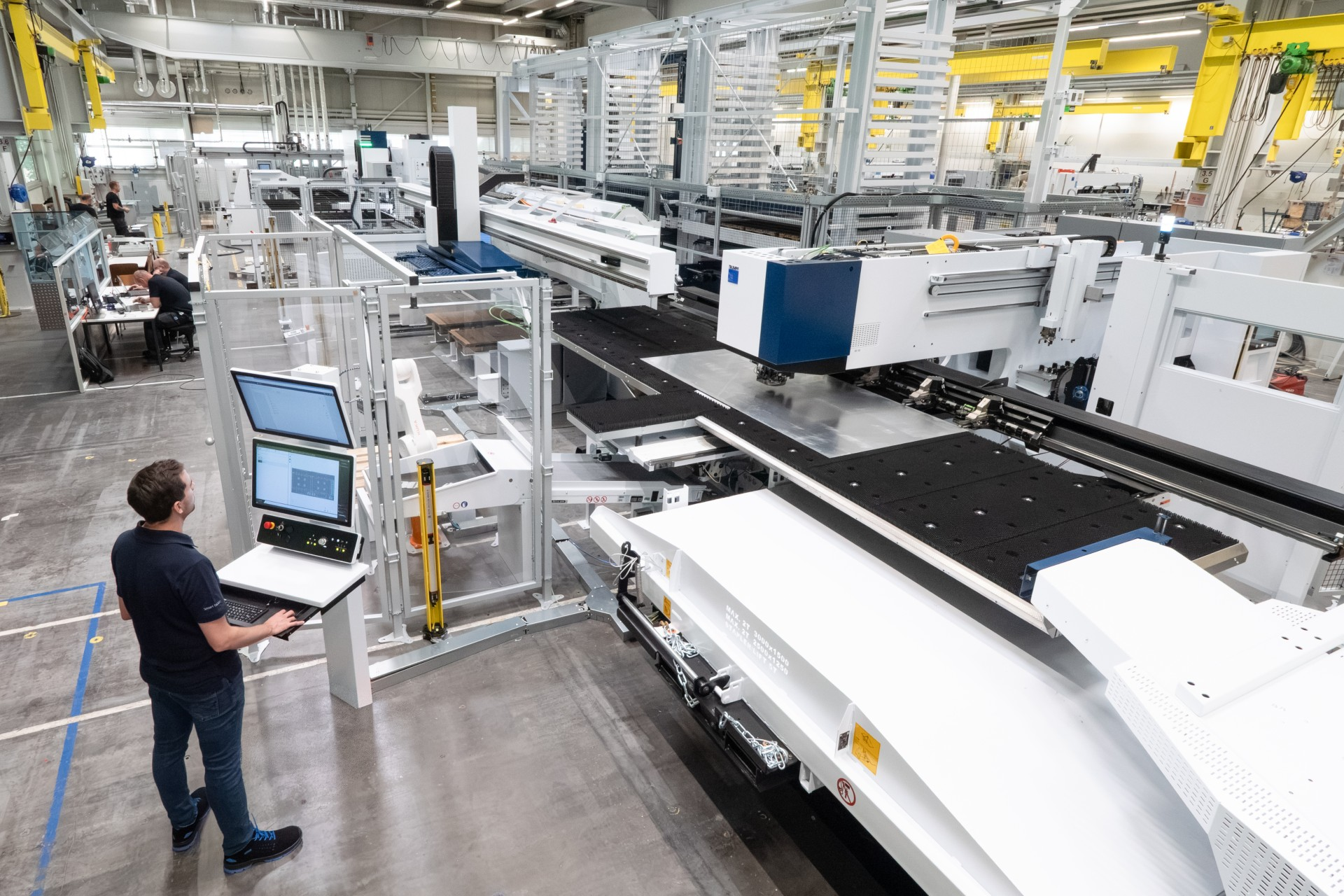
TRUMPF has introduced a new generation of its TruPunch 5000 punching machine, adding expanded digital monitoring, simplified tool setup, and support for AI-assisted component handling while retaining the established mechanical performance of the previous platform.
The machine forms part of TRUMPF’s EuroBLECH 2026 programme and is aimed at manufacturers producing high volumes of punched sheet-metal components. It retains 22 tonnes of punching force, can process sheet up to 8mm thick, and operates at up to 1,600 strokes per minute.
Rather than chasing a larger headline punching figure, TRUMPF has concentrated much of the redesign on utilisation around the process itself. The company is adding more information about machine condition, material flow, tooling, and production status, with the stated aim of reducing interruptions and supporting longer periods of unattended operation.
Vision Equipment Pro uses cameras positioned around the machine to give operators greater visibility of the working area, while production and machine-status data can be connected to TRUMPF’s Smart View monitoring environment. Information can also be displayed through a second screen at the machine, bringing operating data closer to setup and intervention points.
The emphasis on visibility reflects a familiar limitation in automated sheet-metal production. A machine capable of running quickly still produces nothing when a minor stoppage goes unnoticed during an unmanned shift. Overnight production therefore depends as much on fault detection, material handling, tooling readiness, and reliable escalation as it does on nominal strokes per minute.
TRUMPF has also redesigned the control architecture to support more automated component handling. At EuroBLECH, the company is demonstrating an AI-assisted sorting system in which cameras identify the position of punched small parts and allow a robot to pick and separate them without conventional part-by-part programming.
The approach targets a bottleneck that becomes more visible as upstream punching gets faster. Producing a sheet full of components rapidly has limited value if operators still have to identify, separate, and route each item manually. Conventional robotic handling works well for predictable, repetitive layouts, but mixed production can require enough programming and fixturing to undermine the automation case.
Machine vision offers another route, allowing the system to detect where parts are positioned rather than relying entirely on predetermined coordinates. The engineering challenge is keeping recognition and picking reliable across different geometries, surface conditions, lighting, and material movement while maintaining the cycle time expected from a high-output machine.
The revised ToolMaster Linear changer is intended to simplify another routine source of lost production time. An additional display at the setup station presents tool information where operators are carrying out the change, while TRUMPF has altered the safety concept to reduce unnecessary movement around the machine.
The TruPunch 5000 continues to support forming operations including embossing and drawing alongside conventional punching. Its active-die arrangement is designed to reduce surface marking and increase forming capability, allowing more work to be completed before a component moves to bending, joining, or finishing.
TRUMPF is demonstrating the platform as part of a directly connected production system with its TruBend Center 7030. SheetMaster automation places punched components onto a buffer conveyor before they move to the bending cell, where a manipulator takes over the next stage.
The important point is the buffer between the processes. A directly linked line can become inefficient when punching and bending operate at different cycle times, because the faster machine ends up waiting for the slower operation. Buffering lets each piece of equipment work closer to its optimum rate while production control determines when material moves onwards.
The system is also intended to retain alternative material routes. Parts can be returned to storage or handed to mobile transport equipment rather than being forced directly into bending. That matters in factories producing varied component families, where the next operation can change according to order priority, available capacity, or product configuration.
Typical applications identified by TRUMPF include control cabinets, data-centre components, and detailed functional and trim parts. Those sectors combine increasing demand with considerable product variation, making setup, identification, and routing important contributors to total output.
The broader development mirrors the direction of mature machine-tool automation. Mechanical performance remains fundamental, but productivity increasingly depends on whether equipment can report its own condition, exchange usable production data, operate reliably without constant supervision, and adapt when product mix changes.
The new TruPunch 5000 therefore represents an incremental change in punching hardware but a more substantial change in how TRUMPF expects the machine to sit inside an automated factory. Its commercial value will be determined less by the unchanged 1,600-stroke maximum than by whether monitoring, sorting, tooling, and buffered material flow keep those strokes available for productive work.