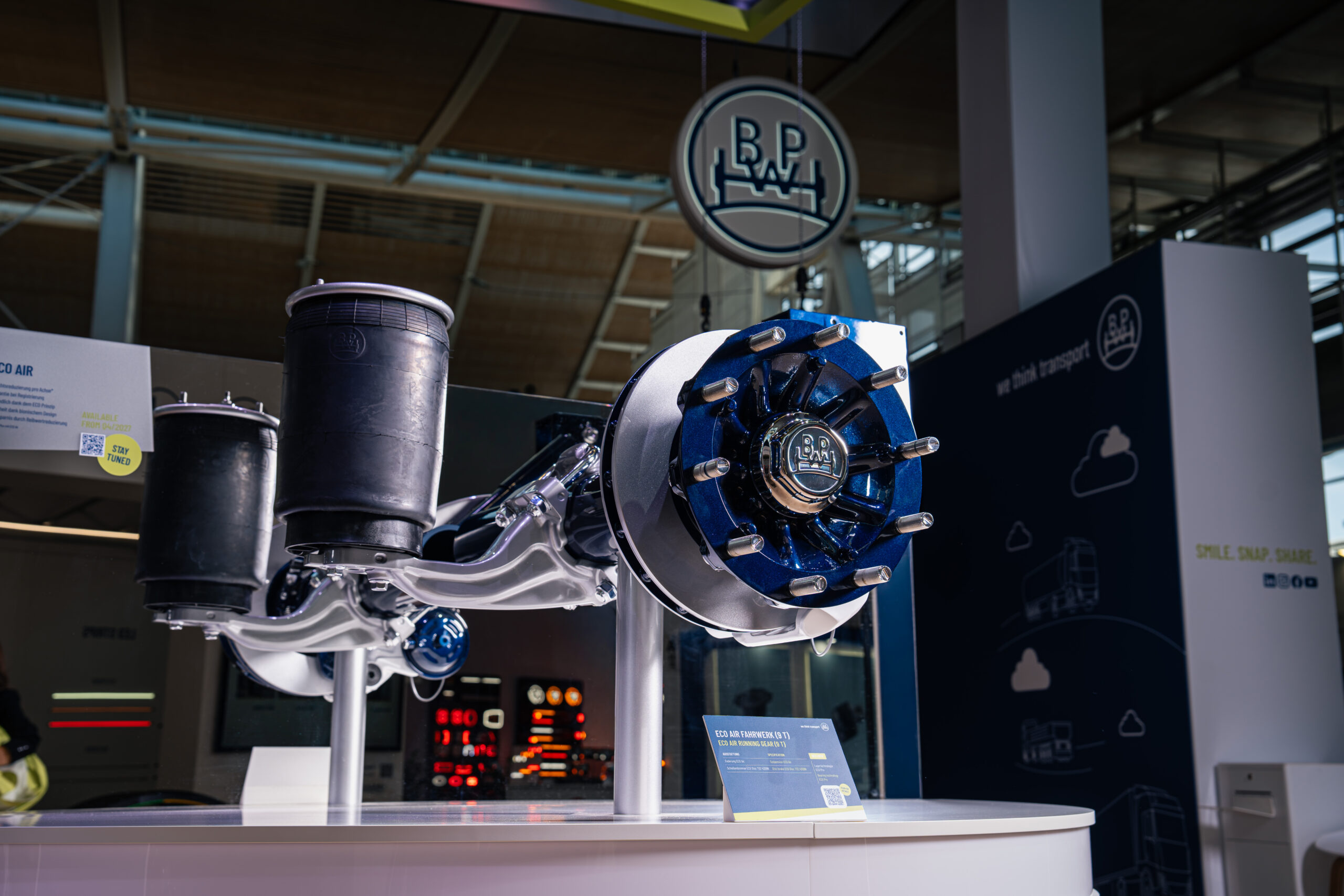
BPW has redesigned its ECO Pro wheel-end for Europe’s high-volume nine-tonne trailer axle segment, cutting approximately 20kg from each axle while retaining the company’s established service concept.
The new assembly is intended for nine-tonne axles using offset-120 disc brakes, a configuration BPW says accounts for more than three quarters of European trailers in the weight class. On a conventional three-axle trailer, the wheel-end changes therefore remove around 60kg before other lightweight running-gear components are considered.
BPW has reworked the hub, bearing arrangement, axle nut, brake disc, and surrounding interfaces rather than treating the development as a simple material substitution. The company describes the hub and brake-disc structure as using a bionic design in which material is concentrated around the paths carrying structural loads.
That approach reflects a familiar engineering problem in commercial vehicles. A wheel-end assembly has to tolerate vertical loading, braking forces, cornering loads, road shocks, bearing forces, heat from the braking system, and long operating mileages while adding as little unnecessary mass as possible.
Removing material therefore becomes a question of geometry rather than simply making every section thinner. Modern modelling and optimisation tools allow engineers to reduce material in relatively lightly loaded regions while retaining stiffness and fatigue strength where loads are concentrated.
The resulting mass reduction has a direct operating value. Trailer operators working close to legal gross weight can convert part of the saving into payload, while lighter vehicles consume less energy moving their own structure when payload is limited by volume rather than weight.
Twenty kilograms on a single axle is not transformative in isolation. Across three axles, however, the saving becomes 60kg, and BPW says combining ECO Pro with its Airlight II suspension and lightweight LightTube trailing arm can increase the reduction to around 34kg per axle.
That makes lightweighting increasingly relevant as road transport electrifies. Battery-electric tractors generally carry more powertrain mass than diesel equivalents, creating additional pressure on manufacturers and operators to remove weight from chassis, running gear, wheels, trailers, and ancillary equipment without reducing durability.
The same engineering remains useful for conventional fleets. A lower-mass trailer can increase available payload regardless of what powers the tractor, while components that reduce friction can contribute to energy savings across both diesel and electric operation.
BPW has also revised the bearing arrangement with the aim of reducing internal friction. The contribution of one wheel end to overall vehicle energy use is small beside tyres, aerodynamics, gradient, speed, and driving pattern, but a bearing operates on every kilometre the trailer travels. Small losses therefore accumulate over a long service life.
Serviceability has remained a design requirement. The new wheel end retains BPW’s established ECO principle, allowing the assembly to be removed through the central axle connection without turning routine maintenance into a specialist dismantling exercise.
That is commercially important because component weight and theoretical efficiency can be overwhelmed by workshop costs if brake-disc or bearing work takes substantially longer. Trailer operators generally measure running gear through total availability, service intervals, parts consumption, and maintenance time rather than the sophistication of the component geometry.
BPW is backing the redesign with an eight-year warranty without a mileage limit, subject to its applicable warranty conditions. The commitment is significant because weight optimisation is useful only if the resulting component retains the durability expected from equipment exposed continuously to road contamination, weather, high loads, braking heat, and mechanical shock.
The company has filed patent applications around several elements of the development, indicating that the redesign extends beyond cosmetic changes to an existing axle family.
Commercial vehicle components also face unusually long verification cycles. A wheel end can accumulate hundreds of thousands of kilometres across different roads, loads, climates, drivers, and maintenance regimes, making fleet experience a more demanding validation environment than laboratory testing alone.
BPW plans to begin small-scale production in 2027 before moving towards series production later in the programme. That gap gives the company time to industrialise the new parts, validate manufacturing processes, build operating experience, and resolve any differences between controlled testing and service conditions.
The useful measures will emerge gradually: bearing life, brake-disc replacement time, seal performance, warranty claims, workshop feedback, and whether the promised weight reduction survives without transferring cost somewhere else in the system.
Trailer running gear rarely receives the attention given to electric powertrains, autonomous driving, or charging infrastructure, but road freight economics depend heavily on such incremental engineering. Removing tens of kilograms from equipment that operates for years across thousands of vehicles is not spectacular. It is simply the sort of improvement that begins to matter once multiplied by distance, payload, maintenance, and fleet size.