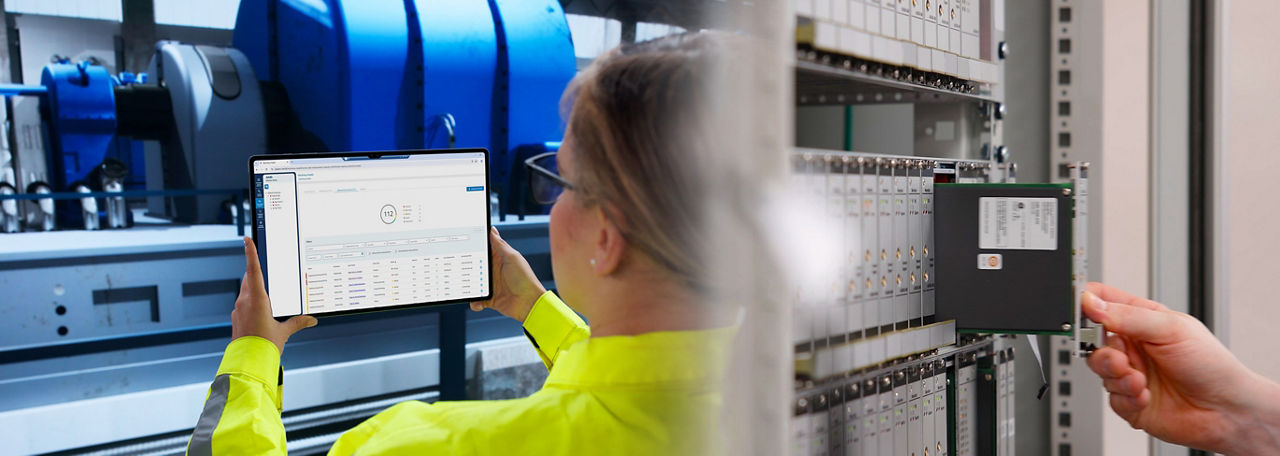
Emerson has updated its AMS 6500 ATG machinery protection system and AMS Machine Works asset-health software to support continuous transmission of turbomachinery data, extending the operating information available to engineers during lengthy startup and shutdown sequences.
AMS 6500 ATG version 5.0 and AMS Machine Works version 2.4 have been developed to operate together across machinery protection, condition monitoring, and analysis. The principal change is continuous, unlimited transmission of machine data from the protection system into the analytics platform, allowing detailed information to be retained across events that may continue for hours or days.
Transient conditions are particularly important in compressors, turbines, generators, and other high-criticality rotating equipment. A machine moving from standstill to normal operation can pass through changing vibration states, resonant frequencies, temperatures, mechanical clearances, and process loads, while shutdown produces another sequence of changing conditions as speed and load fall.
Steady-state condition monitoring provides valuable information once machinery has reached a stable operating point, but it captures only part of its mechanical behaviour. A vibration signature that appears acceptable at normal speed can change significantly while a rotor accelerates through a natural frequency, while coast-down data can expose behaviour that is difficult to isolate during normal production.
The updated systems maintain detailed data through those complete operating events. Analysts can subsequently review longer periods within AMS Machine Works, compare measurements as speed and load change, and retain the same information for longer-term trending after the transient has finished.
Data can also be tied directly to alarms, allowing a reliability engineer to assess the machinery behaviour immediately before and after an alarm rather than treating the threshold crossing as an isolated event. Trends in vibration and other measurements can therefore be considered as part of a developing sequence.
Operators continue to have access to live measurements while the machine is running, providing an immediate operational view alongside the deeper information required by vibration and reliability specialists. Separating those uses is important on critical assets because operating personnel may need a rapid indication of current condition while analysts require a much broader record for diagnosis.
“In complex operations, operators and technicians need precise operational insight, such as the ability to see when machinery reaches its natural frequency so they can improve control speeds,” said Ben Swisher, vice president and general manager of reliability solutions at Emerson.
He added that continuous transmission between the AMS 6500 ATG and AMS Machine Works gives operators, maintenance teams, and analysts access to the information required for both safe operation and longer-term assessment of asset health.
The AMS 6500 ATG combines machinery protection with predictive monitoring. Protection functions detect conditions that exceed defined operating limits and can initiate the appropriate response, including shutdown where necessary, while condition data supports analysis of developing mechanical problems before they reach protection thresholds.
Using the same measurement infrastructure for both functions gives engineers a common view of critical machinery without reducing the role of the dedicated protection layer. Sensors associated with rotating equipment can contribute to immediate protective decisions while supplying information for maintenance and reliability analysis.
Version 5.0 also introduces a web-server-based programmable dashboard within the AMS 6500 ATG. Users can configure up to five dashboard pages, each containing as many as 25 widgets, allowing different views to be created around operating, maintenance, or machinery-health requirements.
Available widgets include live measurements, trend displays, and Boolean alarm values. Machine components can be displayed alongside individual measurement points, helping operators associate a vibration, speed, or condition value with its physical position on the asset rather than seeing the information only as instrument tags.
Browser-based access makes those displays available through a standard interface and allows the configuration to be adapted to the equipment at a particular installation. A compressor train, turbine-generator set, or group of connected machines can therefore be presented according to the information most useful to the people operating and maintaining it.
Connectivity has also been revised, with the systems providing Modbus-independent communication between the protection and analytical functions. Industrial sites frequently contain several generations of control, protection, historian, and maintenance technology, so reducing unnecessary protocol dependencies can simplify management where the two AMS platforms are deployed together.
Cybersecurity remains part of that architecture as machinery-health systems become more connected. Protection equipment has traditionally occupied a relatively contained layer of plant infrastructure, while modern condition monitoring increasingly moves information between field equipment, workstations, servers, historians, and analytical applications.
Each connection has to be managed without compromising the deterministic behaviour expected from the machinery protection system. More extensive analytics therefore have to coexist with the separation and reliability required for equipment whose protection functions may ultimately be responsible for initiating an emergency shutdown.
The engineering case for capturing longer transient periods becomes stronger as operators seek more information from installed sensors while extending maintenance intervals. High-value turbines and compressors can be costly to stop for inspection, making their operating data an increasingly important part of decisions over maintenance scope and timing.
Startup and shutdown contain some of the most useful information because shaft behaviour changes as thermal expansion develops, oil-film conditions stabilise, rotor speeds pass through resonances, and process loads are introduced or removed. Continuous collection does not replace specialist interpretation, but it provides a more complete operating record from which that interpretation can be made.
The AMS updates consequently bring machinery protection, operator visibility, and predictive analysis closer together around the same rotating assets. Their practical value will be measured during the long transient events where a few minutes of high-resolution information is insufficient to explain how a turbine or compressor behaved across the complete operating cycle.