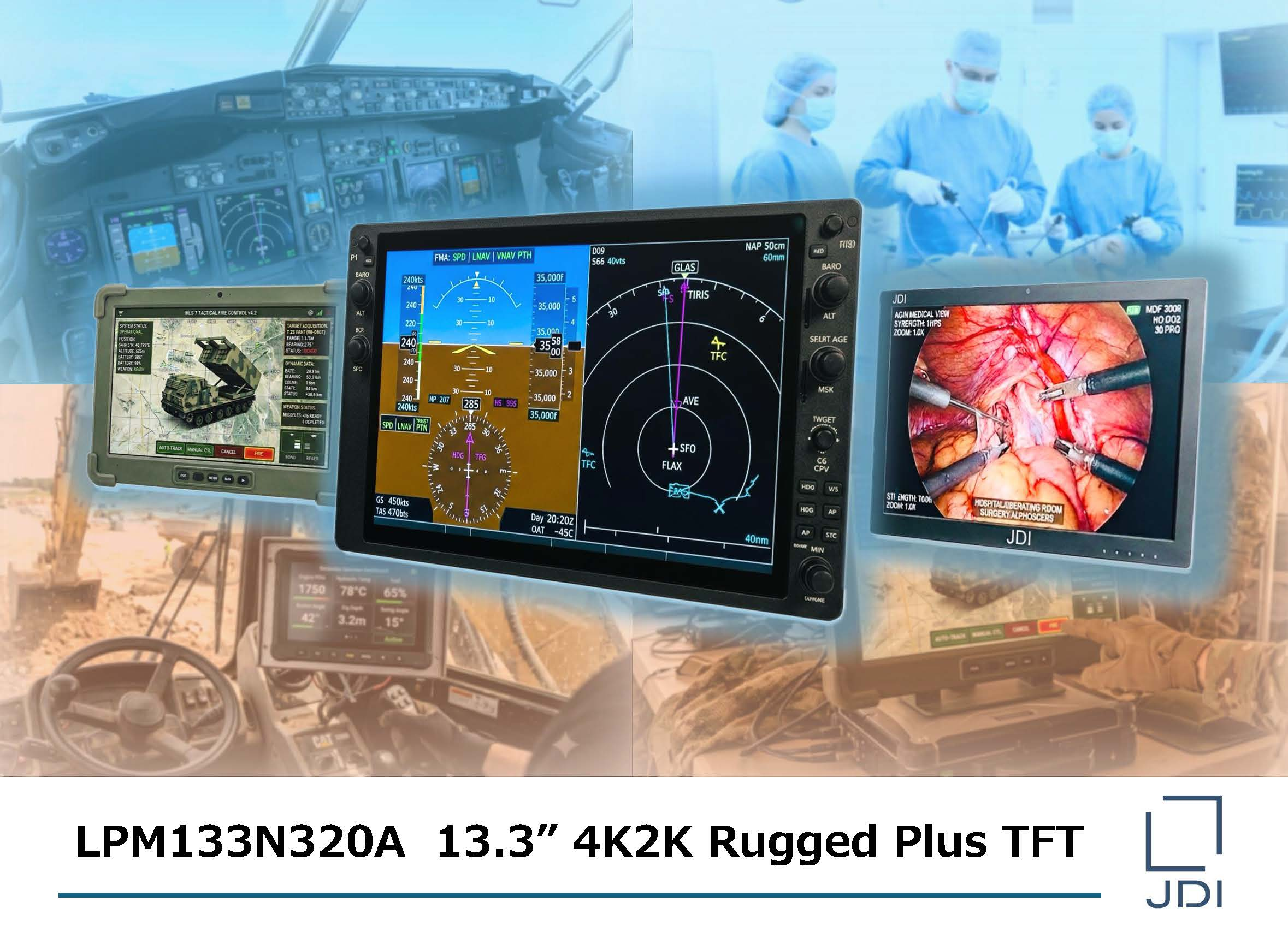
JDIT-K has introduced a 13.3-inch 4K2K Rugged Plus TFT display designed to combine high pixel density and brightness with the environmental performance required by industrial, scientific, medical, aerospace, and defence equipment.
The LPM133N320A uses an LTPS panel with a native resolution of 3840 × 2160 pixels and pixel density of 331ppi. JDIT-K specifies brightness of up to 1,200 nits, a typical contrast ratio of 1300:1, an 80% NTSC colour gamut, and 10-bit RGB data supporting more than 1.073 billion colours.
A second configuration, the LPM133N321A, adds an integrated projected-capacitive touchscreen. Both variants use IPS wide-viewing-angle technology and a four-channel eDP 1.4 interface operating at 5.4Gbps per channel.
The more consequential specification for industrial users is the operating-temperature range of -40°C to +85°C. High-resolution displays are readily available for consumer and office equipment, but systems deployed outdoors, in vehicles, diagnostic equipment, aerospace instrumentation, or other exposed environments have to maintain function well beyond conventional room-temperature conditions.
JDIT-K also specifies resistance to electrostatic discharge, mechanical shock, and vibration as part of its Rugged Plus construction. Those characteristics address failure mechanisms that are less prominent in fixed indoor displays but become important once equipment is mounted in a vehicle, transported between sites, exposed to repeated impacts, or installed close to heavy machinery.
The display is often one of the more vulnerable interfaces in such systems. A computer, sensor platform, or diagnostic instrument may remain electronically functional after an impact or temperature excursion, yet become unusable if the operator cannot read information or enter commands reliably.
Brightness contributes to that usability, although the 1,200-nit figure should not be treated as an outdoor-readability guarantee in isolation. Cover glass, coatings, optical bonding, surface reflections, viewing angle, enclosure design, and ambient illumination all affect the contrast seen by the user.
A higher-output backlight nevertheless gives system designers more latitude in conditions where conventional indoor panels can become difficult to read. That is particularly relevant to vehicle-mounted terminals, field instruments, and equipment operated in direct or reflected daylight.
Resolution creates a different set of engineering demands. Packing more than eight million pixels into a 13.3-inch panel provides sufficient density for detailed diagrams, maps, medical imagery, inspection interfaces, instrumentation, and dense multi-window displays without increasing the physical size of the operator console.
Driving those pixels also increases interface bandwidth and processing requirements. The four-lane eDP 1.4 connection provides the data path needed for the panel’s resolution and colour depth while using an interface already familiar to designers of embedded computing platforms.
The LTPS backplane supports that pixel density by providing higher carrier mobility than conventional amorphous-silicon TFT technology, allowing smaller transistor structures and more densely packed pixels. The technology is well established in compact high-resolution displays, but ruggedisation adds a separate layer of mechanical and thermal requirements around the panel.
Temperature is particularly awkward because several display characteristics change with it. Liquid-crystal response time, backlight output, electronic-component behaviour, adhesives, optical films, and touch performance can all vary as equipment moves between very cold and hot environments.
A wide-temperature LCD therefore removes only one part of the system-design problem. The finished product still has to qualify its processor, storage, power supply, connectors, cabling, touch controller, enclosure, seals, and any battery across the same operating envelope if the manufacturer intends to claim equivalent system-level performance.
The same qualification caveat applies to shock and vibration. Component-level robustness can make system compliance easier, but it does not certify the complete assembly automatically. Mounting arrangement, fasteners, bezel design, enclosure stiffness, cable routing, and mass distribution all influence how mechanical loads reach the panel.
JDIT-K says the new modules support a Zero Bright Dot Defect standard. Pixel-defect criteria become more significant in applications where small displayed features may represent measurement data, targeting information, diagnostic imagery, or alarms rather than entertainment content.
The optional projected-capacitive touchscreen introduces its own integration choices. Touch control can reduce the need for separate buttons and keyboards, but rugged use can involve gloves, moisture, contamination, thick cover lenses, electromagnetic noise, and other conditions capable of altering touch sensitivity.
That makes the touchscreen-equipped LPM133N321A a starting point for system design rather than a complete operator-interface solution. Equipment manufacturers still have to tune the touch stack around the intended cover material and user environment.
JDIT-K specifies a 70,000-hour LED backlight lifetime for the two modules. Actual service life will depend on operating brightness, duty cycle, temperature, thermal management, and the threshold used to define end of life, but the rating reflects the longer deployment cycles expected of industrial equipment compared with consumer electronics.
The company is making both modules available through its distribution partners for embedded, open-frame, and mobile equipment designs. Their industrial proposition is not simply that a 13.3-inch panel can display a 4K image; that capability ceased to be remarkable some time ago.
The more demanding part is retaining the resolution, brightness, colour depth, and operator interface when the surrounding equipment is cold, hot, moving, vibrating, or expected to remain supported for years. In rugged electronics, the useful display is the one still working after the specification sheet has been folded away.