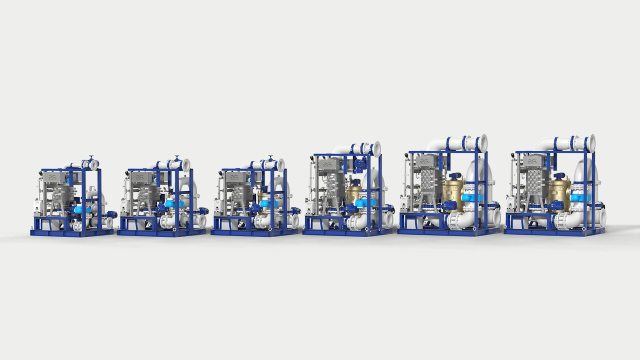
Alfa Laval has introduced a skid-mounted version of its PureBallast 3 Ultra ballast water treatment system, packaging filtration, ultraviolet treatment, piping, and controls into a factory-assembled module intended to reduce shipyard installation work.
PureBallast 3 Ultra Skid is available for ballast water flows from 32 to 600m³/h and is supplied fully assembled and factory tested. It joins Alfa Laval’s existing PureBallast configurations, giving shipyards and vessel designers another integration option rather than replacing the modular system.
The automated treatment process operates without chemicals, combining filtration with enhanced ultraviolet disinfection. Alfa Laval says it is designed to handle fresh, brackish, and marine water, including low-clarity conditions that can be demanding for UV equipment because suspended matter reduces the amount of light transmitted through the water.
Ballast water is carried by ships to manage stability, draught, trim, and structural loading as cargo and fuel conditions change. The environmental problem arises when organisms taken aboard in one region survive the voyage and are discharged somewhere else, potentially establishing invasive populations outside their original ecosystem.
International ballast water rules require vessels to limit the viable organisms and specified microbes discharged with that water. Treatment equipment has consequently become a standard part of the marine engineering package rather than an optional environmental system.
For shipyards, biological treatment performance is only one part of the integration problem. Filters, reactors, pumps, valves, pipework, controls, electrical equipment, maintenance access, and structural supports have to fit around machinery spaces already occupied by propulsion, utilities, fuel, ventilation, and other ship systems.
The skid arrangement moves more of that work away from the vessel. Alfa Laval supplies the treatment package with prefabricated piping and factory assembly completed, reducing the amount of component-by-component installation and testing required in the yard.
That approach is well established elsewhere in process engineering. Building a package in a controlled manufacturing environment can improve repeatability and allow equipment interfaces to be checked before the module reaches a site where access is tighter and installation delays affect a larger project schedule.
It does not make the system plug-and-forget. The shipyard still needs suitable ballast connections, electrical supplies, control interfaces, foundations, drainage, access for maintenance, and enough surrounding space to replace components during the vessel’s operating life.
The 32–600m³/h range gives the skid relevance across substantially different ballast duties, but flow rate is not the only variable affecting treatment. Water salinity, temperature, suspended solids, ultraviolet transmittance, filter loading, pump behaviour, and the vessel’s operating pattern can all influence system performance.
Filtration acts as the first barrier, removing larger organisms and particulate matter before water enters the UV stage. Reducing suspended material also limits shielding, where organisms can be protected from ultraviolet exposure by particles carried in the water.
The reactor stage then subjects the remaining biological load to ultraviolet light. Alfa Laval says the PureBallast 3 Ultra reactor architecture has been designed to maintain treatment performance while reducing power demand, an important consideration when large ballast pumps and other vessel systems are operating simultaneously.
Power consumption is particularly relevant during loading and discharge because treatment systems can operate at high flow for sustained periods. A lower-energy reactor can therefore reduce the electrical capacity required to support compliance rather than merely lowering annual energy consumption in isolation.
Unlike systems using active chemical substances, the PureBallast process does not require a treatment chemical to be stored and dosed onboard. Maintenance does not disappear: filters, lamps, sensors, cleaning equipment, valves, controls, and pumps still need access and lifecycle support.
The skid is delivered connectivity-ready for remote monitoring and service support. Diagnostic access can help operators and service teams analyse operating data without waiting for a vessel to return to a particular port, although its usefulness depends on the quality of the instrumentation and fault information recorded by the system.
PureBallast 3 Ultra, including the skid configuration, is type approved by the International Maritime Organization and the US Coast Guard. Those approvals demonstrate treatment against prescribed standards rather than relying only on the manufacturer’s process claims.
Alfa Laval says more than 10,000 PureBallast systems have now been ordered globally over almost two decades. A fleet of that size changes the engineering emphasis from initial technology acceptance towards service support, spare parts, installation efficiency, operating cost, and long-term equipment availability.
The skid version addresses part of that lifecycle problem at the front end. Standardising more of the installation before delivery can reduce yard engineering and variation while giving Alfa Laval greater control over the assembled treatment package leaving its production process.
There remains an obvious trade-off. A compact standardised skid suits projects where the machinery-space geometry allows it, but ships are not built around ballast equipment alone. Retrofit projects in particular can involve pipe routes and access restrictions that make distributed components easier to accommodate.
Alfa Laval is therefore retaining both installation approaches. Customers can use the skid where factory assembly reduces project work or specify the more flexible modular arrangement where vessel geometry demands it.
That is an incremental development rather than a reinvention of ballast water treatment, but mature regulated equipment markets tend to move in increments. Once compliance is established, installation hours, footprint, energy use, maintenance access, and serviceability are where engineering teams start finding the next worthwhile savings.