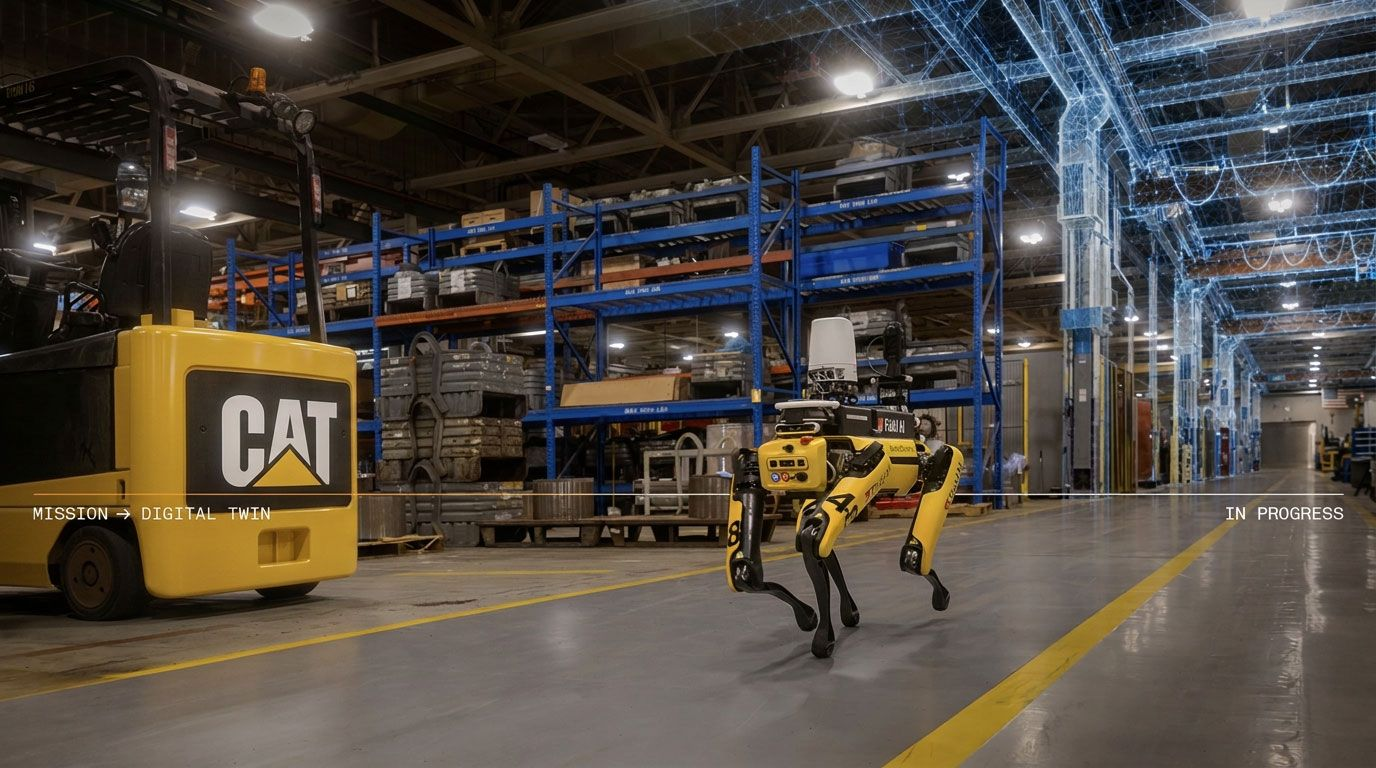
Caterpillar is collaborating with FieldAI to develop physical AI, robotics, autonomy, and digital-twin applications for factories and industrial jobsites. The programme combines Caterpillar’s engineering expertise and operational data with FieldAI’s robot-agnostic foundation models, with initial applications covering autonomous inspections, facility visibility, situational awareness, and operational optimisation.
The collaboration puts artificial intelligence into an environment considerably less forgiving than the office applications that have dominated much recent investment. Factories, mines, construction sites, and equipment yards contain moving machinery, people, changing surfaces, restricted areas, weather, dust, and incomplete information. An AI system operating in those surroundings must do more than produce a plausible answer; its decisions have to remain predictable enough to coexist with equipment capable of causing physical damage when something goes wrong.
FieldAI develops autonomy software intended to operate across different robotic platforms rather than being built around one machine. Caterpillar says the company’s foundation models combine large amounts of operational data with an ability to work across complex and changing industrial environments where traditional automation can struggle. FieldAI already has deployments spanning hundreds of sites worldwide, giving the partnership a base of operating experience rather than beginning with a laboratory prototype.
Autonomous inspection is one of the first applications. Mobile robotic systems can collect repeated observations in areas where manual inspection is hazardous, time-consuming, or difficult to schedule, giving engineering teams more frequent information without requiring a person to make every data-gathering visit. That does not remove the maintenance decision from human operators, but it can shift labour away from routine collection towards interpreting exceptions and planning the work needed to correct them.
Digital twins form another part of the programme. Caterpillar and FieldAI intend to use operational information to build models of jobsites and manufacturing facilities that provide current visibility of equipment, infrastructure, and activity. Those models can then support simulation and analysis before a layout, work sequence, or production process is changed physically, reducing the amount of experimentation that has to take place around live operations.
Caterpillar already has a substantial programme in that area. In January, the manufacturer expanded its work with NVIDIA and said it was building physically accurate factory digital twins using Omniverse libraries and OpenUSD. Its manufacturing data platform is also being used with an NVIDIA AI Factory to support activities including forecasting and scheduling. The FieldAI relationship therefore adds robotic perception and autonomy to an existing manufacturing digitalisation programme rather than creating an entirely new technology direction.
The additional capability is particularly relevant where fixed automation is difficult to justify. Traditional industrial robots perform well when the process, geometry, and work area can be tightly controlled, but jobsites and large factories contain activities that move over time or take place in spaces designed primarily for people and mobile equipment. A robot capable of adapting to those conditions could address tasks that would otherwise remain manual because conventional automation requires too much dedicated infrastructure.
Adaptability comes with a different validation burden. Highly constrained automation can be inflexible precisely because its permitted behaviour has been engineered and tested in detail. A general-purpose robotic system is expected to cope with more variation, increasing the importance of uncertainty awareness, fail-safe behaviour, communications resilience, supervision, and clear limits on what the machine is allowed to do when its observations do not match previous experience.
FieldAI says its models combine data-driven AI with physics-based reasoning and uncertainty awareness, and Caterpillar selected the company for its ability to deploy in dynamic industrial environments. The robot-agnostic approach could allow similar autonomy capabilities to operate across several machine types, but software portability does not remove the physical differences between platforms. Payload, dimensions, sensor position, stopping distance, ground conditions, and available actuation still define what any individual machine can safely achieve.
Caterpillar’s own factories give the partnership a useful proving ground. The manufacturer can test inspection, digital-twin, and situational-awareness systems around production operations where process data and engineering support are already available before attempting broader deployment across less controlled customer environments. The company has said improved visibility is intended to help production teams identify opportunities to improve safety and optimise flow, tying the work directly to manufacturing rather than treating physical AI solely as a future equipment feature.
The scale of Caterpillar’s industrial footprint makes that potentially significant. The company reported 2025 sales and revenues of $67.6 billion and manufactures construction and mining equipment, engines, industrial gas turbines, and diesel-electric locomotives. Its machines operate through a global customer and dealer network, so even selective adoption of inspection robotics or autonomy tools would expose the technology to a much broader range of working conditions than a single demonstration site.
The collaboration will also use NVIDIA accelerated computing and Omniverse technologies, allowing digital models and robotic systems to draw on the same broader infrastructure Caterpillar is already developing for manufacturing and autonomous equipment. That common technology base may help move applications between simulation and physical deployment, although real operating data will remain essential if models are to reflect changing sites rather than idealised digital versions of them.
No commercial rollout schedule, number of robots, factory deployment count, or financial value has been disclosed. The announcement should therefore be treated as a development collaboration rather than evidence that physical AI has already been deployed across Caterpillar’s manufacturing system. Those missing figures also provide useful markers for what needs to come next: named applications, operating hours, safety performance, productivity data, and evidence that autonomous systems remain dependable when industrial environments change around them.
Physical AI has accumulated much of the familiar technology-sector enthusiasm, but Caterpillar’s involvement puts the idea against production lines, heavy machinery, and jobsites where capability is measured through uptime, safety, and output. FieldAI brings autonomy technology already used across hundreds of sites; Caterpillar brings factories, machines, engineering data, and industrial scale. The collaboration becomes materially important if those ingredients produce systems that perform repeatable work without requiring the real world to be rearranged for the robot first.