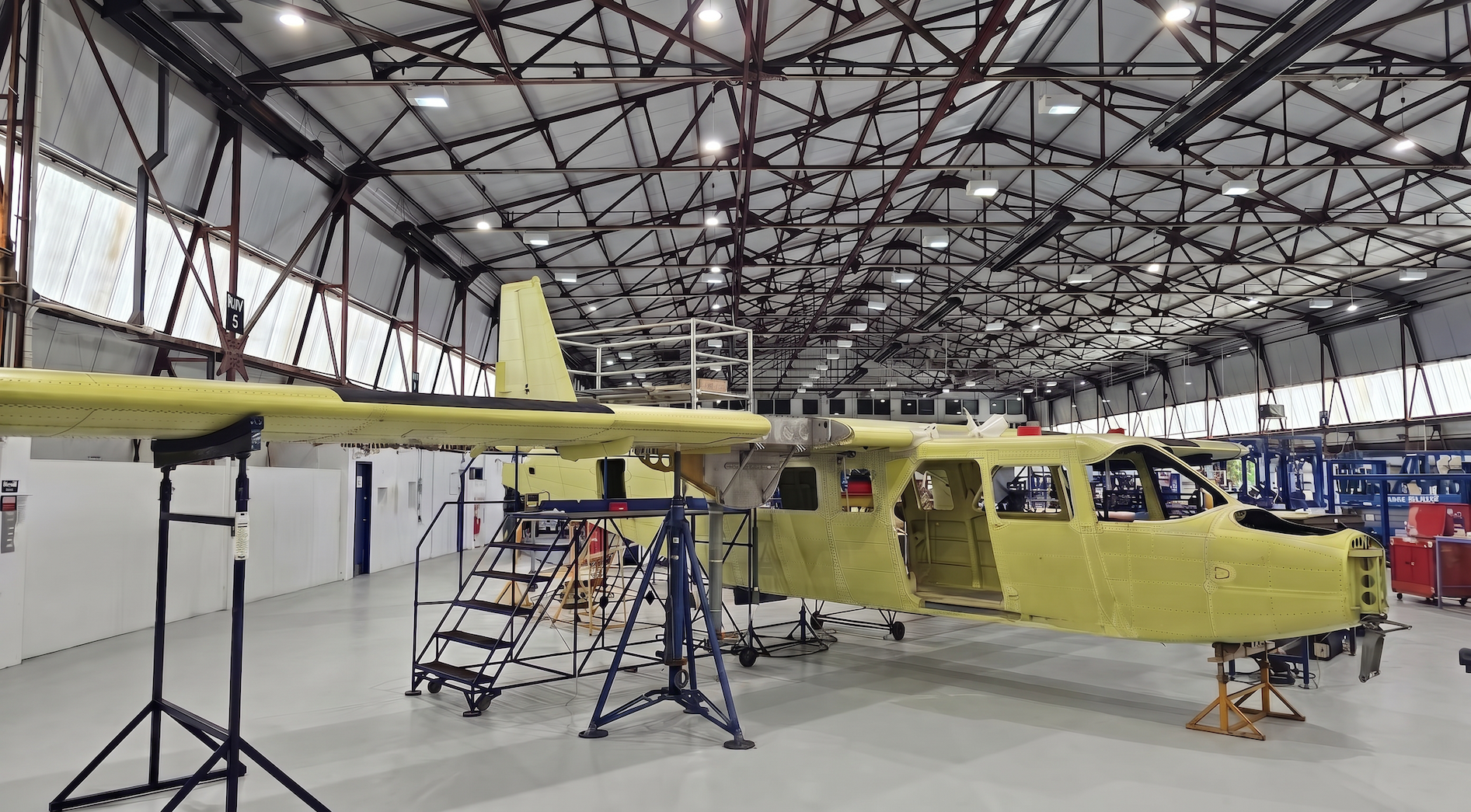
Britten-Norman’s first Islander from its fully reshored UK production line has entered ground testing at Bembridge, taking the aircraft from final assembly towards its planned first flight in September.
Britten-Norman is building the BN2B-26 for the Falkland Islands Government Air Service, which is due to receive the aircraft after flight testing and customer preparation are complete. The programme is the first complete Islander manufacturing cycle at Bembridge since the company returned major assembly work to the Isle of Wight.
The aircraft has progressed through structural assembly, engine and propeller installation, electrical work, brakes, flight controls, and other systems before entering its current test phase. Ground testing allows the integrated aircraft to be exercised progressively before flight, covering systems and functions that can be checked without adding the additional risks of airborne operation.
The latest milestone follows a June update showing the aircraft at 75% structural completion. At that point, the reshored Islander programme was entering final assembly, while a second airframe was approaching 25% completion and components for follow-on aircraft were already in manufacture.
That second aircraft is continuing through the line behind the first, providing an early indication that Bembridge is developing a production flow rather than completing a single showcase airframe. Repeatability is the more demanding measure of a reshoring programme because jigs, tooling, material supply, inspection, and workforce processes have to function across successive builds.
The production move reverses a model under which major Islander assemblies were manufactured overseas before final assembly took place in Britain. Britten-Norman began restoring full civil production to Bembridge in 2023 and has since invested in CNC equipment and other manufacturing capability while increasing its workforce by more than 40%.
Reshoring an established aircraft involves considerably more than relocating assembly benches. The manufacturer must recreate or requalify manufacturing processes, supplier routes, tooling, inspection methods, production records, skills, and configuration control while continuing to meet the standards attached to an existing certified product.
The Islander itself is deliberately conventional compared with many current aerospace development programmes. The BN2B-26 is a piston-powered utility aircraft designed around short-field performance, straightforward operation, and access to locations where runway length and ground infrastructure are restricted.
Britten-Norman lists the variant with a maximum take-off weight of 6,600lb, or 2,994kg, and a maximum cruise speed of 142kt. Published performance data give a take-off ground roll of 621ft and a distance of 1,218ft to clear a 50ft obstacle, depending on operating conditions and configuration.
The standard commuter layout carries nine passengers, while the airframe can be adapted for freight, air ambulance, executive, surveillance, and other specialist roles. The aircraft’s combination of low-speed handling, short-strip capability, and relatively simple support requirements has kept the design in service in remote and island markets for decades.
Those characteristics align closely with operations in the Falkland Islands. FIGAS uses aircraft to connect settlements and islands where short airstrips, rapidly changing weather, passenger movements, freight, and medical requirements create an operating environment very different from scheduled regional airline networks.
The customer relationship gives the Bembridge production restart a defined route into service. A factory can demonstrate that it has rebuilt structural capability relatively early in a programme, but delivery requires assembly, systems integration, ground testing, flight testing, documentation, rectification work, customer preparation, and final handover to operate as one controlled process.
Ground testing is where several of those activities begin to converge. Electrical, mechanical, propulsion, braking, and control systems have already been installed individually; the current phase checks whether they function correctly as parts of an integrated aircraft before the programme moves to flight.
First flight will add another level of evidence, but it will still not complete the manufacturing cycle. Flight-test findings can produce adjustment or rectification work, and the aircraft must subsequently be prepared to the customer’s agreed configuration before delivery.
The second airframe progressing behind it is equally relevant to the industrial programme. Reshoring only becomes a sustainable manufacturing change when the plant can reproduce the first aircraft’s quality without rebuilding the production system for every subsequent unit.
Britten-Norman has already demonstrated that Bembridge can take the first aircraft through structural build and into integrated ground testing. A successful September first flight would extend that record into flight validation; customer delivery will be the point at which the reshored line has completed an entire commercial aircraft cycle.