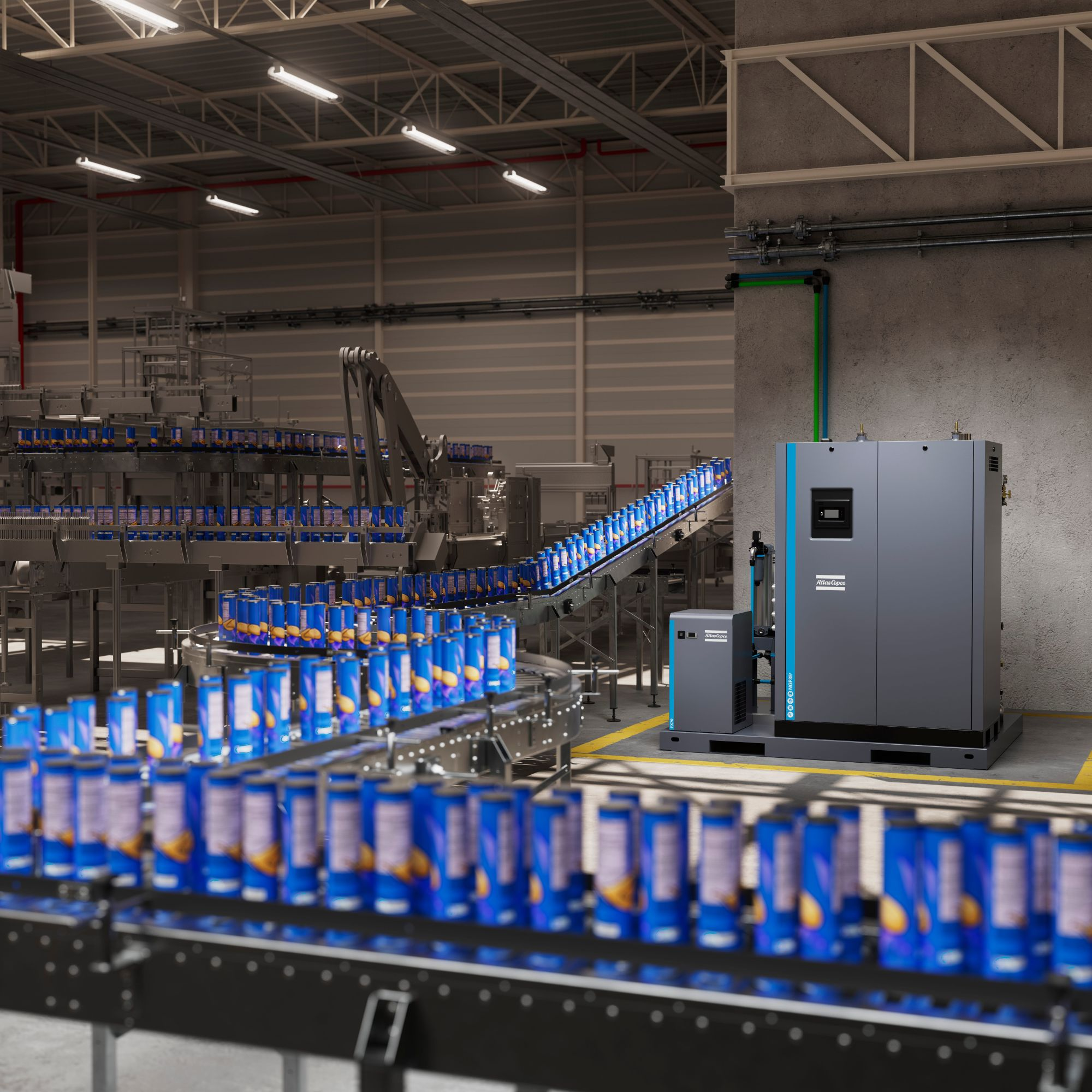
Atlas Copco will introduce an integrated nitrogen-generation skid for modified atmosphere packaging at PPMA Show 2026, combining gas generation, air treatment, purification, storage, and controls in a pre-engineered package for food and beverage manufacturers.
The system is built around the company’s NGP+ pressure swing adsorption nitrogen generator and is designed to connect to an existing compressed-air installation. Drying, filtration, purification, storage, and control equipment are supplied as an integrated and tested package rather than being specified as separate systems on site.
For modified atmosphere packaging, nitrogen is used to alter the gas composition surrounding a food product before the pack is sealed. Reducing oxygen can slow oxidation and aerobic spoilage, while carefully selected nitrogen and carbon-dioxide mixtures can help protect product quality and package integrity during storage.
The new skid is intended to produce nitrogen at purities between 99% and 99.9%, covering the range required by many MAP processes without forcing every application to operate at the highest possible gas purity. That distinction has a direct effect on energy consumption because higher purity requires the generator to remove progressively more oxygen from the compressed-air stream.
Chris Hyde, Business Line Manager for the Air and Gas Applications division at Atlas Copco Compressors UK, said: “Most manufacturers are used to buying nitrogen as a consumable, but in modified atmosphere packaging it is an integral part of the production process.”
Delivered cylinders and liquid nitrogen move much of the production equipment away from the food factory, but they introduce dependence on storage, scheduled deliveries, transport, supplier availability, and the handling infrastructure required to receive and distribute the gas.
On-site generation reverses part of that dependency. The manufacturer owns and maintains more equipment, consumes additional electricity and compressed air, and needs sufficient redundancy for a production-critical utility, but avoids organising repeated deliveries of nitrogen from an external supplier.
The commercial comparison therefore extends beyond the unit price of gas. Compressed-air capacity, power consumption, peak flow, gas purity, storage volume, maintenance, available floor space, food-production requirements, and the cost of a packaging-line stoppage all influence the economics of the installation.
Pressure swing adsorption separates nitrogen and oxygen using carbon molecular sieve material. Two adsorber vessels operate alternately, allowing one vessel to produce nitrogen while the other regenerates. The cycle is controlled according to flow, purity, pressure, and operating conditions.
Atlas Copco’s current NGP+ architecture continuously checks nitrogen output and can redirect gas that does not meet the selected purity. On the inlet side, feed-air monitoring is designed to prevent unsuitable compressed air from entering the generator and damaging performance.
The company will also highlight the NGP 8+, the smallest unit in its NGP+ 8–130 range. Where a manufacturer requires a standalone generator rather than the complete MAP package, the range can supply nitrogen up to 99.999% purity for processes that genuinely require a more demanding specification.
The generator’s controls also adjust the PSA operating cycle when nitrogen demand falls or ambient conditions change. Atlas Copco’s Variable Cycle Saver algorithm is designed to optimise cycling at lower demand and in colder conditions, with the company stating additional energy savings of up to 40% in suitable operating circumstances.
That part-load capability is relevant in food manufacturing because gas consumption rarely remains fixed. Product changes, line cleaning, shift patterns, upstream interruptions, planned maintenance, seasonal demand, and different packaging formats can all move nitrogen demand well below the peak used when sizing the installation.
An oversized generator operating continuously for a peak that occurs only occasionally can waste compressed air and electricity. Matching production more closely to actual consumption is therefore as important as selecting the correct nominal flow when evaluating on-site generation.
Atlas Copco will use PPMA to place the skid alongside other factory utilities rather than showing it as an isolated gas product. The company’s TCX 4-90A industrial chillers combine refrigeration, pumping, water storage, and control for process cooling, while filtration and oil-free compressed-air technology will also form part of the display.
Those systems intersect frequently in food plants. Compressed air can operate actuators and machinery, nitrogen protects packaged products, filtration controls contamination risks, and chilled water stabilises process temperatures. Poorly matched utilities can restrict production even when the packaging machine itself has unused capacity.
The engineering contribution of the MAP skid is consequently integration rather than a new method of separating nitrogen. PSA technology is well established; bringing the generator, treatment stages, storage, controls, and monitoring into a tested package reduces the number of interfaces left for the plant engineer or installer to specify independently.
Whether on-site production delivers a lower total cost will still vary by factory. A plant consuming large, predictable volumes of nitrogen has a different business case from one running intermittent packaging shifts, while an existing compressed-air system close to its capacity limit may require additional investment before the generator can be installed.
The new system gives manufacturers another option for treating nitrogen as production infrastructure rather than a delivered consumable. PPMA will provide the first public UK showcase, but the useful comparison will ultimately take place in individual factories, where gas purity, demand profile, energy consumption, and delivery costs can be measured against one another rather than against a brochure.