Emerson’s Branson business will present a group of welding and joining technologies at MSV 2026 in Brno, combining ultrasonic, heat-staking, laser, automation, and connectivity systems aimed at manufacturers working across plastics and mixed-material assemblies.
The display is scheduled for 6 to 9 October at the Brno Exhibition Centre, where MSV will run alongside the WELDING, PLASTEX, IMT, PROFINTECH, and FOND-EX fairs. Branson’s line-up covers several joining methods rather than treating one process as suitable for every combination of material, component geometry, production rate, and validation requirement.
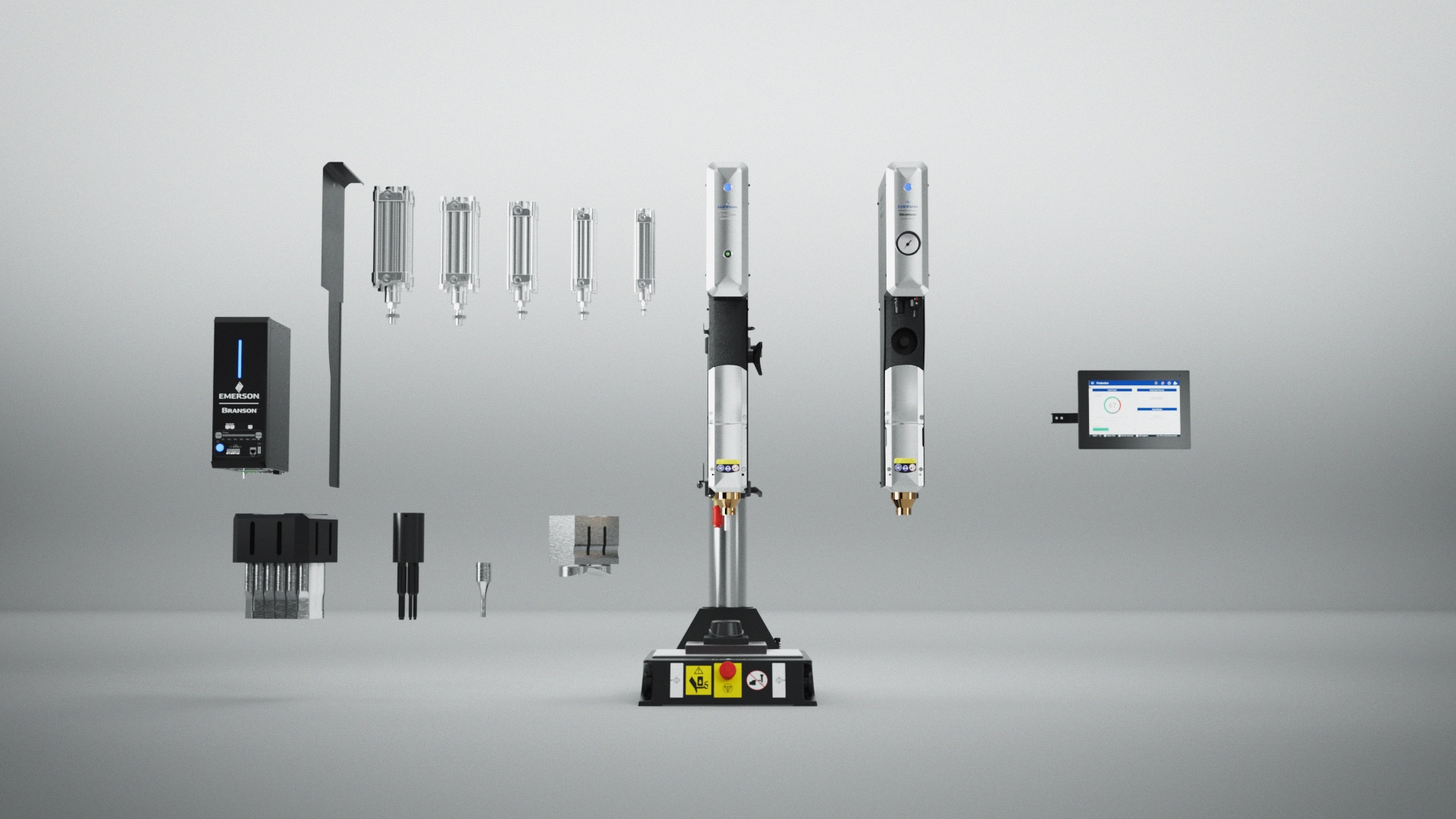
The Polaris ultrasonic platform provides the clearest example of that configurable approach. Branson offers actuator and power-supply combinations that can be assembled around the application, with systems capable of operating as stand-alone equipment or being integrated into automated production machinery.
Current Polaris specifications include weld modes based on time, energy, power, ground detection, absolute distance, and collapse distance. Connectivity options include Industrial Ethernet, OPC UA, Ethernet, and conventional user I/O, allowing the welding system to exchange operating information with line controls and higher-level production systems.
That data connection becomes more useful as joining moves deeper into automated and validated manufacturing. A weld can occupy only a fraction of the overall cycle, yet its quality may determine whether the finished assembly survives pressure, vibration, sterilisation, environmental exposure, or long-term mechanical loading.
Process records therefore need to travel with the physical joint. Manufacturers increasingly want cycle conditions, alarms, recipes, force or displacement data, and machine status to be available to the wider production system, particularly where traceability or regulated validation makes end-of-line inspection alone insufficient.
The display also includes Branson’s GPX PulseStaker platform, which uses localised heating and cooling to form thermoplastic stakes around another component. The process is intended for assemblies where surrounding parts are sensitive to heat or vibration, including sensors, printed circuit boards, and other delicate electronic elements.
Because the heating is concentrated at individual staking points, the process can join dissimilar materials and complex three-dimensional geometries without heating the whole component. The MSV demonstration combines the technology with a collaborative robot, illustrating how a local joining process can be moved around a part automatically rather than requiring the product to be transferred between several fixed stations.
Laser welding addresses a different class of plastic assembly. The GLX-1 uses Branson’s Simultaneous Through-Transmission Infrared process for micro and small parts, directing laser energy through one component into the joint interface while servo control manages the mechanical conditions applied during the weld.
Emerson’s current GLX-1 specification provides up to 500W at the weld line and offers optional OPC UA and Ethernet/IP data interfaces alongside USB. The machine is designed around smaller, more delicate plastic components and applications where a non-vibratory joining process can avoid disturbing electronics or other sensitive features already present in the assembly.
The exhibition package also includes special automated machinery built around Branson’s core processes. Joining equipment rarely operates in isolation at production scale: feeding, orientation, fixturing, guarding, robotics, inspection, unloading, and interaction with upstream and downstream stations determine whether the weld process can maintain the required takt time.
Branson’s connectivity gateways address the same system-level problem from the data side. The Data Interface Gateway can connect up to ten welding machines to a customer’s IT network through OPC UA, while a Fieldbus Interface Gateway links machines to line-level automation and a Service Interface Gateway provides secure remote access for diagnostics and software support.
Bringing those functions together reduces the gap between proving a joining process and running it repeatedly inside an automated factory. A development system can establish the operating window, but production also needs machine control, recipe management, alarms, traceability, maintenance, and a predictable interface with the rest of the line.
The engineering trade-offs remain process-specific. Ultrasonics can deliver fast cycle times but introduces vibration; heat staking can be useful for mixed-material assemblies but is tied to moulded thermoplastic features; laser welding avoids mechanical vibration but depends on material optical behaviour and joint design. Automation cannot erase those constraints, only make a suitable process more repeatable.
MSV’s 2026 programme places Industry 4.0, digital factory technology, machining, forming, plastics, welding, robotics, measurement, and automation inside the same event. That gives the Branson display a broader industrial setting than a stand-alone product launch, particularly as manufacturers try to connect specialist joining stations with plant-wide production and quality systems.
The useful test at Brno will be how convincingly those technologies operate as parts of one manufacturing architecture. Branson is showing separate ultrasonic, heat-staking, laser, automation, and connectivity products; the industrial value comes from whether process development, machine integration, data capture, and service support can be carried through without forcing each production line to be engineered from scratch around an isolated welder.