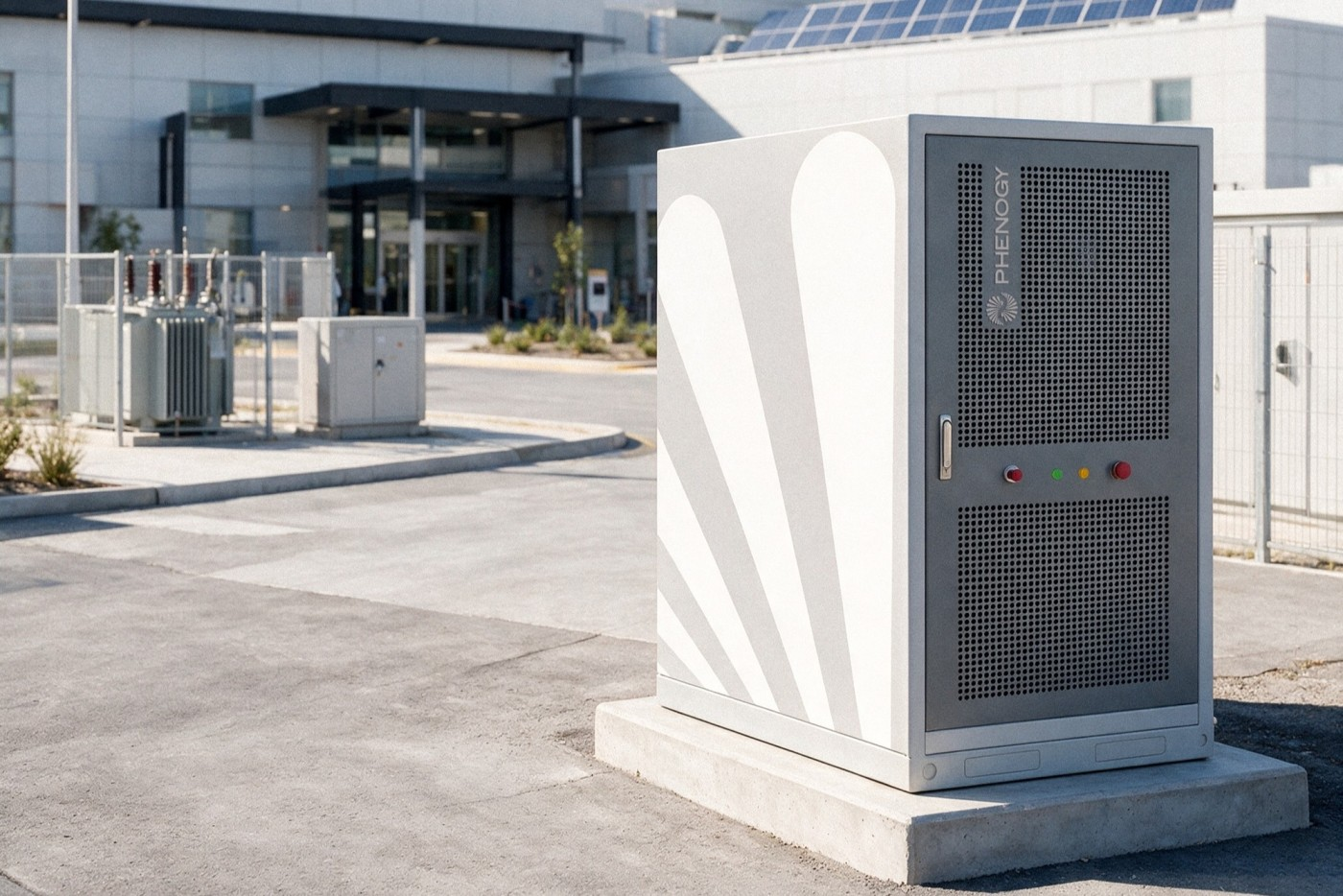
HEIDELBERG is moving part of its industrial manufacturing base into stationary energy storage, with subsidiary HD Advanced Technologies preparing to manufacture complete sodium-ion battery systems for Swiss technology company PHENOGY.
The German engineering group confirmed the programme in its first-quarter update as part of a wider diversification strategy. HD Advanced Technologies will handle industrial manufacturing across much of the PHENOGY system value chain, covering procurement, production, rollout, installation, service, and maintenance.
The companies are also preparing a joint venture intended to develop and manufacture sodium-ion battery cells using PHENOGY’s cell chemistry and a specialised printing process from HEIDELBERG. That second stage would move the relationship deeper into electrochemical production rather than limiting HEIDELBERG to assembly of finished storage cabinets.
The framework was initially announced in July, but its inclusion in the 19 August trading update places the project directly inside HEIDELBERG’s current industrial strategy. The company is seeking to reuse manufacturing, electronics, automation, assembly, controls, and service capabilities developed around printing machinery in markets with different demand cycles.
Under the manufacturing arrangement, HD Advanced Technologies is expected to produce cabinets, containerised storage systems, and related equipment initially in Germany for European customers. The partners have also discussed future US manufacturing for the North American market.
The production scope extends beyond fabrication of an enclosure. Complete stationary storage systems require battery management, power electronics, controls, electrical protection, thermal management, cabling, mechanical assembly, system testing, software, and integration with the site where the equipment will eventually operate.
Sodium-ion chemistry is attracting industrial attention because it can avoid lithium and cobalt within the active cell materials and use more widely available raw materials. It does not automatically replace lithium-ion technology: energy density, cycle life, temperature performance, cost, weight, physical volume, and supply-chain maturity all influence which chemistry suits a given application.
Stationary storage is less constrained by mass than automotive applications, leaving more room for technologies where lower material dependency or different cost structures can offset reduced energy density. Systems deployed beside industrial facilities, renewable plants, or grid infrastructure can often tolerate a larger footprint than a battery installed inside a vehicle.
The proposed cell joint venture would introduce a considerably different manufacturing challenge from assembling storage systems. Cell production involves electrochemical materials, electrode formation, precision coating or printing, controlled handling, assembly, electrolyte management, formation cycling, quality testing, and strong statistical control over process consistency.
PHENOGY would contribute its sodium-ion chemistry and cell design, while HEIDELBERG intends to bring a specialised printing process into the manufacturing route. The partners are still establishing the prerequisites for that venture, so it should be treated as an industrialisation programme under development rather than an operating cell factory.
The system-manufacturing agreement is more immediate. HEIDELBERG already has capabilities in electronics production, automation, mechanical manufacturing, assembly, power electronics, and service. Those provide some of the infrastructure needed to industrialise storage equipment without recreating an engineering organisation from zero.
The model also gives PHENOGY access to an established manufacturing partner. Developing a chemistry and storage architecture requires different resources from building regional procurement, factory quality systems, electronics assembly, installation teams, maintenance capability, and an international service network.
For HEIDELBERG, diversification offers a route to use its existing industrial assets in markets less directly tied to commercial printing. First-quarter incoming orders were €537 million, compared with €559 million a year earlier, while sales fell to €404 million from €466 million. The company described the underlying environment as challenging and is pursuing several strategic initiatives beyond its traditional equipment business.
Jürgen Otto, chief executive of HEIDELBERG, said the financial year was focused on investments aligned with the company’s strategic agenda and intended to create additional growth potential. Energy storage sits alongside other moves into industrial technologies, power electronics, automation, and precision engineering.
The European industrial context strengthens the rationale for regional battery manufacturing. Policymakers and customers are increasingly concerned with supply-chain resilience, raw-material exposure, and retaining more manufacturing value within Europe. Sodium-ion chemistry changes some of those material dependencies, although it does not remove the need for competitive cell production, electronics, quality systems, and scalable supply chains.
Several material questions remain unanswered. HEIDELBERG and PHENOGY have not disclosed the planned production volume, capital investment, factory location for any cell operation, unit capacities, or a firm timetable for the proposed joint venture. Those details will determine whether the cell programme develops into a substantial new manufacturing activity.
The first industrial step is clearer: HD Advanced Technologies is taking responsibility for production and lifecycle support of complete PHENOGY storage systems. If that programme scales, HEIDELBERG will have moved existing mechanical, electrical, automation, and service capability into a new equipment market before the more ambitious cell-manufacturing project has to prove itself.