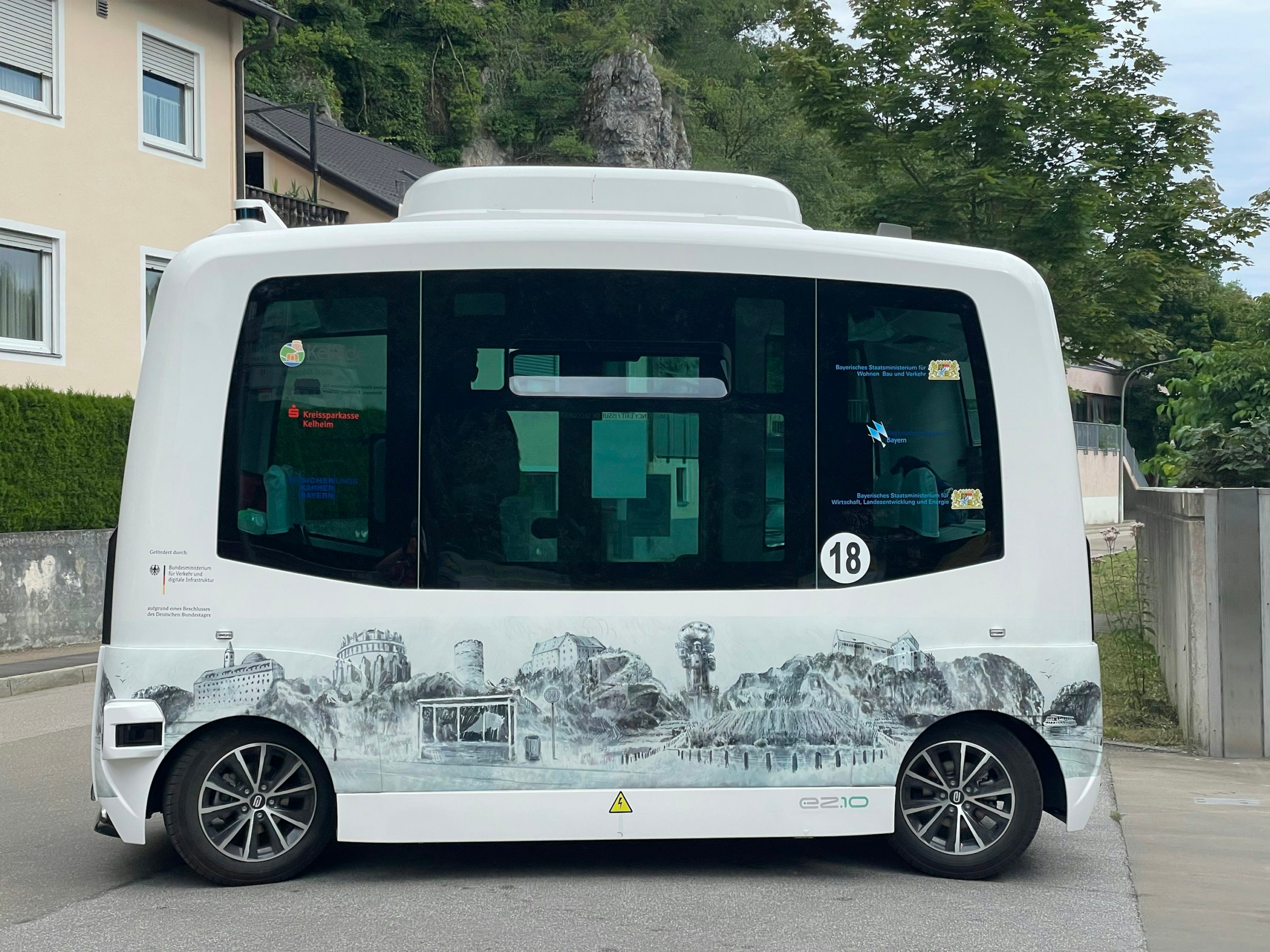
Karsan has begun carrying passengers with its Autonomous e-ATAK at Efteling in the Netherlands, putting the Level 4 electric bus onto a six-kilometre route that includes public roads and mixed traffic.
The service began on 12 August between the Efteling Hoofdingang and Wonderhotel stops, connecting the attraction’s main public transport hub with hotels, accommodation, and other visitor facilities. Passengers can use the service free of charge during a pilot expected to run for around two months.
The route gives the project a more demanding operating environment than an autonomous shuttle confined to a closed campus or segregated lane. Karsan says the vehicle will run among cyclists, pedestrians, hotel traffic, and conventional road vehicles, requiring the automated driving system to deal repeatedly with ordinary road users rather than a tightly controlled demonstration course.
The e-ATAK operates at SAE Level 4 within its defined operating domain. The system is intended to complete the driving task without continuous intervention by a human driver when the environmental and route conditions remain inside that domain.
The Netherlands Vehicle Authority, RDW, is involved in the project alongside Arriva, the Province of North Brabant, the Municipality of Loon op Zand, Dutch Automated Mobility, SmartwayZ.NL, Applied Autonomy, and autonomous-driving technology company ADASTEC. The project was formally launched at Efteling on 10 August.
That list of partners illustrates the amount of work required to turn an autonomous vehicle into a passenger operation. Vehicle engineering is only one component: road permission, fleet operation, risk management, infrastructure, insurance, passenger handling, and local-authority involvement all have to be resolved before an automated bus begins routine journeys.
Karsan describes the Efteling service as the first autonomous bus operation on public roads in North Brabant. It is the company’s second Dutch autonomous deployment following earlier work at Rotterdam The Hague Airport, providing another operating reference under the country’s regulatory framework.
The underlying e-ATAK is an eight-metre electric city bus. Karsan specifies a 230kW TM4 traction motor producing 2,500Nm and a maximum range of up to 300km, while the vehicle is designed for up to 52 passengers in its conventional configuration.
Autonomous operation adds a separate sensing, computing, and control layer to that electric platform. Those systems must identify road users, locate the vehicle accurately, interpret its operating environment, and issue steering, acceleration, and braking commands while retaining the safety architecture required for passenger transport.
Repeated service is a more useful test of that system than a single successful demonstration. The vehicle has to negotiate the same junctions, stops, pedestrians, cyclists, and traffic interactions throughout a working day while maintaining predictable journey times and sufficient availability for passengers to treat it as transport rather than an experiment.
The electric drivetrain creates its own operating constraints. Charging has to fit around service schedules, auxiliary electrical demand affects usable range, and an automated vehicle still needs conventional maintenance for brakes, tyres, suspension, doors, heating, cooling, and accessibility equipment. Autonomy does not remove the bus from normal fleet engineering.
Where the technology changes the operating model is in the relationship between driving, monitoring, and fleet support. Moving towards regular Level 4 operation requires operators to establish how vehicles are supervised, how faults are handled, who responds when the automated system cannot continue, and how passengers are supported when no conventional driver is responsible for every journey.
Karsan says Autonomous e-ATAK vehicles have already accumulated passenger operations across multiple countries and use cases. The expansion from airports and controlled sites into mixed public traffic increases the value of that operating history because the system encounters a broader range of behaviours and conditions.
Bus routes offer some practical advantages for automated transport. They are repetitive, stops are known in advance, and the operating domain can be mapped more tightly than an open-ended taxi service. Those characteristics reduce the problem compared with unrestricted driving, although they do not eliminate unpredictable road users, changing weather, roadworks, or vehicle faults.
The Efteling pilot will therefore be judged on fairly ordinary transport measures as much as autonomous-driving performance. Reliability, journey completion, passenger boarding, dwell times, charging, maintenance, and the ability to operate alongside conventional traffic will determine whether the route can progress beyond a short trial.
The useful evidence will accumulate after the launch ceremony has been forgotten. If the e-ATAK can complete repeated public-road journeys throughout the pilot without its operating model becoming disproportionately labour-intensive behind the scenes, North Brabant will provide Karsan and its partners with a stronger case for extending autonomous buses beyond carefully bounded demonstrations.