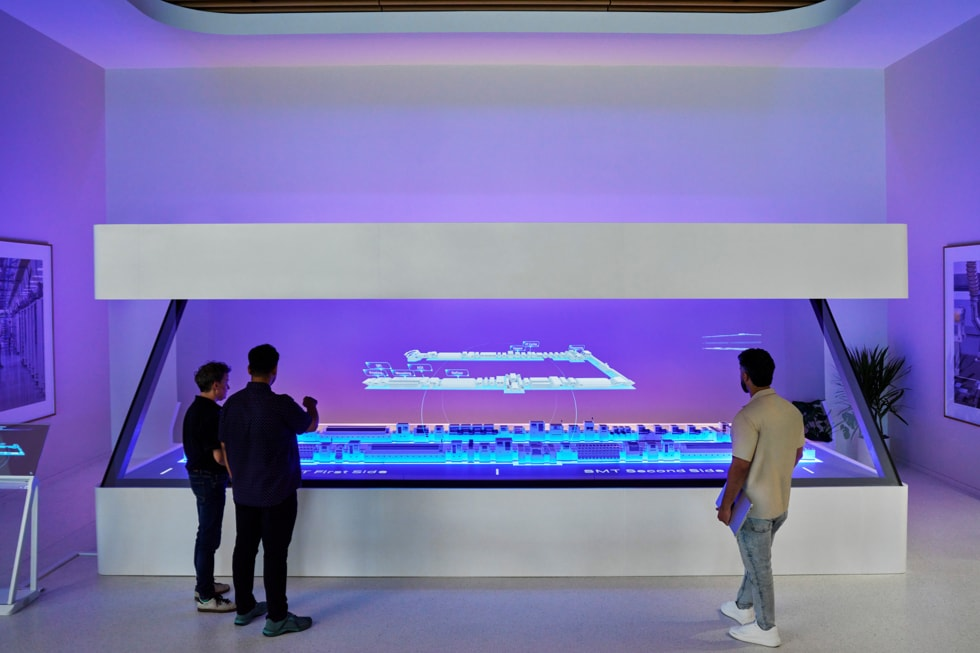
Apple has opened a 20,000-square-foot Advanced Manufacturing Center in Houston, offering small and medium-sized US businesses hands-on training in automation, printed circuit board assembly, machine-learning quality control, and factory processes.
The centre occupies part of the same Houston facility that manufactures and ships Apple’s advanced AI servers. Mac mini production is also due to begin at the site later this year, placing the training operation alongside active electronics manufacturing rather than separating it into a conventional classroom facility.
Apple is offering the programme without charge to participating businesses. The curriculum combines classroom material on advanced manufacturing and final assembly with practical workshops using representative production equipment, allowing participants to work directly with some of the processes discussed during training.
Printed circuit board assembly is among the areas covered, with the programme addressing design considerations as well as production. That connection between product design and factory behaviour is particularly relevant in electronics, where component placement, test access, panel layout, thermal constraints, connectors, and assembly sequence can affect production long before a board reaches the line.
The first cohort is also working on advanced automation and machine-learning-driven quality control. Participants are being trained to respond to simulated production problems, use factory-floor equipment, assemble products, and carry out laser-etching operations.
For smaller manufacturers, access to production equipment without interrupting their own factory can remove one barrier to evaluating automation. A company may understand that machine vision or a robot could potentially improve a process while lacking the engineering time, spare equipment, or available line capacity to experiment safely during normal production.
A training centre cannot reproduce every production environment, but it can expose engineers and managers to the practical questions behind an automation decision. Part presentation, tolerances, lighting, cycle time, safety, changeovers, inspection criteria, and maintenance requirements often determine whether an attractive demonstration translates into useful factory equipment.
Machine-learning inspection brings a similar distinction between demonstration and production. A vision model may classify obvious defects effectively under controlled conditions, but a working quality system also needs representative data, repeatable illumination, clearly defined acceptance criteria, a process for ambiguous results, and a method for monitoring performance as products and suppliers change.
An inspection system producing too many false rejects simply transfers labour into rechecking parts. One missing rare but significant faults can create a more expensive problem later in production. The useful engineering work therefore sits around the algorithm as much as inside it.
The Houston centre is Apple’s second US manufacturing learning site. Its Manufacturing Academy opened in Detroit in August 2025 and has since worked with nearly 1,000 American companies, including through virtual courses covering automation, quality optimisation, machine vision, and professional development.
Houston adds access to physical equipment and sits within a site that has itself undergone a rapid production ramp. Apple says it invested hundreds of millions of dollars in the Houston operation in less than nine months, established server manufacturing, and shipped the first finished AI servers from the line.
The company plans to begin Mac mini production at the facility later in 2026. That will place training participants in a building where multiple electronics manufacturing activities are developing at commercial scale, although Apple has not suggested that visiting companies will simply copy its production system.
That would be unrealistic in any case. Automation economics depend heavily on volume, product mix, labour content, tolerances, available capital, and the rate at which designs change. Equipment justified by Apple’s production volumes may offer a poor return for a manufacturer producing specialised industrial products in batches of a few dozen.
The more transferable skills involve how those decisions are made. Understanding the data required before automating a process, how product design affects PCB assembly, where machine vision is dependable, and how quality controls interact with production flow can be applied without reproducing the same factory hardware.
The centre forms part of Apple’s wider US manufacturing programme, which also covers custom silicon, advanced components, cover glass, and manufacturing partnerships. The company says it and its partners are investing against a $600bn US commitment announced in 2025.
Training output will be harder to measure than server production. Attendance numbers are straightforward; whether participating businesses subsequently shorten cycle times, remove scrap, automate useful work, or decide correctly not to automate a poor candidate process will take longer to establish.
Apple’s Houston site now combines commercial electronics manufacture with a 20,000-square-foot training facility. The industrial value of the new centre will depend less on how advanced its demonstration equipment looks than on whether visiting manufacturers leave with production methods they can apply economically inside their own factories.