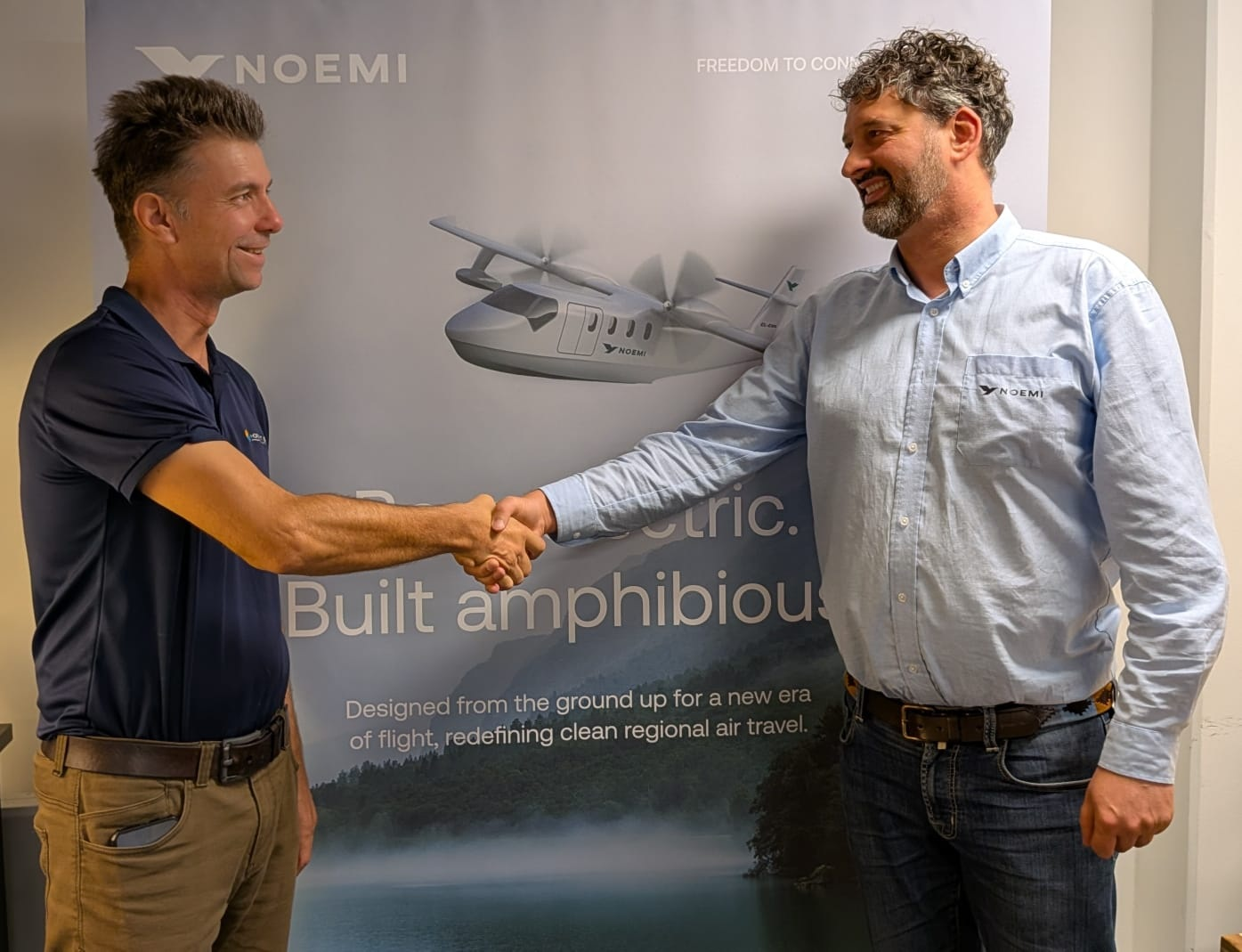
NOEMI Aerospace has signed a memorandum of understanding with Philippine seaplane operator Horizon Sun Charters covering three amphibious aircraft, with options for a further two. The agreement adds another prospective operator to the Norwegian developer’s commercial pipeline as it works towards certification and a targeted 2030 entry into service for its first aircraft.
The MoU should not be confused with a firm five-aircraft order. Horizon Sun Charters intends to acquire three aircraft and holds options covering two more, while the two companies will examine the technical, financial, and regulatory requirements for introducing the type into Philippine operations. Potential routes and the practical integration of the aircraft into Horizon Sun Charters’ existing business will form part of that work.
The operator provides private seaplane services in Palawan, including connections around El Nido, Coron, and other coastal and island destinations. That operating environment is relevant to NOEMI because its aircraft is being designed to use both water and conventional runways, allowing routes to connect locations where building or accessing a full airport at each end may be impractical.
The Philippines presents an unusually obvious geography for amphibious aviation. Thousands of islands create journeys where the straight-line distance can be modest but surface transport requires combinations of road and ferry travel. A seaplane can bypass part of that infrastructure by linking coastal destinations directly, although the commercial case still depends on passenger demand, weather, landing permissions, operating costs, maintenance, and the availability of energy or fuel at remote bases.
NOEMI’s initial aircraft is being developed around a nine-passenger cabin with accommodation for one or two pilots. The baseline configuration remains fully electric, while the wider platform is also intended to accommodate hybrid-electric or conventional propulsion where range, infrastructure, payload, or operating requirements make a battery-only aircraft less suitable.
That propulsion flexibility is material to the Horizon Sun Charters agreement. The operator has identified the hybrid configuration as particularly relevant to the range of missions it envisages in the Philippines. For a commercial seaplane business, propulsion choice ultimately depends on the relationship between payload, range, reserve requirements, charging availability, turnaround time, route frequency, and maintenance rather than the attraction of one propulsion label in isolation.
Battery-electric aviation remains demanding because aircraft place an unforgiving premium on mass. Every kilogram allocated to energy storage competes with passengers, baggage, structure, and operating reserves. Amphibious aircraft add another layer because the airframe must also cope with water loads, corrosion, spray, hull hydrodynamics, and repeated transitions between marine and airborne operation.
Hybrid propulsion can relax some of the range and infrastructure constraints, but it introduces additional engineering of its own. Batteries, motors, inverters, and thermal-management equipment then have to operate alongside an onboard combustion or generation system. The potential advantage is greater mission flexibility; the penalty is extra mass, additional components, more control complexity, and a broader certification and maintenance burden.
The development programme therefore has to reconcile aerodynamics, hydrodynamics, propulsion, batteries, structures, corrosion protection, and certification rather than treating electric propulsion as a standalone substitution for an engine. NOEMI’s current aircraft specification calls for a 21m wingspan, a 16m overall length, and a battery capacity of around 400kWh, although the company continues to describe its published technical figures as subject to change during development.
The Philippine agreement also gives the developer access to operational knowledge before the design is frozen. An established seaplane operator can provide practical requirements around dock access, passenger turnaround, baggage, water handling, route planning, corrosion, servicing, and the infrastructure available at remote destinations. Those details are considerably cheaper to incorporate while certification hardware is still being developed than after tooling and production processes have been fixed.
The Maldives demonstrates that seaplanes can become an established part of tourism infrastructure where geography, passenger demand, and resort economics support high aircraft utilisation. The Philippines offers some similar physical characteristics, but the operating model cannot simply be copied. Passenger flows, regulation, airspace, weather, landing locations, resort density, infrastructure, and utilisation will determine whether routes can support a new aircraft economically.
NOEMI is still some distance from revenue service. Development aircraft, propulsion testing, flight testing, certification, supplier qualification, production engineering, and manufacturing scale-up all have to progress before an operator can put the type into commercial use. The memorandum therefore has value as evidence of customer interest and as an input to product development, but it does not remove the technical work between the current programme and aircraft delivery.
The distinction becomes particularly important as electric aviation attracts increasingly large prospective-order figures long before certification. Commercial agreements can help manufacturers demonstrate demand to investors and suppliers, but they become meaningful industrial orders only when aircraft development, certification, financing, and customer commitments converge.
For NOEMI, Horizon Sun Charters provides a prospective customer in a market where amphibious capability solves a genuine transport problem. The useful measure of progress will not be whether today’s three-aircraft intention and two options can be described as five sales, but whether operator requirements now feed into a certifiable aircraft that can eventually perform the routes on which the commercial case depends.