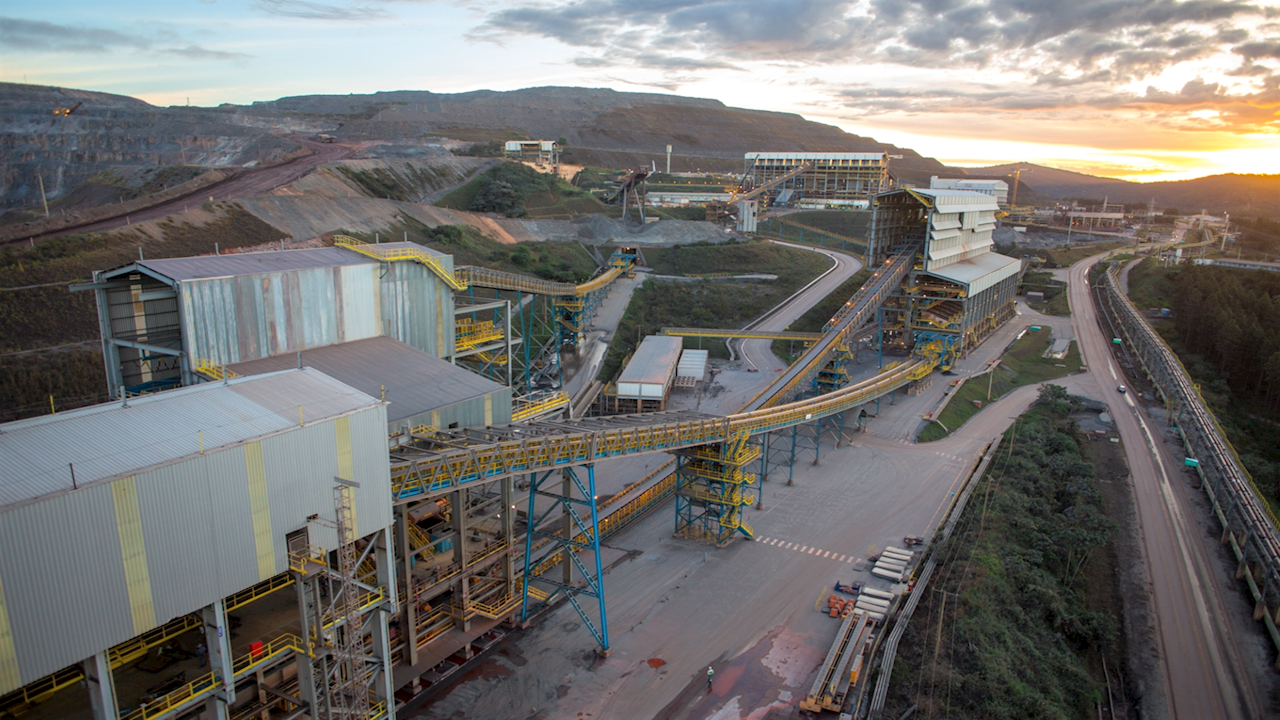
Vale and ABB have agreed a strategic alliance to expand automation, artificial intelligence, and integrated IT/OT technology across the miner’s Brazilian iron-ore operations. The programme builds on Vale’s Conceição II model plant in Itabira, where an existing digitalisation project has produced reported gains in productivity, premium ore output, and material recovery.
ABB worked as consultant, systems integrator, and technology provider on Conceição II, which has become a reference site for Vale’s wider Mining of the Future programme. The 11.2 million-tonne-per-year complex uses more than 100 monitoring cameras, over 7,000 automated instruments and advanced sensors, and data systems controlling or optimising more than 400 variables across the ore-processing workflow.
Since implementation of the model in 2024, Vale reports a 25% increase in productivity, a 40% rise in production of premium ore intended for direct-reduction applications, and a 26% reduction in iron losses to tailings. The configuration has also reduced the need for employees to carry out some manual interventions in the field, providing a safety benefit around heavy machinery and process equipment.
The new agreement is intended to take those methods beyond a single showcase site. Replication is where industrial digitalisation becomes difficult because mines differ in ore characteristics, equipment age, plant layout, instrumentation, operating practices, and data quality. A model that produces useful recommendations at one operation cannot simply be copied elsewhere without establishing which assumptions remain valid and which have to be rebuilt.
Mining also provides an unusually demanding environment for sensors and automated systems. Dust, vibration, moisture, temperature variation, abrasive materials, and continuous heavy-equipment operation can degrade instrumentation. Data quality therefore depends on maintenance and calibration as much as software sophistication. An AI model trained on unreliable sensor information can produce precise-looking answers to the wrong operating problem.
The underlying process provides substantial room for optimisation. Iron-ore beneficiation can involve crushing, screening, classification, concentration, water management, conveyors, stockpiles, and other interconnected stages. Changing one operating parameter can alter throughput, energy demand, product quality, recovery, and equipment loading elsewhere in the plant. Optimisation is therefore a multivariable control problem rather than a succession of independent machine settings.
Vale’s use of more than 400 operating variables at Conceição II illustrates the scale of that problem. Digital systems can identify interactions that are difficult for an operator to monitor continuously, particularly as feed characteristics change. Predictive models can also flag developing equipment or process conditions before they become obvious enough to trigger conventional alarms, giving maintenance and operating teams more time to intervene.
That does not remove human responsibility. Production engineers still need to determine whether a model’s recommendation is physically sensible, whether sensors are behaving correctly, and whether a proposed change creates an unintended constraint elsewhere. Industrial AI is most useful when embedded within process engineering and control rather than added as a separate analytics dashboard whose output competes with established operating procedures.
The IT/OT integration element of the Vale-ABB agreement is therefore as important as the AI label. Operational technology controls physical machinery, while enterprise and data platforms provide computing, storage, business information, and analytical tools. Connecting the two enables richer analysis but expands the cybersecurity boundary around equipment whose loss of availability can interrupt production or create safety problems.
Standardisation across multiple mines could provide another advantage if Vale and ABB establish repeatable architectures for sensors, control, data models, cybersecurity, and applications. Common engineering reduces the amount of bespoke integration required each time a digital project is deployed, while successful software changes can be reused across several sites. The risk is that excessive standardisation ignores local process differences and creates systems that fit a corporate template better than the ore body.
The reported reduction in iron lost to tailings is particularly significant because improved recovery produces more saleable material from the same mined feed. At an 11.2Mt-per-year operation, even relatively small percentage changes can carry material economic and resource-efficiency consequences before additional mining capacity is developed. Higher production of premium direct-reduction ore also matters as steelmakers pursue lower-carbon production routes requiring feedstocks with demanding quality characteristics.
Vale and ABB now have a reference plant with operating figures rather than a digitalisation proposal supported only by simulation. The next challenge is to reproduce enough of those gains across sites with different equipment and geological conditions to justify the broader programme. Mining has never lacked technology demonstrations; scalable engineering begins when the second and third plants work without requiring the first project to be reinvented.