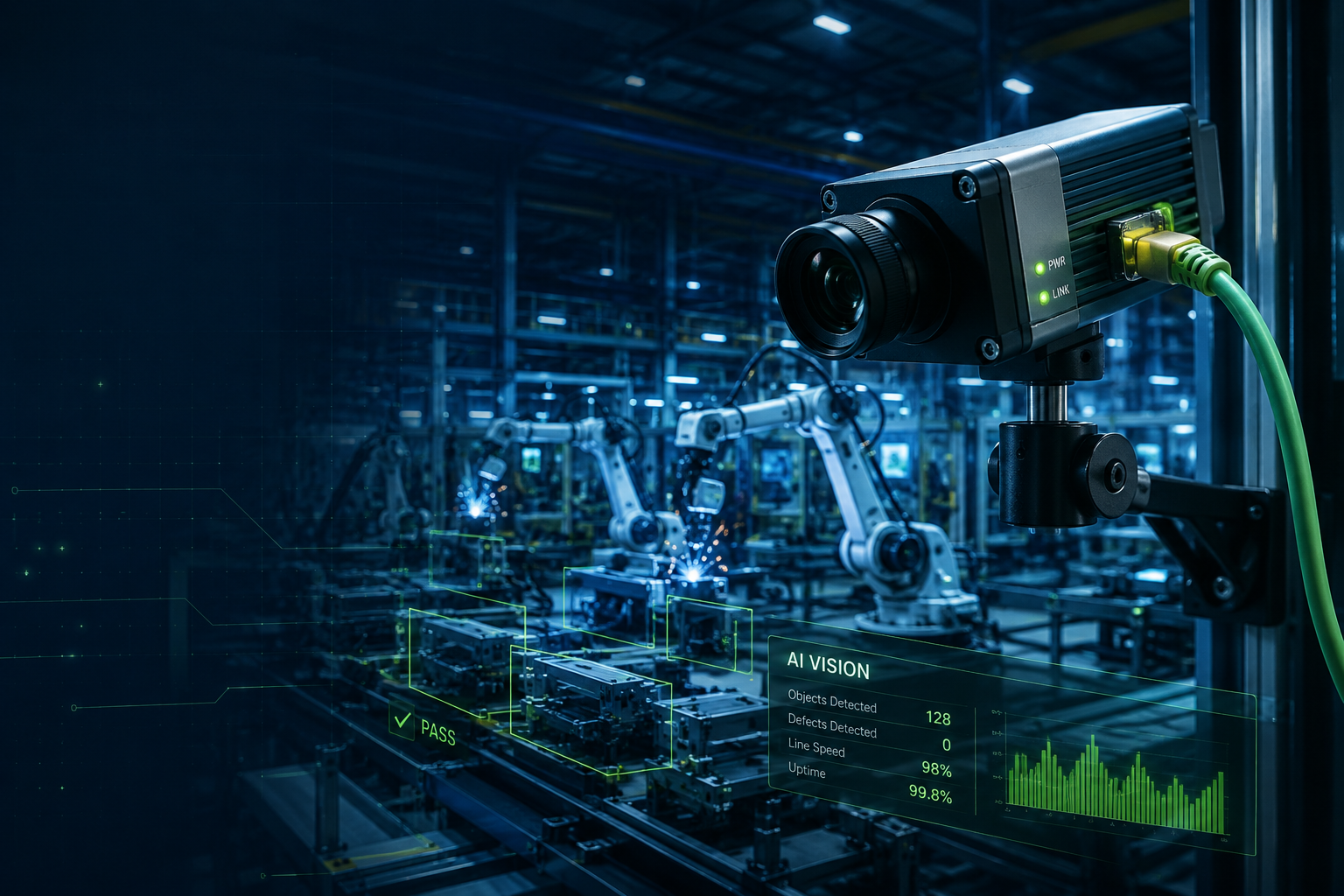
Seeing Machines has secured an advanced development contract with an unnamed global industrial technology company to apply its human-centred artificial intelligence to factory automation and human-robot interaction. The initial programme will deliver a robotics proof of concept, extending technology developed around real-time understanding of people into an industrial environment.
The contract builds on the company’s Perception Map technology shown at CES 2026. Seeing Machines has spent more than two decades developing computer-vision systems that monitor people, particularly drivers and vehicle operators, using cameras, embedded processing, and algorithms to interpret attention, behaviour, and risk. The new work tests whether that perception capability can be transferred into a factory setting where machines need to understand the position and behaviour of people working around them.
Industrial robotics already relies heavily on deterministic safety systems, physical guarding, scanners, and defined operating zones. Closer human-robot interaction presents a different perception problem because people do not move like components on a conveyor or follow perfectly repeatable paths. A system intended to support more flexible interaction needs to recognise people consistently, interpret changing spatial relationships, and do so quickly enough for the information to be useful to the wider control architecture.
Seeing Machines has not named the customer, disclosed the value of the contract, or identified the precise factory application. That limits conclusions about the commercial scale of the programme, and the first deliverable remains a proof of concept rather than a production deployment. The contract nevertheless gives the company a defined industrial setting in which to test technology that has previously been associated mainly with operator and driver monitoring.
Paul McGlone, chief executive officer of Seeing Machines, said: “By combining more than 25 years of Human Factors expertise with advanced AI, we are helping machines better understand people, anticipate risk and enable safer, more intuitive human-machine experiences.”
The technical direction sits alongside a wider shift towards local perception and decision-making in automation. Edge AI hardware is moving closer to robotic control, giving machine builders more processing capability for multi-camera vision, object recognition, and scene interpretation without sending every data stream to a remote cloud platform. The engineering question is whether that perception can be made sufficiently reliable, fast, and predictable for routine industrial use.
A factory also presents harsher conditions than a vehicle cabin. Driver-monitoring systems operate in a comparatively bounded environment with known seating positions and camera locations, whereas industrial workspaces can contain changing lighting, personal protective equipment, tools, pallets, moving vehicles, partial occlusion, and people entering from several directions. Any perception layer deployed there has to remain useful under those conditions rather than performing well only in a controlled demonstration.
Integration will be equally important. Perception software does not itself make a robot safe or productive; its outputs have to connect with robot controllers, safety systems, motion planning, plant networks, and the operating logic governing what the machine is permitted to do. Industrial customers will also need evidence around latency, false detections, availability, cybersecurity, maintenance, and behaviour when cameras are obstructed or environmental conditions change.
Seeing Machines’ existing business gives it experience in deploying vision-based monitoring where missed detections can carry serious consequences. Its driver-monitoring systems measure where an operator is looking and assess cognitive state across automotive, commercial fleet, off-road equipment, and aviation applications. Factory robotics will test how much of that human-factors knowledge remains useful when the person being observed is no longer seated in a fixed position and the surrounding machinery is itself moving.
The development contract is expected to provide a basis for further collaboration across industrial automation and robotics, but there is no commitment yet to a production programme. That distinction matters in a robotics market crowded with persuasive demonstrations: a successful proof of concept still has to survive integration, safety validation, plant conditions, and a customer’s investment case before it becomes routine factory equipment.
For Seeing Machines, the next meaningful milestone will be whether the unnamed customer progresses beyond the proof-of-concept stage. The company now has a paying industrial development programme and a defined human-robot interaction problem to solve. Production deployment would require the perception technology to prove itself against factory conditions, system integration, safety requirements, and operating economics rather than the controlled conditions of a technology showcase.