
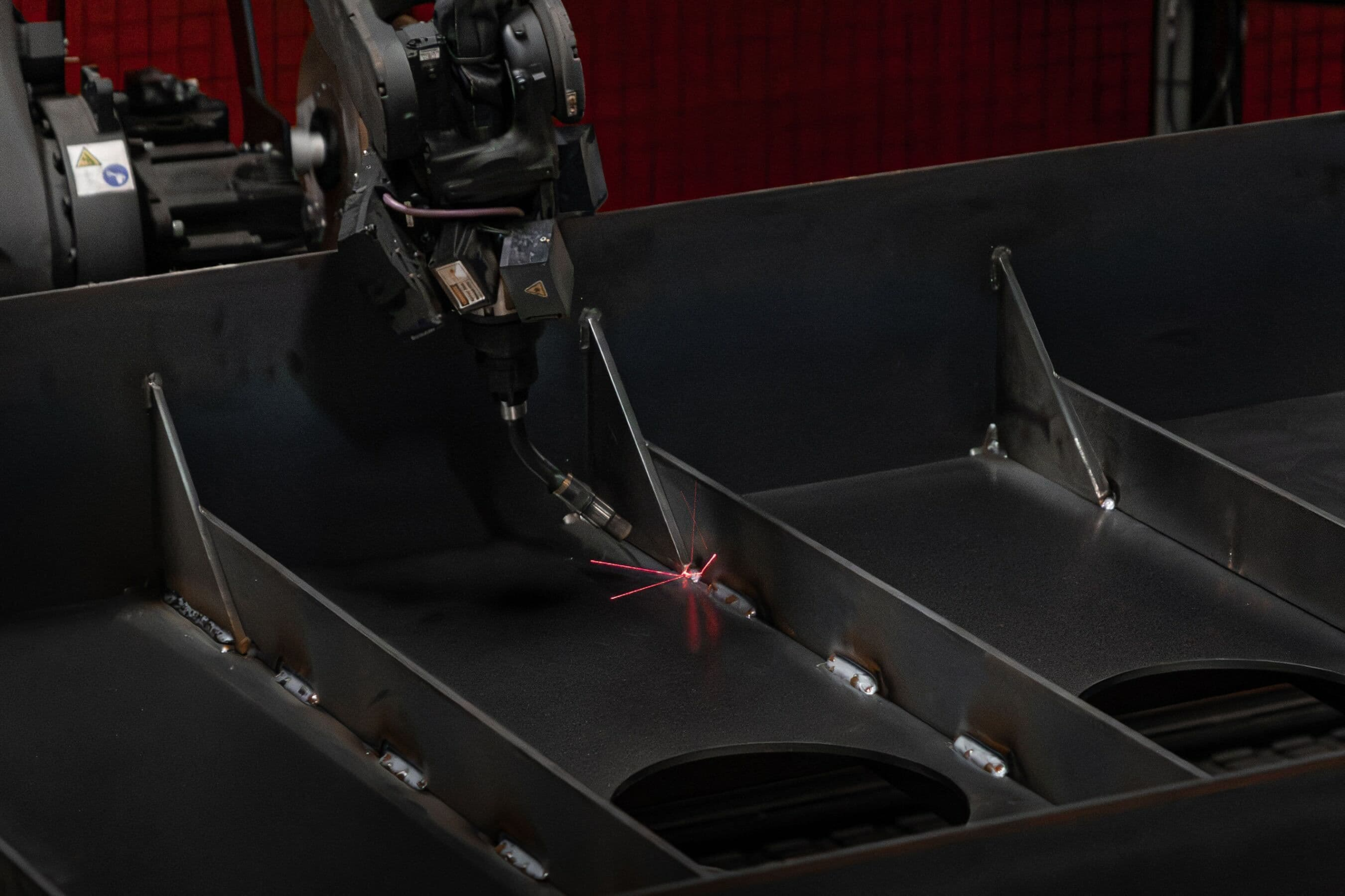
HII has signed performance-based production agreements worth up to $900 million with Path Robotics and GrayMatter Robotics to develop and deploy autonomous manufacturing systems for US naval shipbuilding.
The seven-year agreements cover aircraft carriers, submarines, destroyers, amphibious vessels, future frigates, and unmanned surface vehicles. Awards will depend on the robotics companies meeting defined technology-readiness, manufacturing-readiness, quality, cost, schedule, and performance milestones.
The contracts form part of HII’s High-Yield Production Robotics programme, known as HYPR. The initiative combines Path Robotics’ adaptive welding systems with GrayMatter Robotics’ autonomous surface-preparation, coating, grinding, and inspection technology.
The agreements are divided into development and delivery stages. During development, HII and its partners will establish, test, validate, and qualify autonomous methods for welding, grinding, blasting, painting, assembly, inspection, and related fabrication work.
The individual systems are then intended to be integrated into an autonomous production line. Work will only move into the delivery stage when the technology has demonstrated acceptable cost, schedule, quality, and production performance against naval shipbuilding requirements.
HII would then source work from the new line, initially for smaller steel structures before moving towards larger units and modules. The approach is intended to support a distributed production network in which more structural work is completed outside the principal shipyards and delivered for final assembly.
The difference between a robotics demonstration and qualified shipbuilding production is considerable. Naval structures are large, highly varied, and constructed from parts that may arrive with dimensional, surface, or fit-up differences. Welds must comply with approved procedures and be supported by inspection and traceability records.
Traditional automation performs best when the part, joint, and surrounding environment remain predictable. Shipbuilding contains comparatively low volumes, large structures, restricted access, changing orientations, and a substantial mixture of manual correction and one-off work.
Adaptive robotic systems are being developed to identify the workpiece, interpret variation, and adjust tool paths without requiring every deviation to be programmed in advance. The equipment still has to control heat input, torch position, travel speed, consumables, shielding, starts and stops, and the response to poor fit-up.
Surface treatment presents a different set of problems. Blasting, grinding, and coating are repetitive and physically demanding, but the robot must recognise edges, openings, stiffeners, welds, and changing surface conditions while maintaining the required finish.
Painting and coating quality has a direct relationship with corrosion life. Surface preparation, cleanliness, profile, environmental conditions, coating thickness, and curing must remain within specification, particularly where later access will be limited after compartments and modules have been assembled.
Inspection is therefore part of the production system rather than a separate activity at the end. Automated equipment can record process data and identify areas requiring review, although qualified personnel remain responsible for accepting work against contractual and regulatory standards.
The performance-based structure gives Path Robotics and GrayMatter Robotics a long-term demand signal without guaranteeing the full $900 million immediately. Both businesses are expected to invest in facilities, equipment, software, and workforce capability as the programme passes its development milestones.
That mechanism reduces the risk of placing full-rate production work before the technology is ready, while giving suppliers a potential volume large enough to justify capital expenditure. It also allows HII to judge the systems using completed shipbuilding work rather than laboratory cycle times.
HII plans to outsource more than 2.5 million hours of shipbuilding work during 2026, representing a 30% increase from the previous year. Expanding the assembly-partner network is intended to increase the amount of structural production completed outside its principal yards.
Distributed shipbuilding can relieve congested facilities and bring more suppliers into the production base, but it creates additional interface risk. Modules produced at separate sites must use controlled design data, compatible materials, common inspection standards, and reliable dimensional references if they are to fit during final assembly.
Transport also affects the size and sequence of work that can be distributed. A supplier may be able to produce a large module, yet road, rail, barge, lifting, or quay limitations can make delivery impractical. Production engineering therefore has to begin with the final shipyard interface rather than treating logistics as an afterthought.
The HYPR programme is partly a response to labour and capacity constraints across naval manufacturing. Robotics can reduce exposure to fumes, dust, noise, repetitive work, and confined operations, while allowing experienced personnel to supervise several processes or concentrate on non-standard tasks.
It will not remove the need for welders, inspectors, maintenance technicians, programmers, production engineers, and skilled fitters. A larger automated system adds cameras, sensors, drives, software, calibration routines, spare parts, cybersecurity controls, and failure modes that must be supported through long naval programmes.
HII has moved beyond a pilot announcement by attaching a potential seven-year production value to the programme. The difficult part now begins: proving that adaptive robots can meet naval standards repeatedly enough to become part of the shipbuilding supply chain rather than remaining impressive equipment beside it.
