
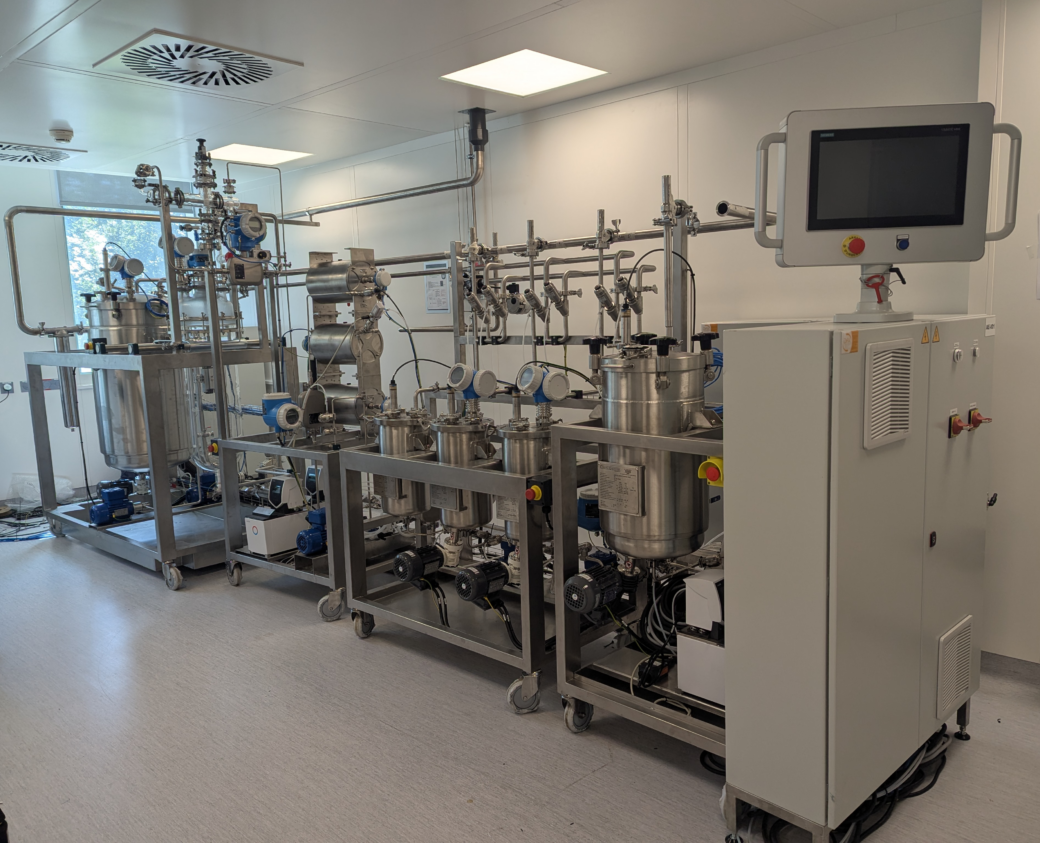
The PIPAC consortium has completed a pilot programme validating a continuous manufacturing platform for active pharmaceutical ingredients.
The project brings together Novalix, De Dietrich, Alysophil, and Bruker. Its system combines continuous-flow chemistry, real-time analytical measurement, automated process control, and an artificial-intelligence-based supervisory platform intended to monitor and adjust production while material remains in the process.
The consortium validated the demonstrator through the continuous-flow production of fentanyl, a highly potent and tightly controlled pharmaceutical ingredient. Selecting a demanding compound tested process containment, analytical sensitivity, control performance, and the ability to maintain operating conditions inside a narrow range.
The result is a technical demonstration rather than a commercially approved manufacturing line. The partners describe it as a foundation for a future Good Manufacturing Practice-compatible system, with further work required to integrate downstream processes and satisfy the qualification, validation, containment, documentation, and regulatory requirements applied to pharmaceutical production.
Traditional API plants commonly manufacture material in discrete batches. Reactants are charged into a vessel, processed for a defined period, transferred, sampled, separated, cleaned, and prepared for the next stage. The model is familiar and flexible, but increasing scale normally requires larger vessels, additional campaigns, or another production train.
Continuous-flow processing takes a different approach. Smaller quantities move through connected equipment while reaction and process conditions are maintained over time. Production can be increased by extending operating duration, running parallel modules, or changing the flow system rather than relying only on progressively larger batch vessels.
Potential advantages include tighter heat and mass transfer, reduced working inventories, more consistent residence times, and earlier detection of process drift. None is automatic. Pumps, valves, mixers, sensors, sampling systems, and control software must operate reliably, while blockages, fouling, corrosion, and unexpected reaction behaviour have to be detected before they disturb the complete line.
Novalix designed and implemented the continuous-flow synthesis route. Bruker supplied analytical technology for real-time measurement, while Alysophil developed the AlchemDrive autonomous control platform used to interpret production data and adjust operating parameters.
De Dietrich developed the industrial hardware and automation architecture, bringing the synthesis, analytical, and control elements into a scalable process environment. This division of work reflects the difficulty of continuous pharmaceutical manufacturing: chemistry, mechanical equipment, instrumentation, software, materials selection, containment, and regulatory evidence all have to mature together.
Real-time analytical monitoring is central to the model. A batch process may be tested at defined stages, whereas a continuous system can generate a stream of measurements while production proceeds. The control system can use that data to identify trends, maintain critical parameters, and intervene before material moves outside an acceptable condition.
The analytical method still has to measure the correct property with sufficient speed, accuracy, and robustness. A sensor that performs well under laboratory conditions may respond differently when exposed to vibration, contamination, temperature changes, cleaning cycles, and extended operation.
Automated adjustment raises similar questions. A control platform must know which variables it can change, how far they can move, and when the safest response is to divert material or stop production. Artificial intelligence may identify relationships across larger datasets, but the operating limits and resulting quality decisions must remain explainable and auditable.
The consortium says the demonstrator could support smaller modular production units and more distributed regional manufacturing. Such facilities could reduce dependence on a small number of distant API plants, particularly for critical medicines or products required in comparatively low volumes.
A decentralised model would alter the supply chain rather than eliminate it. Each site would require qualified raw materials, calibrated analytical equipment, trained personnel, secure digital systems, validated cleaning procedures, waste handling, and consistent regulatory oversight.
Replicating several modules also creates a requirement for strict configuration control so that nominally identical units continue to produce comparable material. Software versions, instrument calibration, replacement components, and process recipes would have to be managed across locations with the same discipline applied to physical production equipment.
The current pilot focuses on synthesis and control. Future development may incorporate filtration, purification, and drying, taking the platform closer to an integrated API process. Those downstream stages frequently account for substantial solvent use, energy demand, yield loss, long cycle times, and variability in the physical properties of the final material.
Moving from a successful demonstrator to GMP manufacture will require the partners to define critical quality attributes, establish cleaning and containment performance, qualify software, demonstrate reproducibility, and develop procedures for start-up, shutdown, abnormal conditions, and diverted material. Potent ingredients also impose demanding occupational-exposure and cross-contamination controls.
PIPAC has shown that continuous synthesis, analytical measurement, and automated adjustment can operate as one pilot platform. Its industrial value will depend on whether the system remains stable over extended campaigns and whether operators and regulators can trust the data used to release material.
Continuous manufacturing has spent years being presented as the pharmaceutical factory of the future. PIPAC has produced another credible piece of that factory; validation, cleaning, maintenance, and regulatory acceptance now determine whether it leaves the pilot room.
