
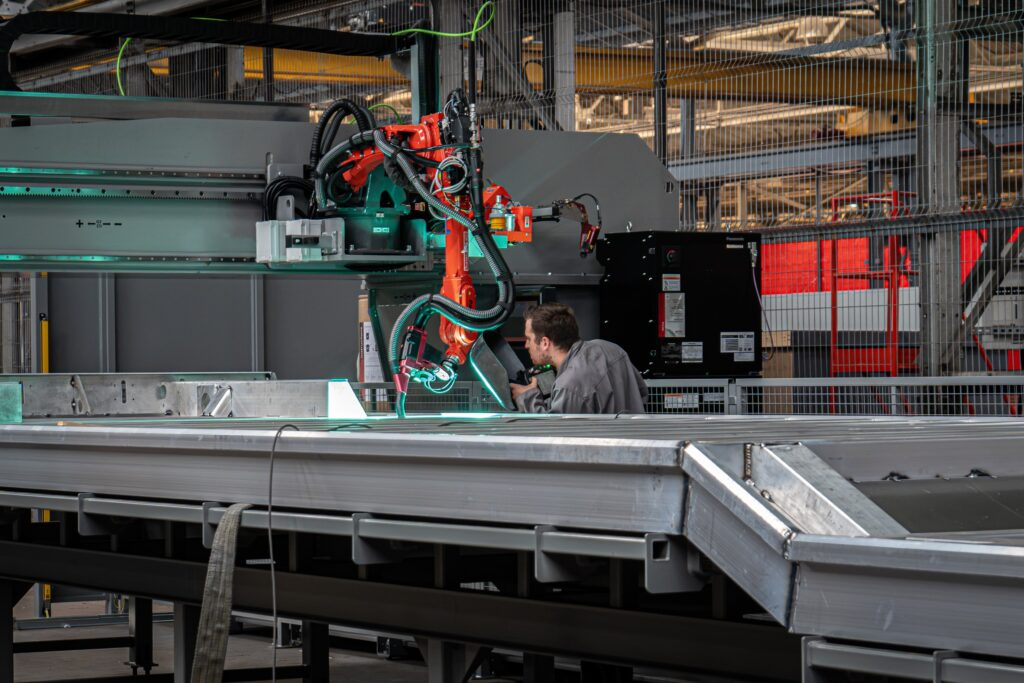
Fruehauf has installed a second large-scale robotic welding cell at its Grantham production site, extending automation from carbon-steel chassis components into aluminium tipper-body manufacture.
The new cell was developed with Valk Welding for the production of aluminium floors and sidewalls. It follows Fruehauf’s first robotic welding installation in 2025 and forms part of a wider project covering assembly jigs, cranes, lifting equipment, and machinery for cutting aluminium extrusions.
Testing and programme optimisation are under way, with the first robot-welded floors and sidewalls expected to enter production later in August. Fruehauf intends to have the full serial-production system operating by the end of 2026.
The cell uses Valk Welding’s Arc-Eye seam-tracking technology to monitor each joint and adjust the robot path in real time. The system is intended to compensate for dimensional and positional variation as welding proceeds, reducing the need to measure every deviation in advance and edit the programme manually.
That capability is particularly relevant to aluminium fabrication. Aluminium conducts heat rapidly, allowing temperature to spread away from the arc and distort long panels as the weld progresses. Fixtures, sequence, travel speed, heat input, joint preparation, and path correction must work together if the completed body is to remain within dimensional limits.
The installation also includes source extraction for welding fumes. The Health and Safety Executive requires employers to control exposure because all welding fume can cause lung cancer, with local exhaust ventilation used to capture contaminants close to the point of generation.
Once fully implemented, Fruehauf expects the cell to automate approximately 12.5 hours of manual work on each tipper body, representing around a quarter of the total welding operation. Employees released from repetitive welding will be redeployed into more specialised and bespoke fabrication work, retaining manual expertise for tasks where variation and judgement make fixed automation less effective.
The project illustrates why robotic welding rarely begins and ends with the robot arm. Long aluminium structures have to be presented consistently, clamped without unwanted stress, moved safely, and released without damaging finished surfaces. Production engineers must also manage wire feed, shielding gas, torch condition, cleaning, fault recovery, and the interfaces with upstream cutting and downstream assembly.
Fruehauf has addressed part of that integration through new jigs designed and manufactured by its in-house team. Fixtures determine where parts sit and how they respond as heat is introduced, while cranes and lifting equipment affect cycle time, ergonomic risk, and the ability to load large assemblies without interrupting surrounding work.
The company’s second installation reflects a more mature route into automation than purchasing a cell around a catalogue specification. The Manufacturing Technology Centre’s Robot Experience Centre was established around the same principle, allowing manufacturers to test process constraints, integration requirements, operator skills, and likely payback before equipment reaches the shop floor.
Experience from Fruehauf’s first system is now being used to define a different process more precisely. The earlier cell was configured for carbon-steel chassis components, where repeatability, fume control, and production availability have already been assessed under operating conditions. Aluminium broadens the programme but changes the process window, handling requirements, and sensitivity to distortion.
Fruehauf manufactures tipping trailers at Grantham for sectors including aggregates, agriculture, waste, and haulage. The new welding capacity sits within a longer modernisation programme intended to increase equipment capability and bring more production under direct factory control.
Quality control will have to follow the process into serial production. Weld appearance alone cannot confirm penetration, distortion, joint integrity, or repeatability, so the cell’s programmes, fixtures, consumables, and inspection records must remain controlled as product variants and production volumes change.
Maintenance planning will be equally important. Torches, liners, contact tips, cameras, extraction components, and robot axes all degrade with use, and unplanned stoppages can quickly erase the cycle-time benefit promised by an automated operation.
Automation does not remove the need for welding knowledge. Robot programmers, maintenance technicians, quality engineers, and experienced fabricators still have to develop procedures, investigate defects, manage changeovers, and respond when components arrive outside the expected condition.
The first production parts later this month will provide an early measure of programme quality and fixture performance. Full operation by year-end will be the more demanding milestone, when seam tracking, extraction, handling, operator routines, and production scheduling must function as one system rather than a collection of newly installed equipment.
