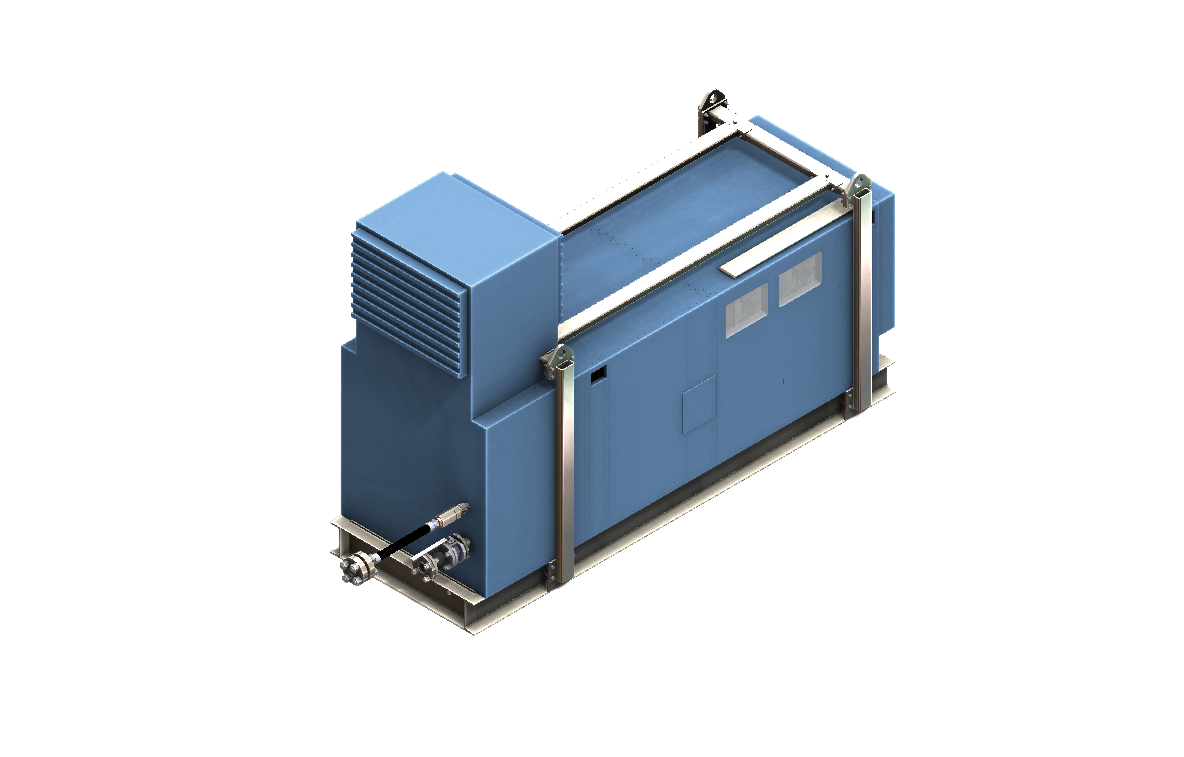
Armstrong Industrial has detailed a high pressure wash system combining industrial cleaning equipment with variable speed control, operating data monitoring, alarms, and maintenance diagnostics.
The system is intended for applications including mining, power generation, cement manufacture, petrochemicals, ports, general manufacturing, and bulk materials handling. Target equipment includes cooling coils, boilers, air preheaters, electrostatic precipitators, fans, ducts, and solar panels.
Armstrong is positioning the equipment as an engineered plant system rather than a standalone high pressure pump. Its control platform adjusts pressure and flow according to the cleaning requirement and records operating information for maintenance planning.
The system is available in low flow and high flow configurations. The low flow version delivers between 10 and 70 litres per minute, while the larger configuration provides between 70 and 120 litres per minute.
Both versions operate from 300 bar to more than 1,000 bar. The wide range allows the system to address different types of contamination and equipment, although pressure and flow must be selected carefully for each surface and cleaning task.
High pressure water can remove deposits effectively, but inappropriate settings can damage coatings, seals, fins, insulation, joints, sensors, and softer materials. Cleaning performance depends on nozzle design, stand off distance, angle, flow, pressure, temperature, deposit characteristics, and exposure time.
The controls therefore have an important role beyond energy management. Repeatable settings can help operators apply an established cleaning procedure rather than relying solely on manual adjustment.
Variable speed operation allows pump output to change according to demand. This can reduce throttling losses and avoid running the motor continuously at maximum speed when the cleaning task requires less pressure or flow.
Soft start and soft stop functions are intended to limit electrical surges and reduce sudden hydraulic changes. Abrupt pressure transitions can increase stress on pumps, hoses, valves, seals, and connected equipment.
An automatic stop function reduces unnecessary running during idle periods. This can lower electricity and water use while reducing the operating hours accumulated by the pump and its drive components.
The system monitors pressure and flow in real time. Comparing actual values with expected performance can reveal blocked nozzles, leaks, pump wear, restricted supply, or changes elsewhere in the equipment.
Integrated alarms and diagnostics are intended to support faster fault identification. Predictive maintenance functions use runtime and load history to indicate when inspection or servicing may be required.
Runtime based maintenance is more useful than a fixed calendar interval where equipment use varies considerably. A wash system operating daily at high pressure experiences a different duty cycle from one used intermittently for short maintenance campaigns.
Load history can add further context by recording whether the equipment has operated mostly at moderate conditions or near its maximum output. The quality of any maintenance prediction will still depend on the sensors, thresholds, failure models, and accuracy of the collected data.
Armstrong says the technology can produce energy savings of 20% to 30%, reduce carbon emissions by a similar proportion, and extend component life by between 20% and 40%. These are supplier claims rather than independently verified performance levels applicable to every installation.
Actual savings will vary by application. Cleaning a heavily fouled heat exchanger may restore substantial thermal performance, while cleaning equipment that was already close to its design condition will deliver a smaller improvement.
The underlying engineering principle is straightforward: deposits on heat transfer surfaces create additional thermal resistance, while dust and contamination on fans, ducts, and filters can restrict airflow. Both effects can force equipment to consume more energy or operate for longer to deliver the required output.
Boiler and air preheater fouling can increase fuel use and exhaust losses. Dirty cooling coils can reduce heat transfer capacity, while blocked ventilation equipment can alter pressures and temperatures elsewhere in the process.
Removing contamination can therefore restore part of the equipment’s original performance. The result should be measured before and after cleaning using suitable indicators such as temperature difference, pressure drop, airflow, energy use, heat transfer duty, or production throughput.
Without those measurements, claimed efficiency gains can be difficult to separate from changes in ambient conditions, production load, or operating practice. A connected control system could make verification easier if its information is combined with data from the cleaned asset.
Water consumption is another important factor. High pressure cleaning can use less water than lower pressure washing when it removes deposits more quickly, but that outcome depends on the nozzle, cleaning time, and operator procedure.
The system’s variable speed control and automatic stop may reduce unnecessary flow, but wastewater must still be contained and treated where it carries oils, chemicals, metals, solids, or process contamination.
Industrial sites must also assess personnel protection. Water jets operating at hundreds of bar can cause severe injury, making guarding, exclusion zones, hose management, emergency stopping, training, and suitable protective equipment essential.
Automated or remotely operated cleaning can reduce direct exposure in some applications. It may also allow more consistent coverage of surfaces or equipment that is difficult to access manually.
Armstrong’s integration of pumping, controls, diagnostics, and maintenance data reflects a wider change in industrial equipment supply. Manufacturers increasingly market systems around lifecycle performance rather than the output of an individual machine.
That approach can help operators connect maintenance work with energy, availability, and production targets. It also places a greater burden on suppliers to demonstrate that software and diagnostics continue delivering value after commissioning.
The system’s pressure and flow figures establish its physical cleaning capability. Its industrial case will depend on the less dramatic details: correct application engineering, safe operating procedures, measured improvements, maintainable controls, and evidence that the projected savings persist after the sales material has been filed away.