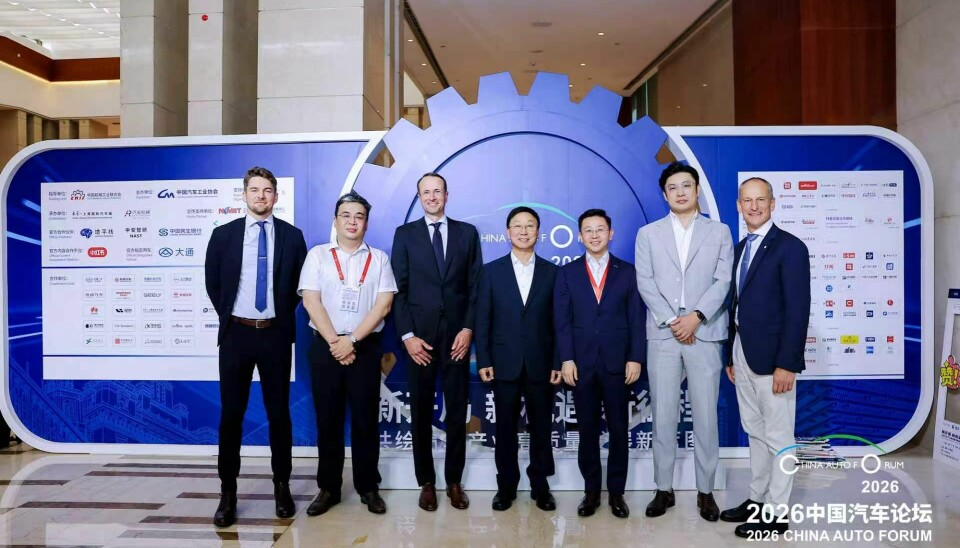
Catena-X has launched a cross-border automotive data ecosystem designed to allow manufacturers and suppliers in Europe and China to exchange verified regulatory and production information while retaining control over commercially sensitive data.
The system has been developed with the China Association of Automobile Manufacturers and VDA China. Zhonglian will operate the network within China, while Cofinity-X will provide licensing, technical support, and interoperability with the established European Catena-X environment.
Initial deployment will focus on compliance with the EU Battery Regulation, which will require battery passports for electric vehicle and plug-in hybrid battery packs entering the European market from February 2027.
Those passports depend on information drawn from across the battery value chain, including material origin, carbon footprint, manufacturing details, composition, performance, and lifecycle records. No individual vehicle manufacturer holds all of that information internally, making participation by upstream suppliers essential.
Catena-X expects the cross-border infrastructure to support battery passports assembled from supply chain data and recognised under European and Chinese requirements. Operations are scheduled to begin in mid-November 2026.
The development addresses a conflict between European product traceability rules and Chinese controls governing the movement of industrial data. Automotive businesses operating across both jurisdictions may otherwise need individual approval for certain transfers, a process that can take months without guaranteeing permission.
A shared ecosystem does not require every participant to place its information in a central database. Catena-X is structured around data sovereignty, allowing companies to define how records are accessed and used while common standards make them interpretable by authorised partners.
Battery supply chains involve mining companies, refiners, active-material producers, cell manufacturers, pack suppliers, vehicle makers, recyclers, logistics providers, and software businesses. Each participant needs to disclose sufficient information for compliance without unnecessarily exposing pricing, processes, customers, or intellectual property.
Automotive manufacturers already control engineering records, supplier quality information, software configurations, and component traceability. Battery passports extend that discipline across more supply tiers while introducing environmental data gathered through methods that may differ between organisations and countries.
Carbon footprint values depend heavily on methodology. Electricity mix, allocation rules, recycled content, transport stages, production yield, and upstream material assumptions can materially change the result.
A digital network can move the number quickly, although it cannot correct an inconsistent calculation. The first industrial task will be agreeing which data fields, identities, calculation rules, and verification methods can be trusted on both sides.
Cross-border automotive collaboration is continuing even as trade tensions increase. The production discussions between Ford and Geely in Spain show how European manufacturing capacity and Chinese vehicle technology can become connected within one programme, increasing demand for controlled engineering and supplier data exchange.
The requirement will extend beyond large vehicle manufacturers. Smaller component producers may need to provide product carbon data, material declarations, quality information, or due-diligence records to remain inside customer supply chains.
Many currently hold relevant information in spreadsheets, separate enterprise systems, and supplier documents that are difficult to combine automatically. Bringing those records into a common structure may require more work than installing the exchange software itself.
Onboarding smaller businesses will be decisive because a network serving only global manufacturers with extensive IT departments would leave gaps in traceability. Costs, certification, software complexity, and data mapping will determine whether lower-tier suppliers can participate at scale.
Cybersecurity will shape adoption as companies connect across borders and supply tiers. Identity management, interfaces, software components, access permissions, and stored credentials must be protected without making the system too cumbersome for routine industrial use.
Permissions also need to remain enforceable after information has moved. Participants must be able to amend or revoke access without breaking the historical records needed to demonstrate regulatory compliance.
Catena-X describes the Chinese extension as open and interoperable rather than a closed vendor platform. Service providers could therefore compete around analytics, passport generation, carbon calculation, quality management, and supply risk while using a common exchange layer.
Once reliable supplier data can move between organisations, the same infrastructure may support quality investigations, circular material loops, demand planning, provenance, maintenance records, and evidence for recycled content. Those applications still depend on accurate information being created at the source.
A digitally signed record remains wrong when the measurement, calculation, or supplier declaration behind it is wrong. Technical standards must consequently be connected with governance, auditing, and real manufacturing controls.
With operations due to begin only months before battery passports become mandatory, implementation will be compressed. Automotive companies must connect suppliers, validate data, and prove the system under production conditions before missing information develops into a market access problem.