Made Smarter is supporting 16 manufacturers across south-east England with projects spanning robotics, automated testing, artificial intelligence, digital inspection, enterprise software, scanning, and additive manufacturing.
Government grants worth £245,000 are expected to unlock £563,000 of private investment, while the participating companies forecast that their projects will support 50 new jobs and generate approximately £3.8 million in additional profit.
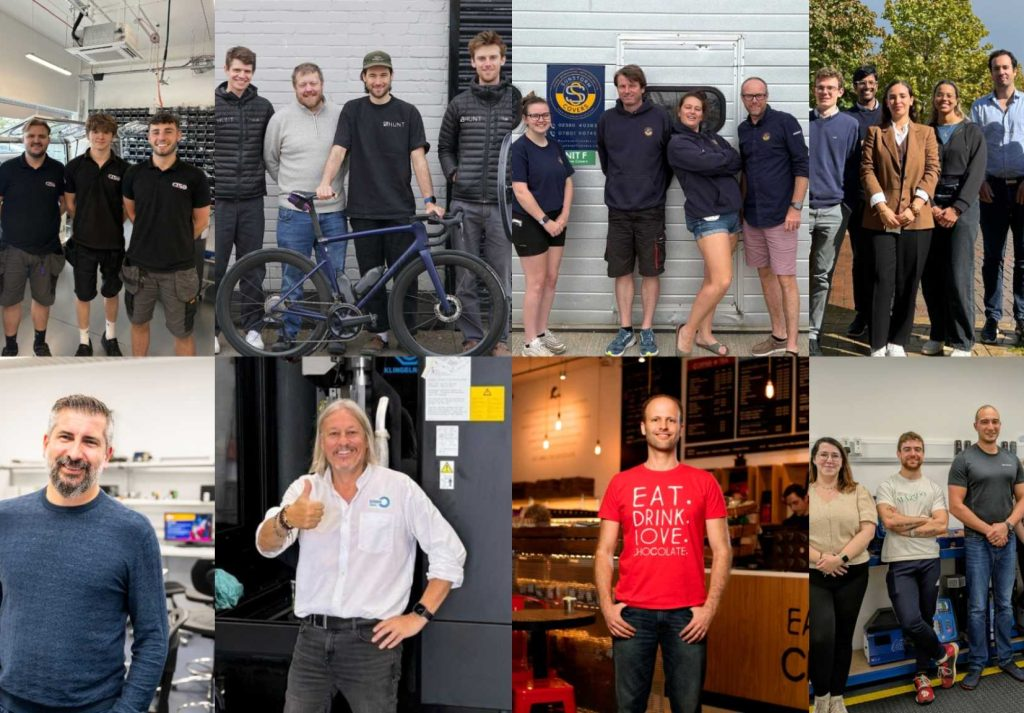
Rather than concentrating on one manufacturing sector, the group covers motorsport electronics, precision engineering, plastics, footwear, laboratory equipment, textiles, renewable energy systems, lighting, marine products, chocolate, and performance cycling components. Each company has selected a project around a specific production or administrative constraint.
Surrey-based General Engine Management Systems is developing an automated testing platform for electronic control products used in racing vehicles, specialist transport, and aircraft. By increasing test capacity and improving consistency, the system is intended to reduce repetitive manual checks while allowing engineers to focus on product development and complex fault investigation.
West Sussex manufacturer Nordell is adopting artificial intelligence software to process invoices, removing more than 60 hours of administration each month. Performance cycling wheel producer The Rider Firm, meanwhile, is investing in advanced computing and three-dimensional printing to shorten design cycles and move new products into production more quickly.
Other participating companies include Gibbs Gears, CTS Europe, BWB Technologies, MRN Engineering, G.W. Martin, NightSearcher, Bradbury Tracks, Lightricity, International Dance Shoes, and Emilia Hunt. Their projects show how factory digitalisation can begin with different operational priorities rather than a standard package of equipment.
While some manufacturers require robots or automated handling, others can gain more immediate value by replacing disconnected spreadsheets, improving inspection, integrating customer and production data, or reducing administrative work around the factory. The strongest projects begin with a defined operational problem and select technology around it.
Bryan Vint, programme manager for Made Smarter South East, said: “Each business has identified opportunities that are right for them, and these investments will help lay the foundations for long-term success.”
Companies enter the programme through a digital assessment that identifies technology and skills priorities before producing an implementation roadmap. Leadership development, employee training, internships, technical support, and match-funded grants of up to £20,000 can then be combined around the selected project.
Smaller investments address persistent factory constraints
Although the individual grants are modest beside the cost of a machining centre, automated line, or factory extension, they reduce part of the initial risk attached to technologies that smaller manufacturers may struggle to evaluate and fund alongside daily operating requirements.
The assessment stage can prevent expensive misalignment between technology and production needs. Software introduced without clear data ownership may create duplicate administration, while automation applied to an unstable process can reproduce existing inefficiency at greater speed.
New systems may also expose weaknesses in maintenance, connectivity, cyber security, employee training, or production planning that were previously hidden by manual intervention. Implementation therefore requires attention to the surrounding workflow rather than concentrating solely on the purchased equipment.
Against a backdrop of weak demand and high operating costs, the capital available for productivity projects remains constrained. Recent manufacturing order figures have underlined the pressure created by uncertain customer pipelines, even as companies face growing demands for shorter lead times, improved traceability, and lower production costs.
Targeted support can make a viable project easier to fund where the expected operational return is sound but initial capital risk remains prohibitive. It cannot compensate for a sustained absence of orders, yet it can help manufacturers improve the cost, quality, or responsiveness of the work they retain.
Automation has also become more modular. Traditional industrial robots remain important in high-volume production, although collaborative robots, lower-cost sensors, machine vision, cloud-connected production systems, and additive manufacturing can now be deployed without rebuilding an entire factory.
Smaller projects allow companies to establish baseline performance, demonstrate a return, and address employee concerns before extending the technology to other operations. They also make failure less damaging, provided the lessons are captured rather than hidden by continuing to operate an unsuitable system.
Realising the forecast £3.8 million improvement will depend on disciplined implementation across the 16 businesses. Production data must remain accurate, operators need to understand the revised workflow, equipment requires maintenance support, and management must measure whether benefits appear in throughput, quality, lead time, labour use, or working capital.
The programme will provide a practical test of whether relatively small interventions can produce sustained gains across very different factories. When those gains can be demonstrated and repeated, digital manufacturing moves beyond isolated technology trials and becomes part of routine capital planning.