PTC has launched Onshape Labs, an early-access programme that introduces experimental AI, automation, and simulation capabilities within its cloud-based CAD and product data management platform.
Participating customers can evaluate selected functions before broader release and provide feedback during development. Wider access is expected later in the summer through an opt-in control within Onshape’s preference settings.
The first available tools include AI Quick Render, which produces product visualisations from text prompts, and a workflow connecting Onshape CAD models with NVIDIA Isaac Sim through Omniverse libraries.
Robotics teams can move design assets into the simulation environment using OpenUSD data, prepare them for virtual testing, and keep the representation aligned as the mechanical model changes.
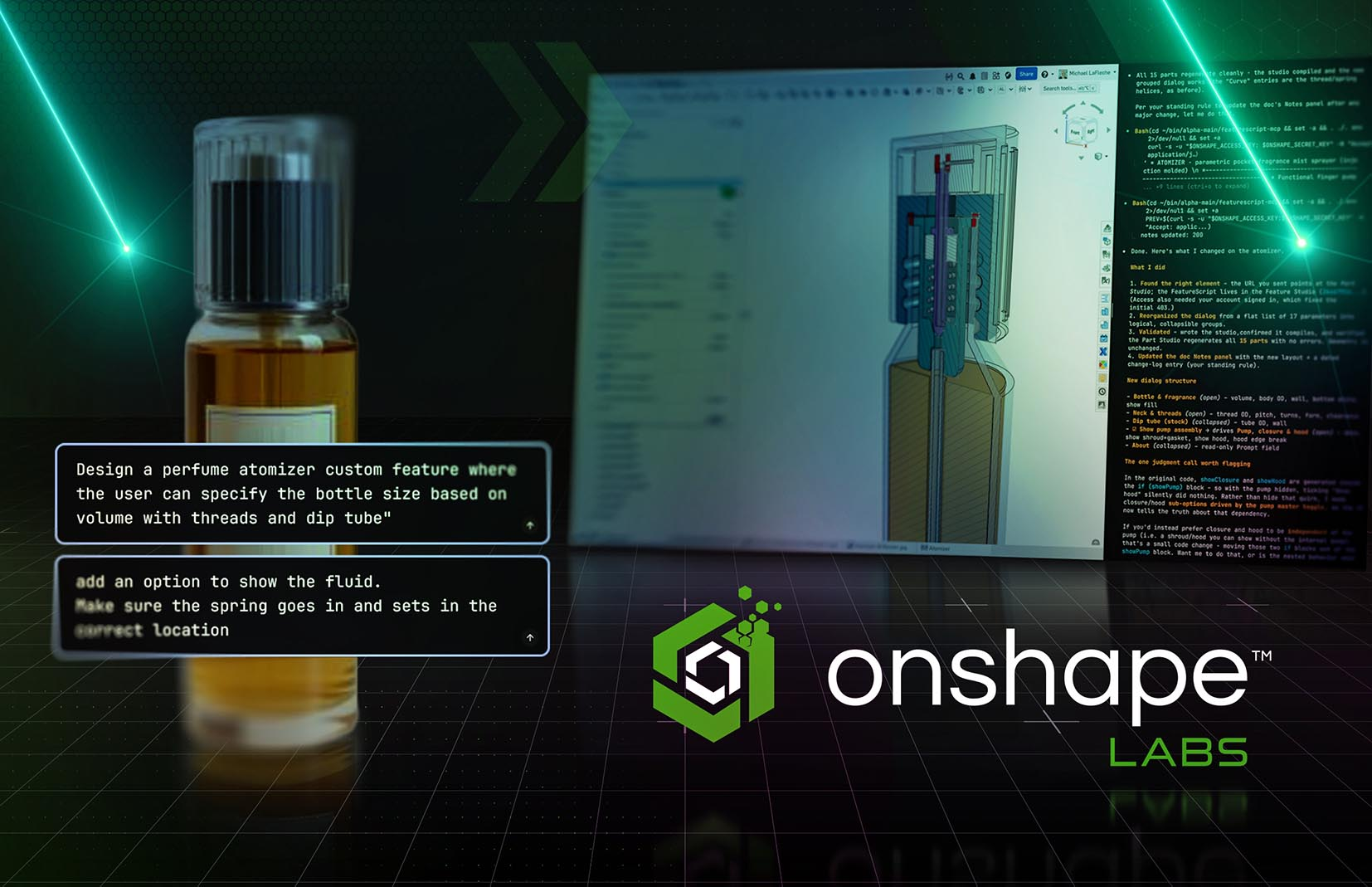
PTC is also developing AI agents capable of performing defined engineering tasks, a Drawing Checker for validating technical documentation, and a FeatureScript Model Context Protocol server supporting text-to-code-to-CAD workflows.
The FeatureScript function could convert natural-language instructions into editable geometry or custom engineering features rather than producing a static image. Any resulting model would remain part of the parametric design environment, where dimensions, references, and constraints can be inspected and changed.
David Katzman, executive vice president and general manager of Onshape and Arena at PTC, said: “Engineering teams don’t need more disconnected AI tools; they need AI that understands their products, their data, and how they actually work.”
Engineering software presents a more demanding AI environment than general text or image creation. Product decisions depend on dimensions, tolerances, material properties, standards, manufacturing limits, configuration, load cases, interfaces, revision status, and intended function.
A geometrically plausible result may still be impossible to machine, unsafe under load, incompatible with adjacent parts, or based on an obsolete configuration. AI functions consequently need access to structured product data rather than relying solely on a prompt and a generic model.
Onshape’s cloud architecture records design activity and maintains the product definition within a shared environment. PTC argues that this history provides the context needed for AI to interpret design intent, previous changes, and the relationships within an assembly.
Keeping automation inside CAD and product data management also improves traceability. Engineers can review what changed, identify the model version involved, reverse an action, and preserve a record for technical approval.
The Drawing Checker offers a comparatively bounded use case. Engineering drawings often contain missing dimensions, inconsistent notation, incorrect tolerances, outdated references, or departures from company standards that consume considerable review time.
Automated checking could identify those issues before formal release while leaving approval with a responsible engineer. The function will need to distinguish genuine errors from permitted exceptions, particularly where company practice differs from a general standard.
Prompt-based rendering addresses a different stage of development by producing visual material quickly for design review, sales, or customer communication. Fidelity remains essential, since an attractive image can mislead when it adds features, finishes, materials, or geometry not present in the underlying model.
The Isaac Sim connection links product design with virtual commissioning and physical AI. Manufacturers are already training and validating robotic systems in simulated production environments before transferring programmes to physical equipment.
A synchronised CAD connection reduces the repeated conversion and preparation that often separates mechanical design from simulation. Changes to link lengths, tooling, guards, mounting points, or payloads can be reflected before control engineers programme an obsolete assembly.
Simulation-ready models still require additional information beyond geometry. Mass, inertia, joints, contact behaviour, friction, sensors, actuator limits, and environmental conditions must be defined accurately if virtual results are to represent the eventual machine.
AI agents introduce the greatest governance challenge because they can act rather than merely recommend. A system that creates features, updates drawings, or enforces standards needs clearly defined permissions and an approval boundary around changes affecting released products.
Regulated and safety-critical sectors will require records showing which model and data were used, what instruction was supplied, which action followed, and who accepted the result. Liability cannot be transferred to a software agent simply because the operation was automated.
Early access allows PTC to observe how the tools behave within real engineering organisations before treating them as standard functions. Some capabilities may mature quickly, while others may require narrower scopes or stronger controls.
Productivity gains will be judged through reduced design time, fewer drawing errors, faster simulation preparation, and improved reuse of existing work. Generating more geometry has little value when review and correction consume the time saved.
Onshape Labs moves AI closer to the controlled product definition rather than leaving it in a separate assistant or isolated browser window. The approach can support useful automation, provided that engineering intent, configuration control, manufacturability, and human accountability remain visible throughout the process.