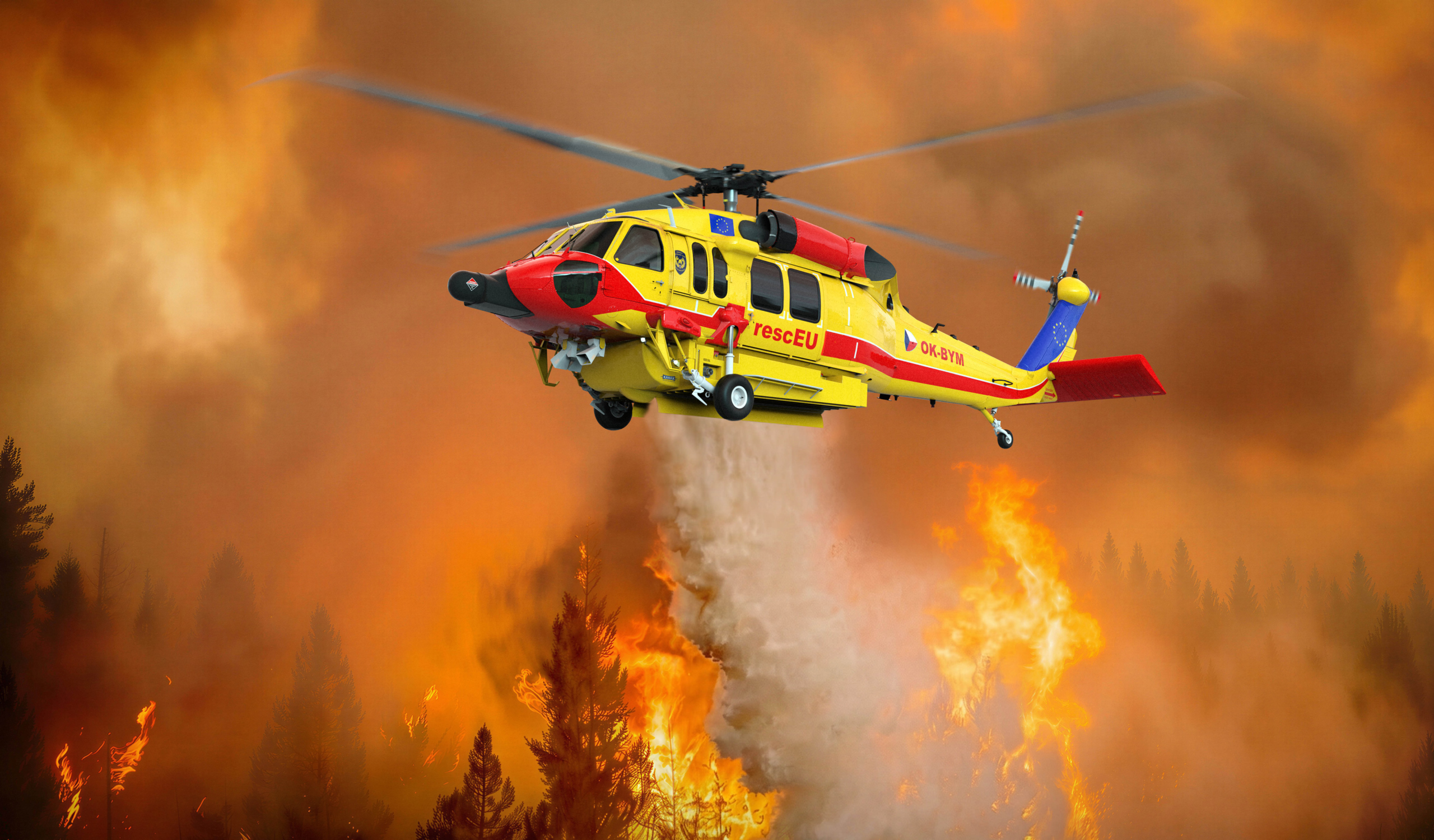
PZL Mielec has begun manufacturing two Sikorsky S-70 Firehawk helicopters for the Czech Republic, establishing the first European production programme for the specialist aerial firefighting aircraft.
Airframes are being assembled at the Lockheed Martin-owned plant in Poland before mission equipment is installed in the Czech Republic through a partnership involving Česká letecká servisní and United Rotorcraft. The completed aircraft will form the Czech Republic’s inaugural Firehawk fleet.
Both helicopters will become permanent assets within the European Union’s RescEU emergency response pool, allowing them to support cross-border operations during wildfires, floods, earthquakes, and other major incidents.
Derived from the S-70 Black Hawk, the Firehawk combines a utility helicopter platform with a 1,000-gallon, or 3,785-litre, water tank, retractable snorkel, twin engines, and equipment for night operations. The tank is integrated beneath the fuselage rather than suspended externally, preserving a comparatively clean aerodynamic and handling configuration.
Refilling from a suitable water source allows the aircraft to return repeatedly to the fire line without landing. Crews can also reconfigure the helicopter for search and rescue, personnel transport, evacuation, and civil protection work outside peak wildfire periods.
PZL Mielec manufactures the underlying Black Hawk airframes with support from more than 1,200 European suppliers. Lockheed Martin estimates that the wider activity sustains about 5,000 jobs across the EU, covering materials, machining, components, systems, assembly, engineering, and support.
Mission integration will add another layer of regional capability. United Rotorcraft plans to install the firefighting equipment and additional search-and-rescue systems in the Czech Republic, while also providing crew training and long-term sustainment.
Producing the airframe in Poland and completing the specialist conversion in the customer country distributes industrial knowledge more widely than importing a finished aircraft. Engineers and technicians gain direct experience of structural interfaces, electrical systems, mission equipment, maintenance procedures, and operational configuration.
That experience will become increasingly valuable if other European states adopt the platform. Wildfire seasons are placing greater pressure on national fleets, particularly when several countries face severe incidents simultaneously and short-term leased aircraft are already committed elsewhere.
Aerial firefighting places unusual loads on helicopters. Repeated low-level flight, heat, smoke, turbulence, restricted terrain, rapid manoeuvring, and frequent water pickup cycles affect engines, rotor systems, transmissions, structures, filters, sensors, and crews.
Availability therefore depends on maintenance capacity as much as fleet size. Spare parts, component overhaul, inspection, technical publications, training devices, software support, and rapid repair will determine how many aircraft can be dispatched during the most demanding periods.
The programme creates the basis for a European aftermarket alongside initial manufacturing. Black Hawk commonality provides an established platform and supply network, while the Firehawk conversion introduces specialist equipment requiring separate maintenance and operating knowledge.
European civil protection procurement is also becoming more coordinated. RescEU assets are owned or hosted by participating countries but can be deployed across borders, requiring interoperability with different command structures, communications systems, airspace authorities, logistics organisations, and emergency services.
Common assets can improve collective response, although national operating conditions still vary. Terrain, water availability, weather, airfield access, crew regulations, and certification arrangements influence how the same helicopter is deployed and supported.
Night capability could extend operating windows, provided that crews, authorities, and ground teams have the procedures and training required to manage the additional risk. Firefighting in reduced visibility demands accurate navigation, communication, obstacle awareness, and coordination around an already congested incident area.
European production also reduces dependence on a completely external modification and support chain. Local capability does not make every component sovereign, but it improves access to engineering knowledge, training, and maintenance during periods when emergency demand is high.
PZL Mielec has long combined military, security, and civil aircraft work, giving the factory experience of controlled aerospace manufacturing and international customer requirements. The Firehawk programme adds a civil protection application to that base without requiring development of a clean-sheet helicopter.
The first two aircraft will provide operational evidence under European conditions, including terrain, weather, water sources, and cross-border deployment. Their performance will influence later procurement decisions and determine whether other operators commit to the same platform.
Sufficient follow-on orders would support a stable regional ecosystem for conversion, training, spares, and heavy maintenance. A fleet limited to two aircraft would retain much of its dependence on distant support, whereas adoption across several countries could justify dedicated European capacity.
Production has now begun on the hardware around which that capability could develop. The next stages — mission integration, certification, training, delivery, and operational deployment — will determine whether Europe’s first Firehawk programme becomes the foundation of a broader fleet.