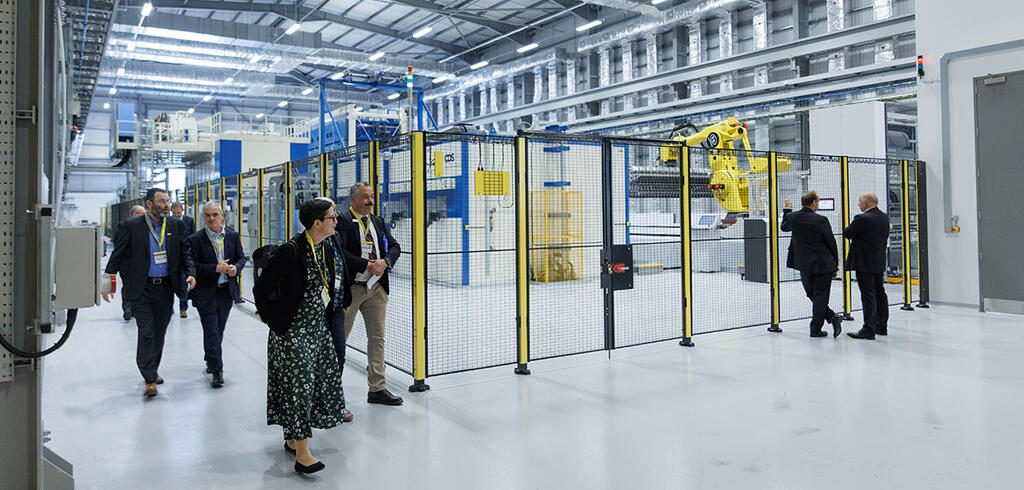
The University of Sheffield Advanced Manufacturing Research Centre has opened its £54 million COMPASS facility, creating an open-access centre for developing large composite structures at industrial production rates.
Located within the South Yorkshire Investment Zone, the Composites at Speed and Scale centre combines advanced materials, automated handling, robotic preforming, digital manufacturing, process control, and inspection equipment. Boeing will become its first major user through an aerospace research programme focused on high-rate aerostructure production.
The centre has been developed with support from the Aerospace Technology Institute Programme, Innovate UK, the Department for Business and Trade, the High Value Manufacturing Catapult, the South Yorkshire Mayoral Combined Authority, and the University of Sheffield.
Rather than operating as a closed corporate laboratory, COMPASS will provide companies of different sizes with access to equipment that would be difficult to purchase and maintain for an individual development project. Full-scale composite research requires large tooling, controlled material storage, automated deposition systems, metrology, curing equipment, machining, and non-destructive inspection.
Boeing’s initial Isothermic High-Rate Sustainable Structures programme will examine whether manufacturing times for large components can be reduced from about 40 hours to four. Loop Technology is supplying its FibreLINE robotic preforming system and acting as systems integrator for the sequenced production environment.
Reaching that target will require gains across the complete process rather than accelerating one machine. Material preparation, preforming, transfer, lay-up, consolidation, cure, dimensional verification, trimming, drilling, and inspection must operate at compatible rates, since a faster deposition process provides limited benefit when the component waits elsewhere in production.
Large composite structures magnify variation that remains manageable in laboratory coupons or small demonstrators. Temperature distribution, resin flow, fibre position, tooling expansion, vacuum integrity, handling loads, and component geometry can all affect final quality across several metres of material.
Scrap and rework become correspondingly expensive as components grow. A defect detected after cure may represent many hours of machine time and a large quantity of high-value material, while repair procedures can require additional engineering approval and inspection.
Digital traceability will consequently form a central part of the research. Aerospace manufacturers need records covering material batches, storage history, environmental conditions, machine settings, process temperatures, dimensional measurements, inspection results, and any approved deviation or repair.
Capturing that information automatically allows engineers to connect manufacturing conditions with finished-part performance, although useful analysis depends on consistent data structures and accurate time synchronisation across several pieces of equipment.
Automation will also change the skills required around composite production. Robotic systems reduce some repetitive manual operations but create demand for engineers who understand materials, controls, programming, fixtures, metrology, maintenance, and statistical process behaviour.
Open-access research helps suppliers build those capabilities without learning solely during a customer production programme, where a delayed industrialisation can affect aircraft delivery schedules and contractual performance. Smaller companies can test tooling, software, materials, and process changes against representative equipment before investing in their own production assets.
Aerospace demand gives the facility its initial scale. Commercial aircraft manufacturers continue to carry extensive order backlogs, while future platforms are expected to use lighter structures to reduce fuel consumption and accommodate new propulsion arrangements. Increased production rates cannot be achieved simply by duplicating processes designed for lower volumes.
Composite structures have also moved beyond conventional wings and fuselage sections. Engine components, nacelles, interiors, rotorcraft, defence platforms, space structures, and advanced air mobility vehicles create different combinations of volume, certification, temperature, impact resistance, and maintenance requirements.
The engineering work beginning under the Global Combat Air Programme will similarly require manufacturing routes capable of producing complex, lightweight structures while accommodating sensors, systems, and future upgrades. Although defence volumes are lower than commercial aerospace, programme life and performance requirements can justify substantial process development.
Beyond aviation, COMPASS can support wind energy, transport, and other industries requiring large composite components. Wind turbine blades, pressure vessels, marine structures, and high-performance vehicles face similar challenges around material use, dimensional control, inspection, repair, and end-of-life treatment.
The environmental performance of composites remains more complicated than their low weight suggests. Manufacturing can require energy-intensive processes and generate offcuts that are difficult to reuse, while thermoset structures present recycling challenges at the end of service.
Higher yield and more consistent production can reduce those losses. Research into thermoplastic composites, recyclable resin systems, automated material nesting, repair, and component reuse may also influence whether future lightweight structures deliver lower emissions across their complete life cycle.
COMPASS gives UK manufacturers the infrastructure to test these questions at a scale closer to production. Its success will be measured by qualified processes, secured manufacturing programmes, and technologies adopted inside factories rather than the number of laboratory demonstrations completed.
Future aircraft work is allocated during early industrialisation, when manufacturers decide which suppliers can meet cost, rate, quality, and certification requirements. By bringing industrial-scale composites research into South Yorkshire, the centre gives British engineering teams a stronger opportunity to shape those decisions before production systems are fixed elsewhere.