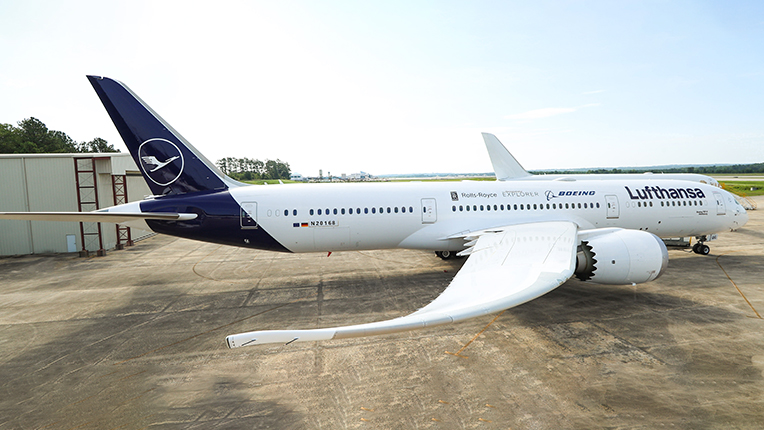
Rolls-Royce, Boeing, and Lufthansa will conduct flight tests of a shortened engine inlet and modified operating procedures intended to reduce fuel consumption and aircraft noise.
The programme will use a Boeing 787-9 scheduled for delivery to Lufthansa after completing its work as the 2026 ecoDemonstrator Explorer. The aircraft is powered by Rolls-Royce Trent 1000 engines.
Flights will take place during July and August from Boeing’s facility in Glasgow, Montana, where a ground-based microphone array will measure noise as the aircraft passes in several configurations and operating conditions.
The principal hardware development is a Next Generation Inlet with reduced length and an expanded acoustic liner. Shortening the inlet can lower nacelle weight and aerodynamic drag while helping manufacturers integrate larger and more efficient engine architectures with future aircraft.
A conventional inlet also contributes to noise attenuation, however, so removing length reduces the surface available for acoustic treatment. The demonstrator uses a liner covering a greater proportion of the remaining structure to recover that performance.
Engineers will fly the aircraft over the microphone array with different flap, landing gear, speed, and engine-power settings. Cabin microphones will record interior sound, allowing the external and passenger-environment effects of the modified inlet to be considered together.
The tests build on earlier work undertaken by Rolls-Royce at its ground facility in Stennis, Mississippi, and aboard the company’s Boeing 747 Flying Test Bed. Installing the technology on a representative 787 brings the assessment closer to the aircraft configuration in which the inlet would ultimately operate.
Alan Newby, director of research and technology at Rolls-Royce, said: “This programme is the culmination of a decade of collaboration with Boeing, built on a shared ambition to reduce noise, improve efficiency and unlock more sustainable flight.”
Aircraft-level testing is necessary because inlet length cannot be evaluated solely as an engine component. Its geometry affects airflow into the fan, nacelle drag, structural weight, pylon loads, wing interaction, acoustic behaviour, maintenance access, and resistance to foreign-object damage.
An improvement recorded on a ground rig may be reduced or reversed once installation effects are included. Flight data allows engineers to observe the complete system under atmospheric variation, manoeuvring, take-off, approach, and realistic airframe interference.
Modern turbofan development increasingly favours larger fan diameters and higher bypass ratios to improve propulsive efficiency. Larger fans can reduce fuel burn but create challenges around nacelle dimensions, weight, ground clearance, structural loads, and integration beneath the wing.
Reducing inlet length can offset part of that penalty, although the inlet must continue to provide stable flow across the engine operating envelope. Distortion or separation entering the fan can reduce efficiency, increase vibration, or narrow the margin before aerodynamic instability.
Acoustic treatments face equally demanding service conditions. Liners must retain performance through temperature change, moisture, contamination, vibration, impact, cleaning, and maintenance activity over a long operating life.
The programme will also test Intelligent Operations flight paths generated through algorithms using several operational data sources. Proposed procedures include higher altitude constraints and continuous descent arrivals intended to reduce fuel use and community noise without requiring new aircraft hardware.
Continuous descent can reduce periods of level flight and repeated thrust changes during approach, allowing an aircraft to follow a smoother energy path. Higher intermediate altitudes may also move some noise farther from communities, although local airspace, terrain, traffic, and runway configuration determine whether a procedure is practical.
Implementation would require agreement among airlines, airports, air navigation service providers, regulators, and air traffic control authorities. A route that benefits one aircraft must still operate safely within traffic flows containing different types, performance levels, and destinations.
Lane Ballard, chief technology officer at Boeing, said the inlet and Intelligent Operations procedures were among several concepts being assessed to improve aircraft value and operational performance.
The work forms part of Phase III of the US Federal Aviation Administration’s Continuous Lower Energy, Emissions and Noise programme, which shares development costs with aerospace manufacturers. Boeing will process the data with the FAA and Georgia Tech before publishing a final programme report.
Using a Lufthansa delivery aircraft avoids constructing a dedicated test platform, although all temporary equipment and modifications must be removed or incorporated into the approved configuration before handover. The arrangement also allows the customer to participate in technology evaluation before the aircraft enters service.
Neither the inlet nor the flight procedures are guaranteed to move directly into production. The tests will determine whether measured gains justify the certification, manufacturing, maintenance, operational, and integration work required for wider adoption.
Aerospace efficiency is now advancing through combinations of smaller improvements rather than a single isolated technology. Weight, drag, propulsion, flight planning, air traffic procedures, and maintenance all contribute, and the ecoDemonstrator programme provides a route for testing those interactions before they are committed to a commercial fleet.