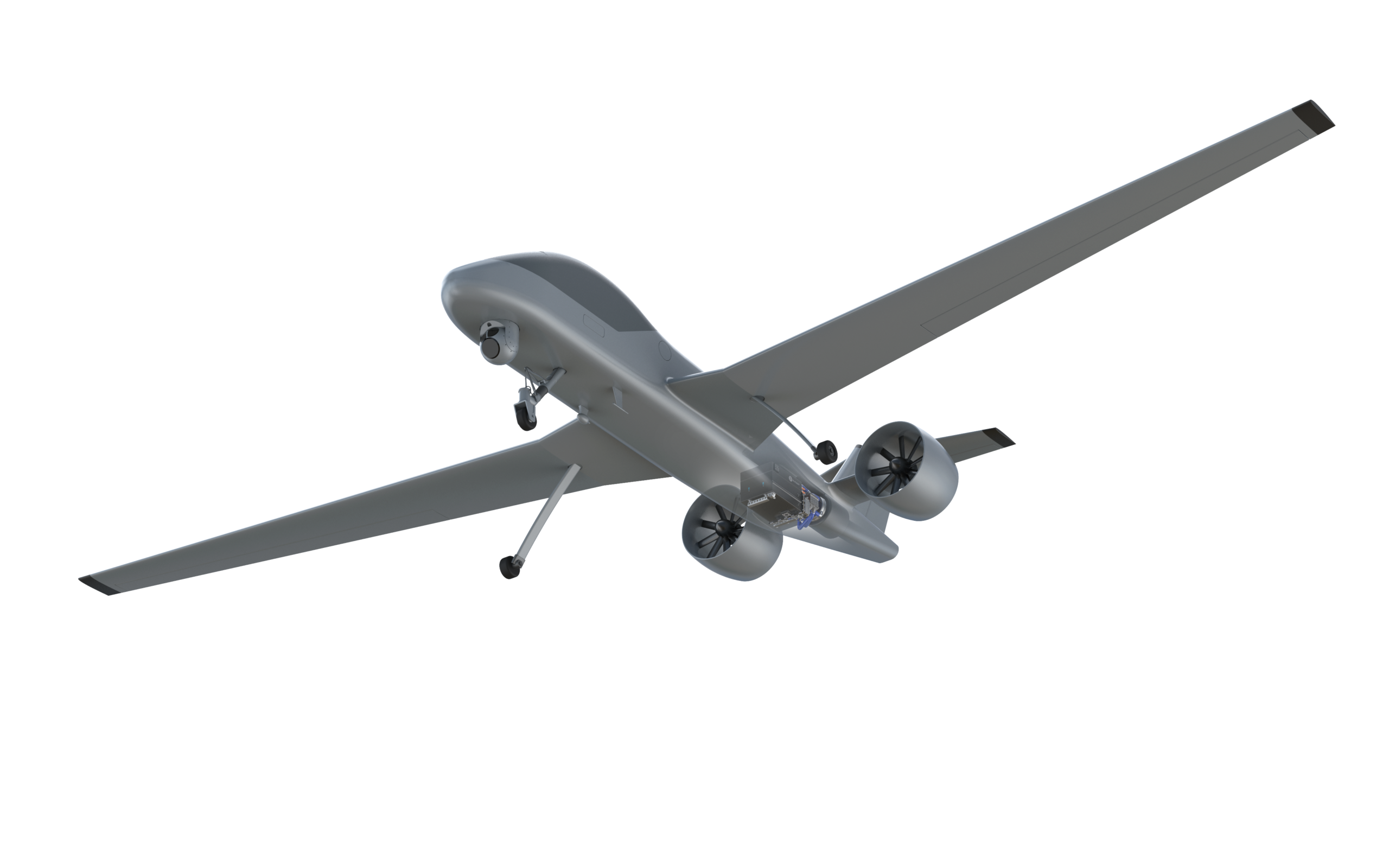
Intelligent Energy has unveiled a 120kW hydrogen fuel-cell power system for heavy lift fixed-wing uncrewed aircraft and secured its largest commercial UAV propulsion order to date.
The IE-FLIGHT 120 system is aimed at aircraft carrying payloads between 150kg and 750kg across surveillance, defence, security, and logistics operations. It sits between the company’s smaller IE-SOAR products and the higher-power technology being developed for electric vertical take-off and landing aircraft and regional aviation.
According to Intelligent Energy, its fuel cells can provide flight durations three to five times longer than battery systems in suitable applications. The electrochemical reaction generates electricity from hydrogen and releases water vapour at the point of use.
Lower noise, vibration, maintenance demand, and thermal signature are among the advantages identified over internal-combustion propulsion. Those characteristics can improve aircraft utility during surveillance and defence missions, where endurance and detectability influence how a platform can be deployed.
The launch has been accompanied by a record order for IE-SOAR systems, although the customer and contract value have not been disclosed. The order provides an indication that hydrogen propulsion is moving beyond individual demonstrations into repeat UAV procurement.
Scaling to 120kW requires more than enlarging a smaller drone unit. The complete powertrain must coordinate fuel-cell stacks, hydrogen storage, air supply, cooling, power electronics, electrical distribution, start-up, shutdown, redundancy, and rapidly changing demand.
Fuel cells perform efficiently under relatively steady operating conditions, while aircraft experience changing loads during take-off, climb, manoeuvre, and cruise. Batteries or other energy-storage systems can absorb peaks and provide emergency capability, although hybridisation adds mass, controls, thermal management, and additional failure modes.
Hydrogen storage remains one of the principal design constraints. Although the gas has high energy per unit mass, its low volumetric density requires compressed or alternative storage systems, which influence tank shape, airframe integration, structural protection, refuelling, and crashworthiness.
Fixed-wing aircraft offer more internal volume and aerodynamic efficiency than small multirotor drones, creating a stronger early application for higher-power hydrogen systems. Long-duration missions allow the endurance advantage to offset the mass and volume of tanks and balance-of-plant equipment.
IE-FLIGHT 120 also provides a development route towards larger aviation products. Components, controls, manufacturing processes, and test methods demonstrated on heavy UAVs can inform eVTOL and regional-aircraft programmes, although certification and redundancy become more demanding as aircraft size and operational risk increase.
Intelligent Energy secured £17m through the Aerospace Technology Institute-backed HEIGHTS programme earlier in 2026 to accelerate high-power aviation fuel-cell development. The company has also invested in a high-power test centre at Chelveston in Northamptonshire.
Such infrastructure allows propulsion systems to be examined under sustained load, transient demand, vibration, environmental exposure, fault states, and repeated operating cycles. Moving from a laboratory stack to an aircraft-ready system depends on evidence covering both normal performance and safe response to failure.
The product enters a UK market receiving substantial government investment in drones and autonomous systems. Examination of the manufacturing base required to support British drone programmes has highlighted the need for propulsion, sensors, electronics, secure communications, materials, software, test facilities, and repair capability to expand together.
Hydrogen UAVs also require a dependable ground infrastructure. Operators need fuel of the correct purity, transport, storage, handling procedures, refuelling equipment, training, and contingency arrangements, particularly where aircraft are expected to operate from remote or temporary locations.
Manufacturing scale presents a separate challenge. Fuel-cell stacks rely on controlled membrane-electrode assemblies, bipolar plates, seals, catalysts, compression, and inspection, with relatively small defects capable of affecting leakage, durability, efficiency, and output consistency.
Intelligent Energy has developed fuel-cell technology for more than 25 years and holds around 500 patents across products ranging from 1kW to 1MW. Heavy UAVs offer an application in which endurance and payload provide a clearer operational case than smaller aircraft already served effectively by batteries.
Broader adoption will depend on aircraft integration, hydrogen availability, certification, reliability, and lifecycle cost. The new 120kW system moves fuel-cell propulsion into a larger unmanned-aircraft class where those engineering and logistical requirements will be tested under more demanding conditions.