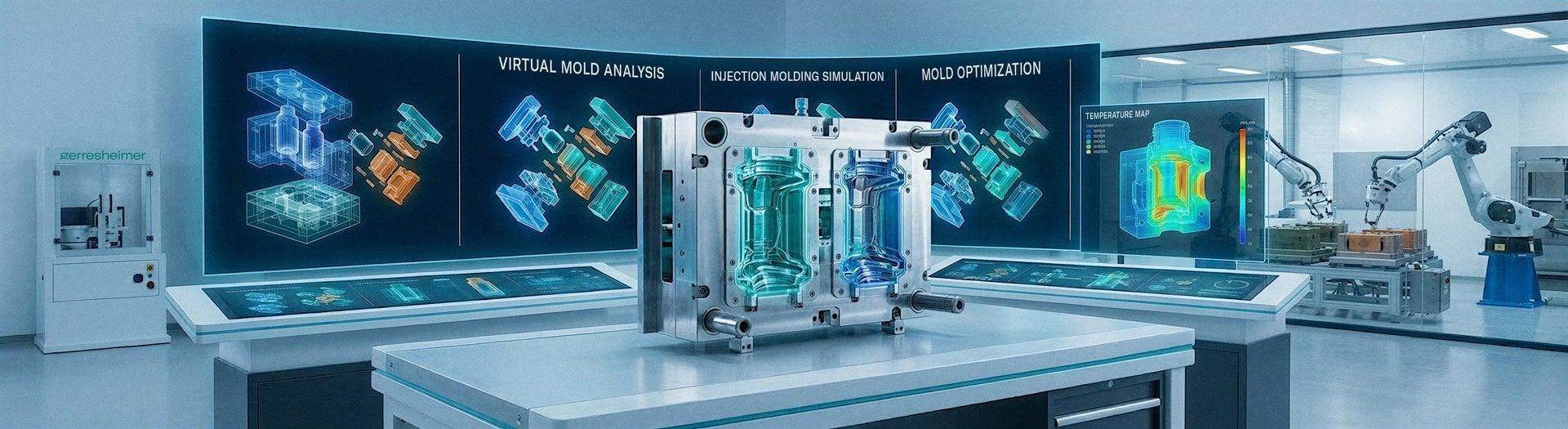
Gerresheimer has introduced a Digital Mold development system that combines virtual injection-mould analysis with production data to improve tooling for pharmaceutical and medical components.
The approach is designed to shorten development, reduce physical optimisation cycles, and establish more reproducible conditions for series manufacturing. A virtual representation of the mould and process is linked with a digital record generated as the physical tool enters production.
Gerresheimer describes those elements as a digital twin and a digital shadow. The twin models the mould, component, materials, thermal behaviour, and process assumptions, while the shadow captures information from the finished tool and its production environment.
Together, the datasets create a record spanning feasibility assessment, tool design, prototyping, qualification, series production, maintenance, and later process changes. Gerresheimer also intends to use the accumulated information for analytics and future artificial-intelligence applications.
The system incorporates the company’s Virtual Injection Mold and Process Development and Optimization methodology, allowing engineers to develop the tool and manufacturing process in parallel before physical construction is complete. Simulation can examine mould temperature, material flow, filling, cooling, construction choices, and interactions between process variables.
Virtual design-of-experiments work can then narrow the parameter combinations taken into physical trials. Rather than using the first moulding runs to explore a wide process space, engineers begin with a smaller and better-defined operating window.
That approach targets one of the most expensive phases in precision injection moulding. Initial trials can expose filling problems, dimensional variation, cooling imbalance, cosmetic defects, excessive cycle times, or unstable cavity performance, and each correction consumes engineering time, machine capacity, material, and customer approval time.
Physical trials remain essential, particularly for regulated products, but a stronger first design can reduce the number of modifications needed before qualification. The gains increase where tools use several cavities or produce components with tight tolerances, demanding polymers, thin walls, fine features, or complex downstream assembly requirements.
Medical and pharmaceutical components add regulatory control to the usual moulding challenge. Parts used in inhalers, injectors, diagnostic systems, syringes, and drug-delivery devices may rely on dimensional accuracy and surface condition for correct clinical function.
Manufacturers must show that critical parameters remain controlled and that design or process changes pass through documented assessment. A connected digital record can strengthen that evidence by preserving the relationship between design decisions, simulation results, physical trials, maintenance, and production performance.
Comparable methods are spreading through other medical manufacturing processes. An automated medical machining cell installed in Leeds combines five-axis equipment, robotic handling, and integrated storage to increase output while retaining the process stability needed for regulated components.
Injection moulding often operates at much higher volumes once a tool has been approved, which raises the financial value of early optimisation. A small reduction in cycle time, scrap, or cavity imbalance can accumulate across millions of parts, while an unstable process can generate large quantities of non-conforming product before the cause becomes clear.
The digital shadow should allow engineering teams to compare the validated process with actual production behaviour. Pressure, temperature, cycle time, machine settings, cavity data, maintenance history, and quality results can reveal drift or recurring faults before they lead to a wider loss of control.
Reliable analysis depends on the quality and structure of that data. Sensors require suitable accuracy and calibration, software platforms must handle information consistently, and records from different machines or sites need common definitions if they are to support meaningful comparisons.
Model governance presents a parallel challenge. When a mould is repaired or modified, the virtual representation must change with it; otherwise, the digital twin gradually becomes a historical model of equipment that no longer exists in the same form.
Artificial intelligence could eventually identify patterns, recommend settings, or predict maintenance requirements across the combined dataset. Within regulated production, those recommendations will still need validation, controlled implementation, and human oversight through established quality and risk-management systems.
Gerresheimer’s manufacturing footprint gives it scope to apply the method across several facilities and product families. Repeated use can build a knowledge base covering materials, component geometries, mould configurations, and recurring process behaviour, provided that sites use common data structures and lifecycle-management practices.
Pharmaceutical customers continue to press for shorter development programmes without accepting weaker validation or less predictable production. Digital Mold moves more engineering work into the virtual stage while preserving a documented route into physical qualification and series manufacture.
The commercial result will be visible in fewer tool corrections, shorter validation cycles, faster stable output, and lower variation over the life of each mould. Maintaining an accurate link between the digital model and years of physical production will determine whether the system becomes a durable manufacturing asset rather than another isolated engineering dataset.