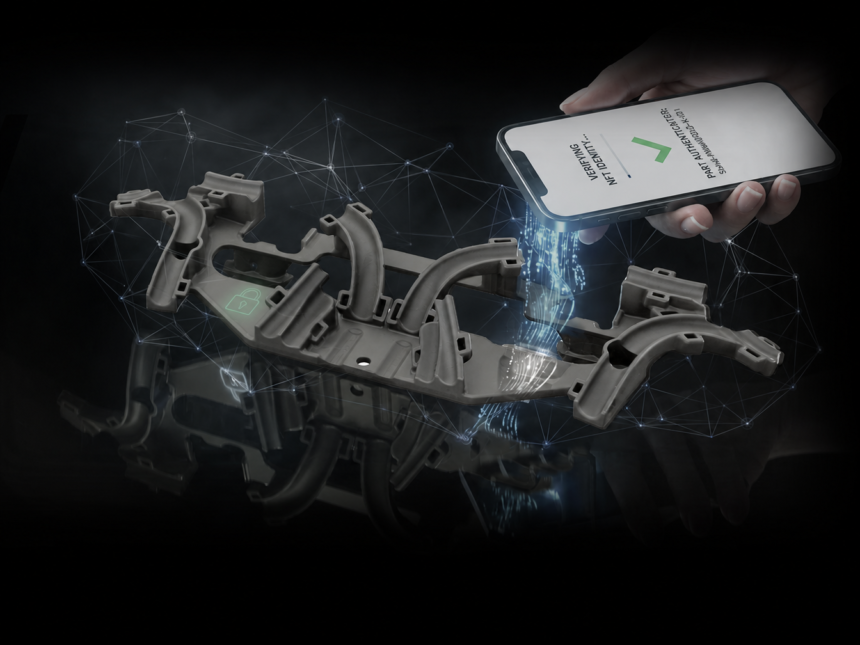
CRP Group has launched CRP UniqTrust, a digital traceability system that gives Windform additive manufacturing components a verifiable identity covering origin, conformity, and production history.
The system is designed for customer-specified components produced for demanding applications in aerospace, robotics, defence, and other high-performance sectors. CRP Group, which works across CNC machining, metal additive manufacturing, and Windform techno-polymer additive manufacturing, has added the system as an assurance layer for parts that need to remain identifiable throughout the supply chain.
CRP UniqTrust links the physical component to a digital identity using a non-clonable element placed in the packaging and associated with the part during manufacturing at CRP Technology, the group company that provides Windform selective laser sintering services. Authorised operators can verify the component by bringing an enabled device close to the packaging.
The digital identity can include a certificate of authenticity, order references, part code, material used, and production history. It can also be expanded with customised technical documentation. CRP Group says the system can reduce reliance on paper certificates and datasheets while keeping information retrievable across the component lifecycle.
Advanced manufacturing has made it easier to produce complex, lightweight, low-volume, and application-specific parts, but it has also increased the need for traceability. In additive manufacturing, a component is not defined only by its geometry. Material batch, machine parameters, build orientation, post-processing, inspection, and documentation all contribute to the final part record.
That record becomes especially important in aerospace and defence, where components may sit inside regulated systems, operate under high loads, or be maintained over long service lives. If a part is replaced, inspected, or moved between organisations, engineers need confidence that the component matches its documentation and that the documentation has not become detached from the physical item.
CRP’s system reflects a wider movement toward digital product assurance. Manufacturers are using digital identity, machine-readable documentation, and controlled access to production records to reduce manual error and improve supply chain transparency. Similar pressures are visible in measurement and inspection, where systems such as compact video measurement platforms are bringing quality control closer to production.
Additive manufacturing adoption depends heavily on repeatability. The technology is often associated with design freedom, but industrial customers still need evidence that subsequent parts can be produced under controlled conditions. A component that performs well once has limited value if the production record cannot be trusted across repeat orders.
The packaging-based element used in CRP UniqTrust connects verification with handling as well as manufacturing. Components may move through goods-in inspection, storage, assembly, customer approval, maintenance, and replacement cycles before final use. Keeping the digital record linked to the component during those movements reduces the risk of mismatches, lost certificates, or unauthorised substitutions.
Supply chain security is also becoming more prominent in high-value additive manufacturing. Sensitive components can move through several organisations, and customers need to know whether a part has been correctly supplied, stored, and accessed. CRP Group says the system can flag read requests that are inconsistent with the intended recipient company, adding an integrity check around information access.
The launch also reflects a change in the role of the component itself. In conventional manufacturing, a part was often treated as a physical object supported by external paperwork. In advanced manufacturing and regulated supply chains, the part and its data record are becoming inseparable. Production history, material data, and conformity evidence increasingly form part of the component’s value.
Digital traceability will not replace inspection, qualification, supplier audits, or process validation. It operates as part of a larger assurance architecture that includes material testing, dimensional measurement, certification, and customer approval. Its value lies in reducing friction and strengthening confidence across the information layer surrounding the physical part.
CRP UniqTrust arrives as additive manufacturing continues to move beyond demonstration parts and into applications where reliability, controlled production, and supply chain integrity determine adoption. For Windform components used in demanding systems, proving identity is becoming part of proving performance.