Aquaterra Energy and James Fisher have formed a strategic partnership to deliver integrated offshore decommissioning services, bringing front-end engineering, well access, subsea capability, and offshore execution into a combined delivery model.
The companies are seeking to reduce the interface risk that can slow well abandonment and offshore infrastructure removal. Aquaterra Energy brings engineering and well access expertise, while James Fisher contributes subsea execution, marine support, asset recovery, and offshore project delivery capability.
Although the partnership is being developed for global decommissioning markets, the North Sea is among the initial areas of focus. Mature basins are carrying a growing end-of-life workload as operators progress from late-life production into plugging and abandonment, conductor removal, subsea infrastructure recovery, recycling, and final field close-out.
Decommissioning has become a major engineering market in its own right. Work programmes can involve reservoir knowledge, well integrity assessment, structural analysis, subsea survey, lifting studies, cutting methods, marine logistics, waste handling, environmental control, and regulatory compliance. Any delay can add vessel days, prolong liability, and increase cost after the asset has stopped generating production revenue.
Aquaterra and James Fisher are addressing one of the persistent weaknesses in offshore decommissioning: the number of handovers between disciplines. Engineering studies, access system design, well abandonment, subsea intervention, lifting, transport, and onshore disposal are often split across several contractors and commercial packages. Each interface adds coordination work, technical assumptions, schedule exposure, and accountability gaps.
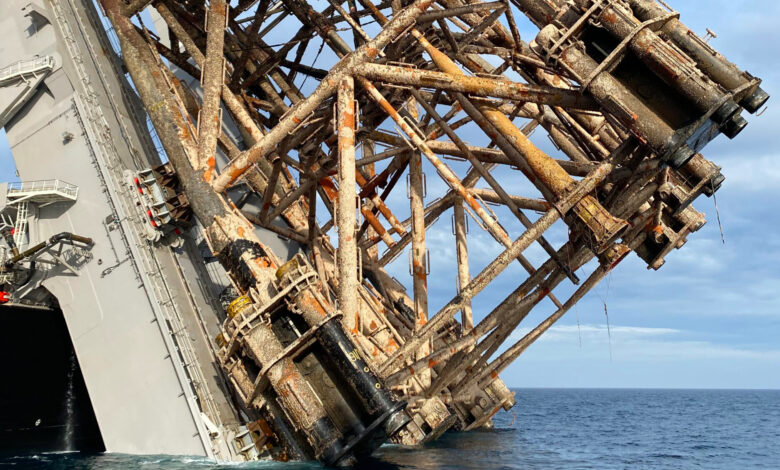
The North Sea has already moved into a phase where installation and removal activity run side by side. In a recent project, Ocean Installer secured subsea recovery work for TotalEnergies covering around 1,000 tonnes of infrastructure from North Sea fields, with engineering, dredging, recovery, transport to shore, and recycling or reuse included in the scope. The work illustrates how decommissioning has become a practical offshore execution discipline, not simply an administrative end point.
Well abandonment remains one of the most technically sensitive parts of the process. Engineers need to confirm barrier condition, reservoir isolation, casing integrity, cement quality, pressure behaviour, and the feasibility of removing or leaving selected equipment in place. Access systems must then be selected around platform condition, wellhead configuration, weather windows, available vessels, and the extent of required intervention.
Subsea recovery introduces a different set of uncertainties. Infrastructure can be buried, damaged, corroded, marine-grown, partially exposed, or constrained by adjacent assets. Recovery planning must account for actual lift weights, trapped sediment, structural degradation, residual fluids, dropped object risks, and the route to shore for reuse, recycling, or disposal.
Operators are also trying to make decommissioning more predictable. Regulators want approved programmes delivered safely, environmental expectations are increasing, and liabilities can remain on balance sheets for years before work is completed. Integrated contractor models can help where they reduce duplicated studies, align engineering with execution, and shorten decision loops.
The value of an integrated approach will depend on how well specialist capability is preserved inside a simplified delivery structure. Decommissioning still requires detailed technical judgement, site history, and regulatory understanding. Combining services only improves delivery if the engineering decisions remain disciplined and the offshore execution plan reflects actual asset conditions.
North Sea capacity will remain under pressure as decommissioning grows alongside production support, tie-back work, offshore wind, carbon storage, subsea power infrastructure, and marine construction. Those activities compete for vessels, engineers, yards, inspection teams, project managers, and specialist contractors. Decommissioning is no longer residual work that can be fitted around more attractive projects.
By combining engineering and offshore execution, Aquaterra Energy and James Fisher are trying to make late-life offshore work more repeatable. Cost certainty, safety performance, technical control, and the ability to manage asset uncertainty will determine whether the model can gain traction across mature basins.