Pixel-Flo has raised £5.25m in seed funding to scale a manufacturing technology designed to address one of the major production barriers limiting wider adoption of microLED displays.
The University of Sheffield spinout is developing Continuous-Flow Mass Transfer technology, which replaces conventional mechanical transfer routes with a fluidic self-assembly process intended to move microscopic LEDs into place at higher speed and lower cost. The round was led by Northern Gritstone, with participation from SCVC, the Parkwalk Northern Universities Venture Fund, and German investment firm HTGF.
MicroLED displays have long been viewed as a high-performance successor to established display technologies, offering high brightness, strong efficiency, and improved durability. The constraint has not been the promise of the device architecture, but the difficulty of transferring vast numbers of microscopic emitters accurately, repeatably, and economically.
Pixel-Flo’s process is intended to move that step away from mechanically constrained batch transfer and toward continuous production. The company says the approach can support high throughput while reducing processing and material costs, with the long-term objective of making microLED-enabled products viable beyond premium and specialist applications.
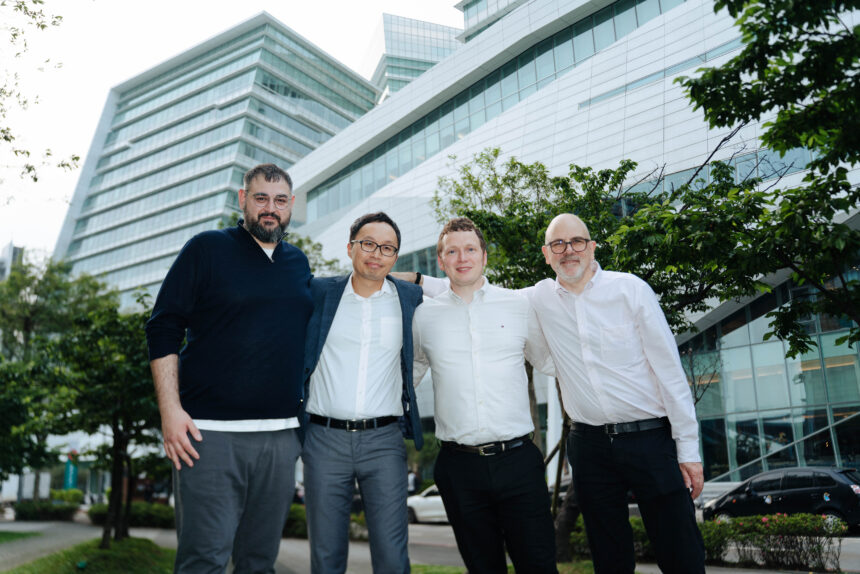
The company was founded by Dr Rick Smith, Dr Suneal Ghataora, and Simon Jones, drawing on semiconductor photonics research at the University of Sheffield and LED research from the university’s School of Electrical and Electronic Engineering. The funding will support a move from laboratory development toward industrial scale up, including team expansion and relocation into new laboratory and office space.
Pixel-Flo has also appointed Taiwan-based Sanger Hsu as vice president of business development, reflecting the importance of Asia’s display and semiconductor manufacturing base to any future commercialisation pathway. Taiwan remains central to global electronics manufacturing, and early engagement with that ecosystem will shape how quickly the company can move from technical validation into customer qualification.
Yield control sits at the centre of the microLED challenge. A display requires very large numbers of emitters to be placed and driven correctly, and even small defect rates can create substantial rework, binning, or scrap when scaled across a full panel. Transfer technology must therefore combine precision, speed, alignment, material efficiency, and defect reduction in a single production step.
That puts microLED in the same industrial territory as other advanced electronics processes where laboratory performance is no longer enough. Production systems must prove economics, repeatability, and integration with manufacturing equipment. A transfer method that works on a limited sample still has to prove that it can sustain quality across commercial volumes and survive the cost pressure of display manufacturing.
Electronics production is already moving toward tighter control of process data, inspection, and line-wide feedback. The same pressure is visible in connected SMT inspection, where manufacturers are linking inspection data more closely with production quality and traceability. MicroLED transfer adds another version of the same problem: complex devices can only scale when process variation is actively engineered out.
The display market also operates inside long qualification cycles and high capital intensity. New process technologies have to fit into manufacturing systems built around demanding equipment roadmaps, narrow margins, and customer validation. Pixel-Flo’s technical differentiation will therefore need to be matched by evidence that the process can be integrated, maintained, and controlled inside real production environments.
UK deep technology companies increasingly have to solve manufacturing bottlenecks rather than simply prove a device concept. Across electronics, the friction often sits in assembly, materials handling, inspection, component availability, and production data. Recent UK demand for board sourcing, including strong growth reported by PCB People, shows how quickly attention returns to the practical foundations of electronics supply when resilience or cost becomes exposed.
Pixel-Flo’s next stage will depend on translating the funding into equipment trials, customer evidence, and manufacturing partnerships. The company has a clearly defined bottleneck to attack, and the commercial opportunity is substantial if Continuous-Flow Mass Transfer can prove its claims under production conditions.