Altus Group has partnered with Optimum datamanagement solutions to introduce Smart Klaus digital worker assistance technology to electronics manufacturers in the UK and Ireland.
The system will make its UK debut at Altus Group’s Factory of the Future event in September 2026 before becoming available for demonstrations at the company’s Redditch headquarters. It is designed to support manual assembly, through-hole technology, final assembly, incoming goods, end-of-line testing, and order picking.
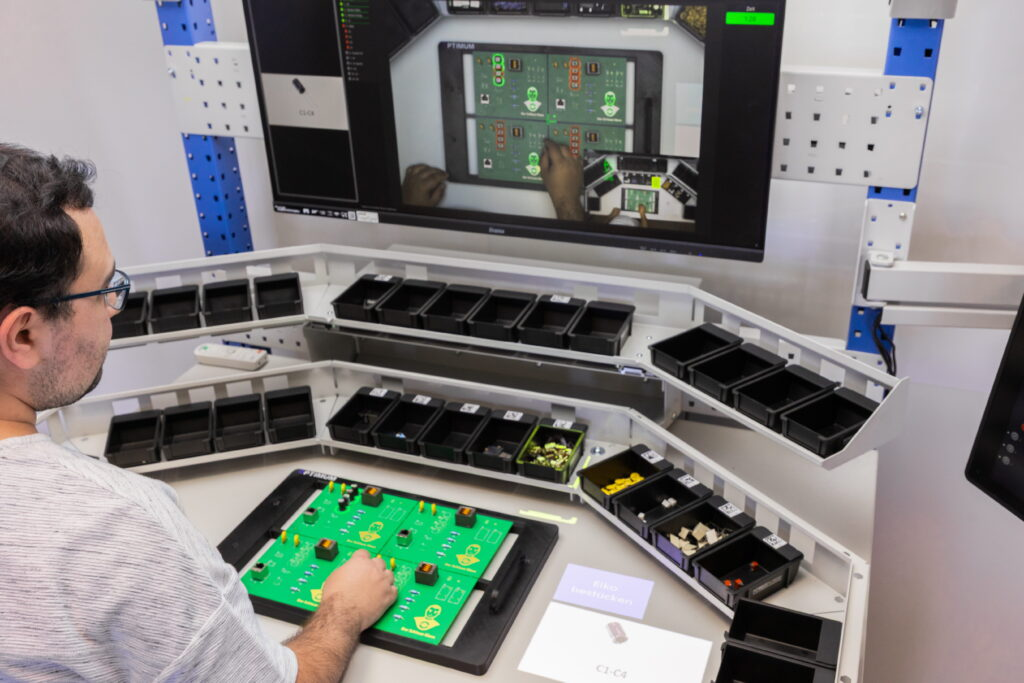
Smart Klaus uses image processing and artificial intelligence to guide operators through production tasks and verify steps in real time. Assembly instructions can be displayed at the workstation while camera-based checks confirm whether the correct action has been completed, helping reduce errors where manual work remains part of the production flow.
Manual and semi-automated assembly continue to play a large role in electronics manufacturing, particularly where product variation, production volume, frequent changeovers, or component complexity make full automation difficult to justify. Worker assistance systems occupy the ground between paper instructions and robotic automation, retaining operator flexibility while strengthening process control.
The UK and Irish electronics sectors are under pressure from labour availability, quality expectations, traceability requirements, and increasingly complex products. Denser assemblies, smaller components, mixed production runs, and greater customer demand for documentation all place more weight on the workstation. A missed assembly step can create rework, scrap, customer returns, or failure during downstream test.
Digital worker assistance adds another layer to the connected shopfloor. Inspection systems, component monitoring, automated optical inspection, X-ray inspection, and manufacturing execution tools are already pushing electronics production toward stronger data capture. That direction is evident in connected SMT inspection systems that link solder paste, optical, and X-ray inspection data, where quality control is increasingly based on process visibility rather than final inspection alone.
Many production issues still originate during handling, manual placement, wiring, assembly sequencing, and final configuration. A camera-based assistance system can check whether a part is present, whether an action has been performed, and whether the operator is following the approved sequence. It can also create a digital record that supports traceability when issues appear later in production or in the field.
That record is becoming more valuable as electronics manufacturers support medical, aerospace, defence, industrial automation, and transport customers. These sectors require evidence that production steps were completed correctly, not simply confirmation that a final test was passed. Preventing an assembly error at the workstation protects capacity, margin, and delivery schedules far better than detecting it after value has been added.
Workforce development also plays into the case for guided assembly. Experienced operators carry process knowledge that is often difficult to capture in static work instructions. As manufacturers bring in new staff, rotate teams, or introduce products with shorter lifecycles, digital guidance can help transfer knowledge more consistently across shifts and sites. The system does not reduce the importance of skilled operators; it gives them a more structured environment in which to work.
Implementation quality will determine the value of the technology. Worker assistance tools need to fit naturally into production flows, connect with the right data, and avoid slowing experienced staff. Poorly integrated guidance becomes another screen on the bench. A system aligned with product data, quality procedures, and real operator behaviour can turn process knowledge into a practical production asset.
Altus Group’s agreement with Optimum extends its role in electronics manufacturing equipment into shopfloor digitalisation. As electronic products become more varied and documentation requirements tighten, the line between manual skill and digital verification is narrowing. Smart Klaus gives UK and Irish manufacturers another route to improve consistency in the parts of production that remain people-led.