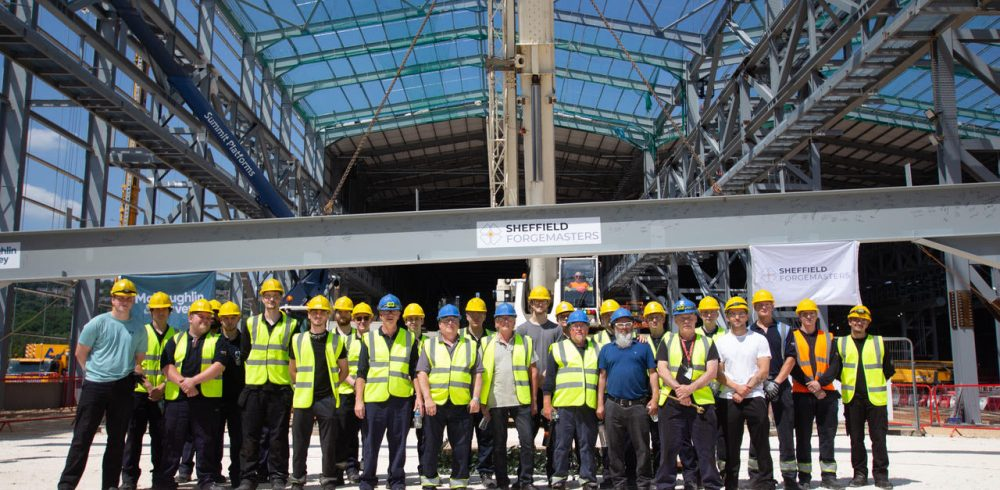
Sheffield Forgemasters has marked a major construction milestone on its new 30,000m² machine shop, with the final steel roof beam installed at the company’s Sheffield site.
The facility forms part of a £1.3bn recapitalisation programme being delivered under Ministry of Defence ownership. Once complete, the machine shop will add large-scale machining capacity for high-integrity components used across defence, nuclear, offshore energy, and heavy industrial applications.
Development contractors McLaughlin & Harvey joined Sheffield Forgemasters’ machine shop teams for the topping out ceremony, which took place as the steel frame nears completion. The new building is expected to become operational by the end of 2028, giving the company a defined route to expand capability across the second half of the decade.
Heavy forging and precision machining capacity cannot be recreated quickly once it has been allowed to run down. It depends on specialist equipment, experienced operators, metallurgical knowledge, inspection discipline, and qualification histories that take years to establish. Large, safety-critical components used in defence, nuclear, and energy systems are often produced in low volumes but to demanding specifications, where certainty of process is as important as production volume.
That makes the Sheffield programme more than a local construction project. The UK is attempting to rebuild capacity in sectors where domestic production has become a strategic concern, particularly as defence readiness, energy security, and supply chain resilience return to the centre of industrial policy. Foundational capability in metals, forgings, machining, and certified production is difficult to substitute with design expertise alone.
The investment is also progressing at a difficult point for UK manufacturers. Energy prices, capital costs, workforce constraints, and uncertainty over long-term policy continue to weigh on factory decisions. The pressure is already visible across the wider sector, where industrial energy costs remain a direct constraint on manufacturing competitiveness. A long-term capital programme at Sheffield Forgemasters therefore carries significance beyond one company’s order book.
The new machine shop will strengthen the link between forging, machining, and finished component delivery from a single site. Customers buying large, complex, safety-critical parts need more than a capable machine tool. They need control of material provenance, technical feedback between engineering and production teams, reliable inspection, and the ability to resolve issues without fragmenting accountability across multiple suppliers.
That integrated model is likely to become more valuable as demand rises for components used in nuclear propulsion, energy infrastructure, offshore systems, and high-duty industrial machinery. These markets operate on long programme cycles and strict acceptance criteria. A delay in qualified machining capacity can ripple through entire projects, particularly where component size, material grade, or certification limits the number of available suppliers.
The physical topping out marks a visible stage in the programme, but the more decisive work will come inside the building. Machine tools, digital production systems, lifting equipment, inspection capability, and skilled operators will determine how quickly the new space becomes usable industrial capacity. A building can be erected on a construction timeline; the production culture behind high-integrity engineering takes longer to develop and protect.
Sheffield Forgemasters’ investment reinforces the city’s continuing role in advanced manufacturing rather than treating heavy industry as a legacy asset. The programme gives the UK an opportunity to retain and modernise a capability that supports defence, energy, and national infrastructure programmes. Industrial resilience still depends on steel, machines, qualified processes, and people able to make difficult components at full scale.