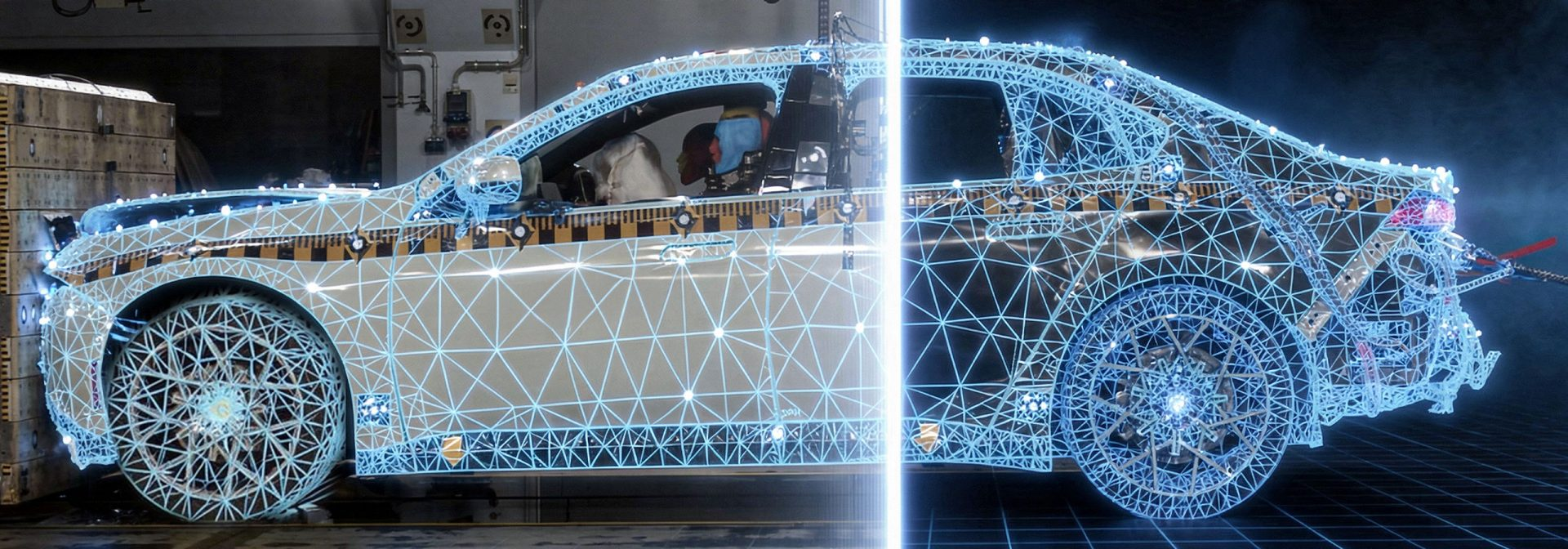
BMW Group and Mistral AI are working together on the use of artificial intelligence in vehicle crash simulation, targeting faster and more accurate engineering workflows for complex safety analysis.
The collaboration applies data-driven industrial AI to simulation tasks involving large volumes of engineering data, repeated analysis, and expert judgement. BMW is using crash simulation as an initial field for the work, with the aim of improving quality, accuracy, and speed in demanding engineering processes.
Crash simulation remains one of the most technically demanding areas of vehicle development. Engineers use numerical models to assess how structures, materials, joints, restraint systems, batteries, sensors, and interior components behave under severe impact conditions. The results influence body architecture, material selection, packaging, weight, occupant protection, battery safety, and regulatory compliance.
Artificial intelligence does not remove the need for physics-based simulation. Its potential sits in helping engineers manage the large datasets generated by simulation and testing. Crash analysis can involve many design variants, load cases, regulatory scenarios, and performance targets, with engineers continually assessing which changes improve one area without weakening another.
AI models trained and constrained around engineering data could help interpret outputs, detect anomalies, compare previous simulations, and narrow the next design iteration. Used carefully, that can reduce the time spent navigating datasets and increase the time available for technical judgement.
The engineering environment is unforgiving. A vehicle safety decision depends on traceable evidence, validated models, material behaviour, boundary conditions, and confidence in both simulation and physical test results. AI output used in this field has to operate inside a disciplined engineering process, where assumptions can be checked and results can be challenged.
Industrial AI differs sharply from general office automation in this respect. Engineering systems have to respect units, constraints, model assumptions, material properties, geometry changes, and uncertainty. A plausible answer that cannot be explained or verified has little value in a safety-critical workflow.
The collaboration sits within a broader change in product development. Automotive manufacturers are trying to shorten development cycles while managing electrification, software complexity, lightweighting, safety regulation, and platform variation. Simulation-led design is already central to that response, but simulation volumes keep rising as vehicle systems become more interconnected.
Electric platforms add further complexity to crash development. Battery packs, underbody protection, high-voltage isolation, thermal systems, and new structural layouts all influence crash behaviour. Weight reduction remains a target, but it cannot compromise occupant protection or battery safety. Small design changes can affect several performance areas at once.
BMW’s separate work on physical AI in production shows how artificial intelligence is moving across both development and manufacturing environments. AI in simulation can accelerate engineering decisions, while AI in production can support flexibility, automation, and process control. The strongest industrial value will come when those domains are connected through reliable data and disciplined validation.
Design teams already hold large volumes of simulation and test evidence, but that knowledge is often difficult to retrieve and reuse across programmes. AI tools that help engineers find relevant cases, compare historical decisions, and identify high-risk design changes could improve continuity between projects.
Crashworthiness remains a physical engineering discipline governed by materials, structures, energy absorption, joints, restraints, and manufacturing quality. AI can support the work, but it cannot bypass validated models, physical testing, or expert review. BMW and Mistral AI are working in a field where the benchmark is not novelty, but whether the technology improves engineering decisions that have to stand up under regulatory and safety scrutiny.