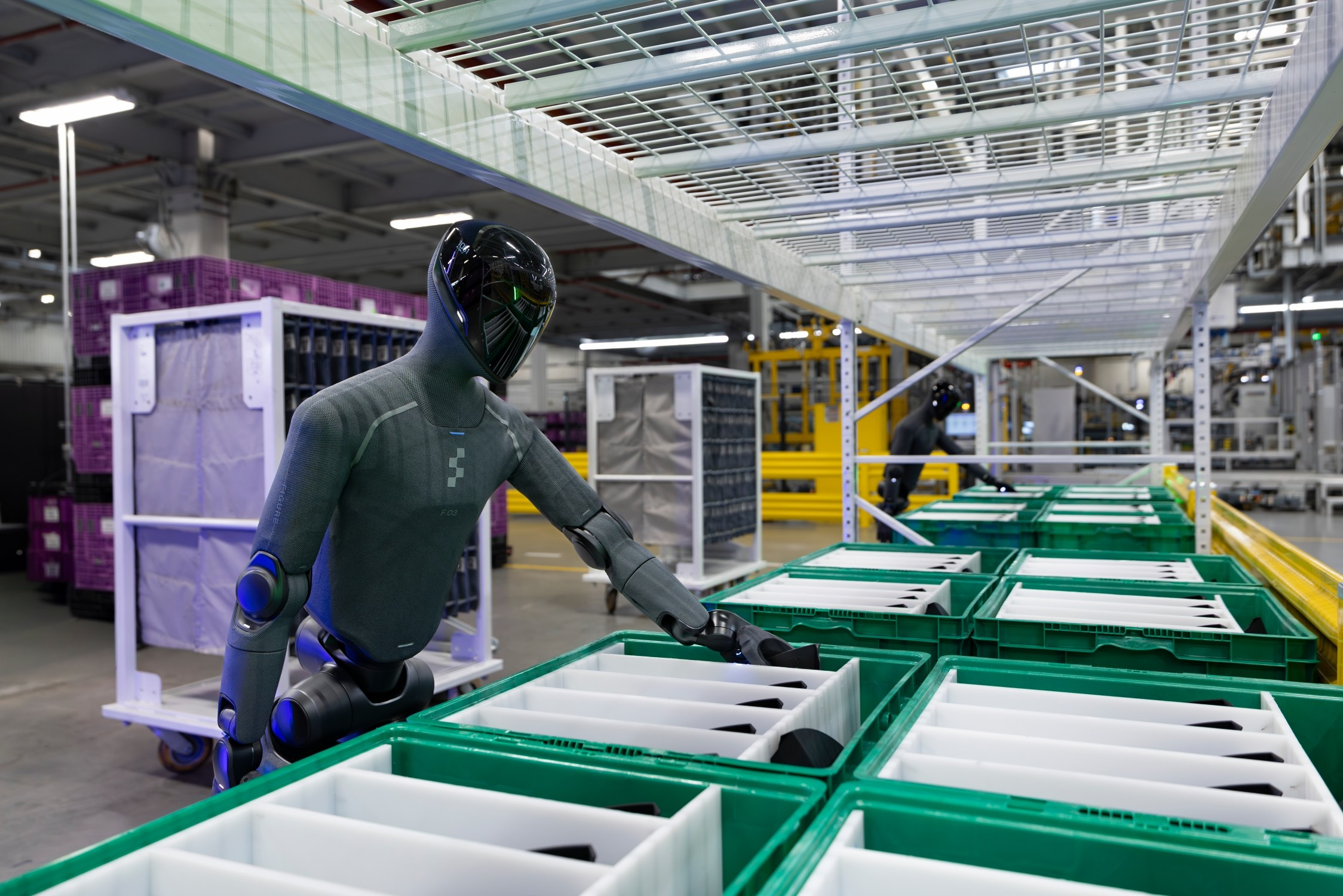
BMW Group is expanding the use of physical AI in production, linking artificial intelligence with machines, robots, logistics systems, and live factory processes.
The company is developing applications across humanoid robotics, component handling, production logistics, and wider digital manufacturing systems. Physical AI is intended to move artificial intelligence beyond analysis and planning into machinery that can perceive, move, and act inside industrial environments.
BMW has tested humanoid robots in production settings, including work at its Spartanburg plant in the United States and pilot activity at Leipzig in Germany. Those programmes sit within a wider production strategy in which AI, robotics, simulation, and digital plant systems are used to improve flexibility, ergonomics, and process control.
Automotive factories already contain some of the most mature automation systems in industry. Conventional robots are highly effective where work is structured, repeatable, and tightly controlled, including welding, painting, handling, and assembly. Physical AI is aimed at tasks where the environment is more variable and where fixed automation can be too costly or too inflexible.
Humanoid robots attract attention because they can theoretically operate in spaces designed for people rather than requiring every task to be rebuilt around a robot cell. Production reality is more demanding. Reliability, safety, payload, cycle time, battery life, programming effort, maintenance, and cost all determine whether a machine becomes a factory asset or remains a demonstration.
BMW’s work appears to be grounded in defined use cases rather than a broad attempt to replace existing automation. Logistics and material handling are natural early targets because they involve repetitive movement, ergonomic strain, and enough variation to challenge fixed systems. If physical AI systems can perform those jobs safely and consistently, they can support production teams while shifting labour toward higher-value work.
Automotive manufacturing is being reshaped by electric vehicles, software-defined functions, battery systems, and rising model variation. Electric drivetrain production, high-voltage components, advanced electronics, and more complex sequencing all increase pressure on plants to adapt quickly. Manufacturing systems have to support shorter product cycles and more data without compromising quality or uptime.
The industrialisation of axial flux motor production at Mercedes-Benz Berlin-Marienfelde shows how demanding that shift has become. New drivetrain architectures increasingly require advanced joining, automated process control, precision assembly, and AI-based inspection. BMW’s physical AI programme sits in the same transition, where competitive advantage depends on how effectively new technologies can be built, inspected, moved, and scaled.
The wider robotics market is also moving toward more adaptive systems. Vision, force sensing, simulation, AI planning, digital twins, and machine learning are being combined with mechanical platforms to handle variation that previously required manual intervention. The value sits not in the robot alone, but in the software, tooling, data, safety architecture, and integration work that allow it to operate repeatedly in a live plant.
Factories still run on cycle time and uptime. Any physical AI deployment has to prove that it can work safely near people, recover from exceptions, be maintained by site teams, and generate a return against alternative investments. Conventional automation, collaborative robots, automated guided vehicles, improved fixtures, and process redesign will remain strong competitors for many applications.
BMW is treating physical AI as a production discipline rather than a technology showcase. By testing use cases across plants, the company can learn where the systems add value and where the technology remains too immature. Labour availability, ergonomic requirements, and rising product complexity will keep pressure on manufacturers to explore more flexible automation, but the successful applications will be those that make production more dependable rather than more fragile.