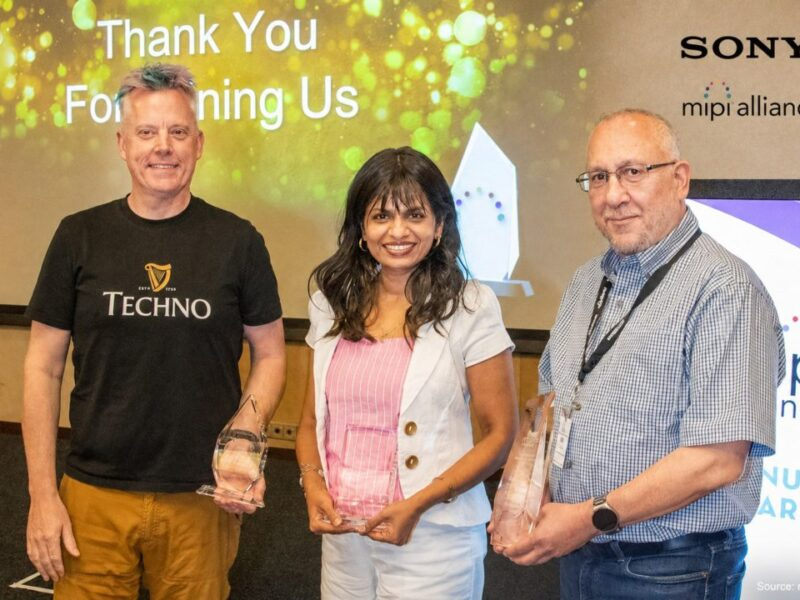
Sony Semiconductor Solutions has been approved as a Promoter member of the MIPI Alliance, giving the image sensor manufacturer a voting seat on the organisation’s board.
The appointment increases Sony’s influence in interface standards used across mobile, automotive, embedded, IoT, display, imaging, and physical AI applications. MIPI specifications are widely used to connect cameras, displays, sensors, and processors inside compact electronic systems, making them central to many modern design architectures.
Sony joins the board as sensing and imaging functions become more important across industrial and mobility platforms. Cameras are no longer confined to consumer devices. They now sit inside robots, vehicles, medical systems, security equipment, machine vision platforms, agricultural machines, logistics automation, drones, and edge AI devices.
That expansion places greater pressure on interface standards. Designers need high bandwidth, low power consumption, compact routing, electromagnetic compatibility, software support, and long-term interoperability. A sensor may be highly capable, but its value depends on whether it can be integrated cleanly into a wider system without creating excessive thermal, electrical, mechanical, or software complexity.
MIPI’s specifications influence how engineering teams connect image sensors, processors, displays, and control electronics across millions of products. Board participation gives Sony a stronger position in the development of specifications that could shape future embedded vision and sensor platforms.
Industrial applications are growing quickly. Robotics and automation systems increasingly rely on cameras for navigation, inspection, object detection, human awareness, and process verification. Vehicles use imaging and sensing for driver assistance, cabin monitoring, surround view, autonomy, and safety functions. Medical and laboratory systems depend on high-quality imaging for diagnostics, positioning, and procedural support.
As these applications scale, engineering teams face the same underlying problem: more sensor data must move through smaller, lower-power, more reliable systems. High-resolution cameras generate large data streams, multi-camera systems multiply that load, and edge AI applications require the data to reach processors quickly enough for real-time analysis.
Recent developments in edge AI hardware, robot safety sensors, and industrial vision systems show how rapidly the sensor-to-compute chain is changing. New robot safety sensing approaches, including certified 3D sensor technology for safer automation, point toward machines that depend on richer perception. Interface standards become more important as those systems move from development benches into production environments.
Product integration depends on more than pixel count. Camera modules bring questions around lane counts, connector selection, cable length, signal integrity, power management, processor compatibility, firmware, device drivers, synchronisation, shielding, test access, and manufacturing repeatability. Interface standards reduce some of that burden by giving suppliers and system designers a shared technical basis.
Sony’s presence on the board also reflects the growing role of sensor makers in system-level design. Image sensors increasingly include on-chip processing, advanced pixel architectures, event-based sensing, stacked designs, and features aimed at AI workloads. As intelligence moves closer to the sensor, the boundary between component and subsystem becomes less clear.
Automotive electronics will be a major pressure point. Vehicles are adding more cameras and sensors while manufacturers face demanding requirements for functional safety, electromagnetic compatibility, temperature performance, lifecycle support, and software maintenance. Standards that help manage bandwidth, reliability, and interoperability can reduce integration risk across vehicle platforms.
Industrial equipment has similar needs, though with different constraints. Factories and machines often require longer service lives than consumer electronics, along with ruggedisation, supplier continuity, and support for mixed hardware generations. A stable and widely adopted interface can help machine builders avoid proprietary dead ends while still adopting newer sensor technology.
Physical AI adds another layer. Systems that combine sensing, local compute, robotics, and real-time decision-making need robust data paths from the physical world into algorithms and control systems. Camera and sensor interfaces are becoming part of the intelligence stack, not just board-level plumbing.
Sony’s board role will not change product designs overnight. Standards development is usually incremental, negotiated, and shaped by many companies. Its importance lies in direction: a leading image sensor company now has a stronger voice in the interface specifications that will support the next generation of embedded vision systems.